

Payer-Specific Denial Patterns: Build a Review Routine
A practical monthly routine for independent practices to segment denials by payer, verify findings against official payer guidance, and route fixes back to the front end.
Most independent practices track denials as a single number: total denials, total dollars, a percentage that goes up or down each month. That number tells you something is wrong, but it rarely tells you where. A growing multi-provider practice usually has several payers, several providers, and several front-end workflows feeding the same claim stream, and a blended denial rate hides which of those combinations is producing the problem. Segmenting denials by payer — and reviewing each segment on a fixed cadence — turns a frustrating aggregate into a short list of fixable causes. This approach to payer-specific denial patterns helps practices focus on the most actionable issues.
Why Denials Should Be Reviewed by Payer, Not Just by Volume
Payers differ in how they want claims submitted, what they consider complete, and how they communicate a problem. Those differences show up as patterns: one payer's denials cluster around a particular documentation element, another's cluster around eligibility timing, another's around authorization references. When you review by volume alone, those clusters average out and the practice responds with generic fixes that don't land.
Payer segmentation is a process decision, not a claim about any specific payer's rules. You are not asserting that Payer A always denies X. You are asking a narrower, answerable question: within our own claim data, for this payer, what do the denial reasons have in common? That framing keeps the review grounded in your remittance data rather than in assumptions about how a payer operates.
Two practical cautions. First, small denominators mislead. A payer that sends twenty claims a month will produce noisy percentages; review those by count and reason code rather than rate. Second, keep the segmentation stable month to month. If the definition of a "payer group" shifts every cycle, you can't compare one month to the next.
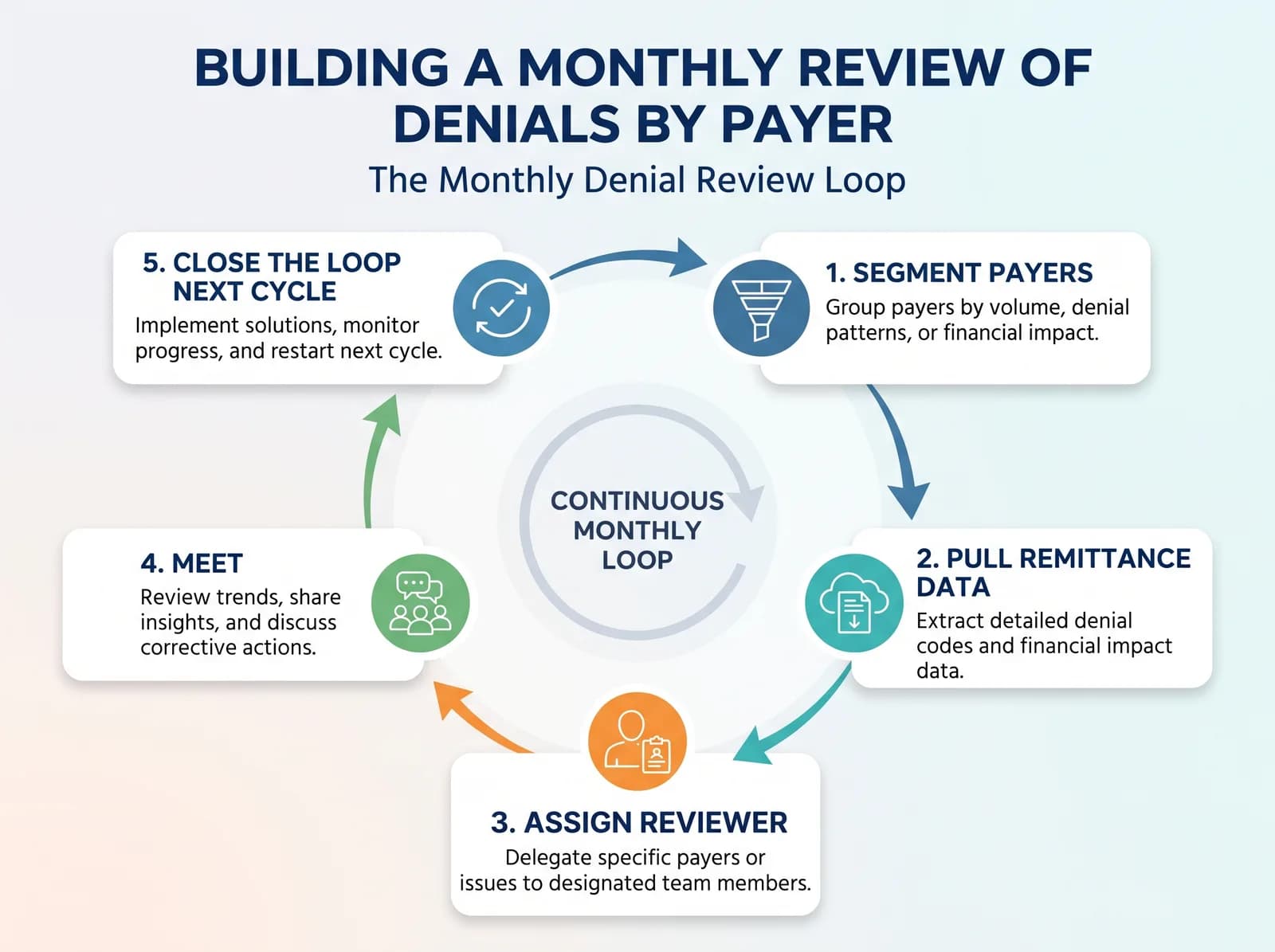
Building a Monthly Review of Denials by Payer
A monthly cadence often balances enough volume to see a pattern with enough time to act before the next cycle. Weekly reviews can be too thin per payer, while quarterly reviews can let a fixable issue run for three months. Pick one cadence, name the owners, and hold it.
Step 1: Define the segments
Group payers in a way that matches how your staff actually works them — often by payer family or by the clearinghouse/payer combination your team recognizes. Document the grouping so a new billing lead inherits the same definitions. If eligibility and benefits verification is part of the front-end workflow you are reviewing, keep that stage in view when defining segments, since coverage timing can shape which denials land in which group.
Step 2: Pull the denial data
Work from remittance and denial records, not from memory. For each segment, capture denial counts, denial reasons as reported, dollars, and the age of unresolved denials. If your practice management system can't produce this view, that gap is itself a finding worth escalating.
Step 3: Assign a reviewer per segment
One person owns each payer segment for the cycle. That person reads a sample of denials — not every one — and writes two or three sentences on what the reasons have in common. The goal is a hypothesis, not a verdict.
Step 4: Meet for thirty minutes
Bring the segment summaries together. The practice manager or billing lead chairs, confirms which findings are real, and assigns each a front-end owner and a due date. Keep minutes short and specific: what changed, who owns it, when it will be checked.
Step 5: Close the loop next cycle
Open each meeting by reviewing last month's assigned fixes. Did the denial reason decline, hold steady, or get worse? A fix that didn't move the number is information, not failure — it usually means the cause was misidentified.
If your team is already stretched, this is the kind of routine that can be run inside your existing systems with defined ownership. Knight Medical Billing's denial management services and revenue performance reporting are built around that model.
What to Verify With Official Payer Guidance
The review tells you what your data shows. It does not tell you what a payer's policy requires. Those are separate questions, and conflating them is how practices end up appealing a denial on the wrong grounds or resubmitting a claim that will deny again.
For any finding that appears to involve a payer rule — timely filing, authorization requirements, documentation standards, modifier use, appeal windows — go to the payer's current provider manual, fee schedule, and published policy bulletins. Verify against the version in effect for the date of service, not the version you remember. A useful first question for each finding is whether the denial reason maps to a filing or edit category or to a documentation category, since that determines who should review it. Where a finding touches coding or clinical documentation, route it to a certified coder or clinician rather than resolving it in the billing meeting. This article does not state payer rules, and nothing here should be read as coding, legal, or clinical advice.
Record what you verified and when. A short verification log — payer, question, source document, date checked, answer — prevents the same question from being re-litigated every quarter and gives new staff a starting point.
Turning Denial Patterns Into Front-End Fixes
A denial review that ends with a report has done half its job. The value comes from pushing each confirmed pattern back to the point where the claim was created.
Most payer-specific patterns trace to one of a few front-end stages: eligibility and benefits verification, authorization capture, charge capture and coding, or claim scrubbing before submission. Map each finding to its stage and change the check at that stage. If a payer segment shows denials tied to coverage status at the time of service, the fix belongs in eligibility and benefits verification, not in the appeal queue. If denials cluster around missing authorization references, the fix belongs in prior and retro authorization tracking.
Then tighten the clean-claim checks that catch these issues before submission. A clean claim is one that passes the payer's edits on first pass; the practical work is building your own pre-submission checklist from what your denial data has taught you. Update that checklist when a review confirms a new pattern, and retire checks that no longer catch anything.
Finally, decide what the practice will do with denials that are genuinely the payer's error. Appeals and reconsiderations need their own tracking, separate from the pattern review, so that a slow appeal doesn't distort the front-end signal. If your practice is weighing how much of this work to keep in-house, our guide to in-house versus outsourced medical billing lays out the tradeoffs.
What to Do Next
You don't need a new system to start. Pick your two highest-volume payer segments, pull last month's denials for each, and have one person write three sentences on what the reasons have in common. That single exercise usually shows whether a monthly payer-specific denial review is worth formalizing — and where your front-end checks are thinnest.
If it would help to talk through how a payer-segmented review would run inside your current workflow, contact our team or schedule a conversation. The first step is usually a look at the denial data you already have.
Sources and Verification
This article is a process guide and does not cite payer policies, denial statistics, or coding rules. No external sources were used; all process recommendations are based on general billing operations knowledge. Where a finding depends on a payer requirement, verify it against that payer's current provider manual and published policy documents for the applicable date of service, and consult a certified coder or compliance resource for coding and documentation questions.
Where this work connects
Related articles.
 Revenue Cycle Management
Urgent Care Front-End Checks: Eligibility and Charge Capture Before Volume Compounds
A practical guide for urgent care operations leads to standardize eligibility verification, registration data, and charge capture at the point of visit, with process metrics to confirm improvement.
Read article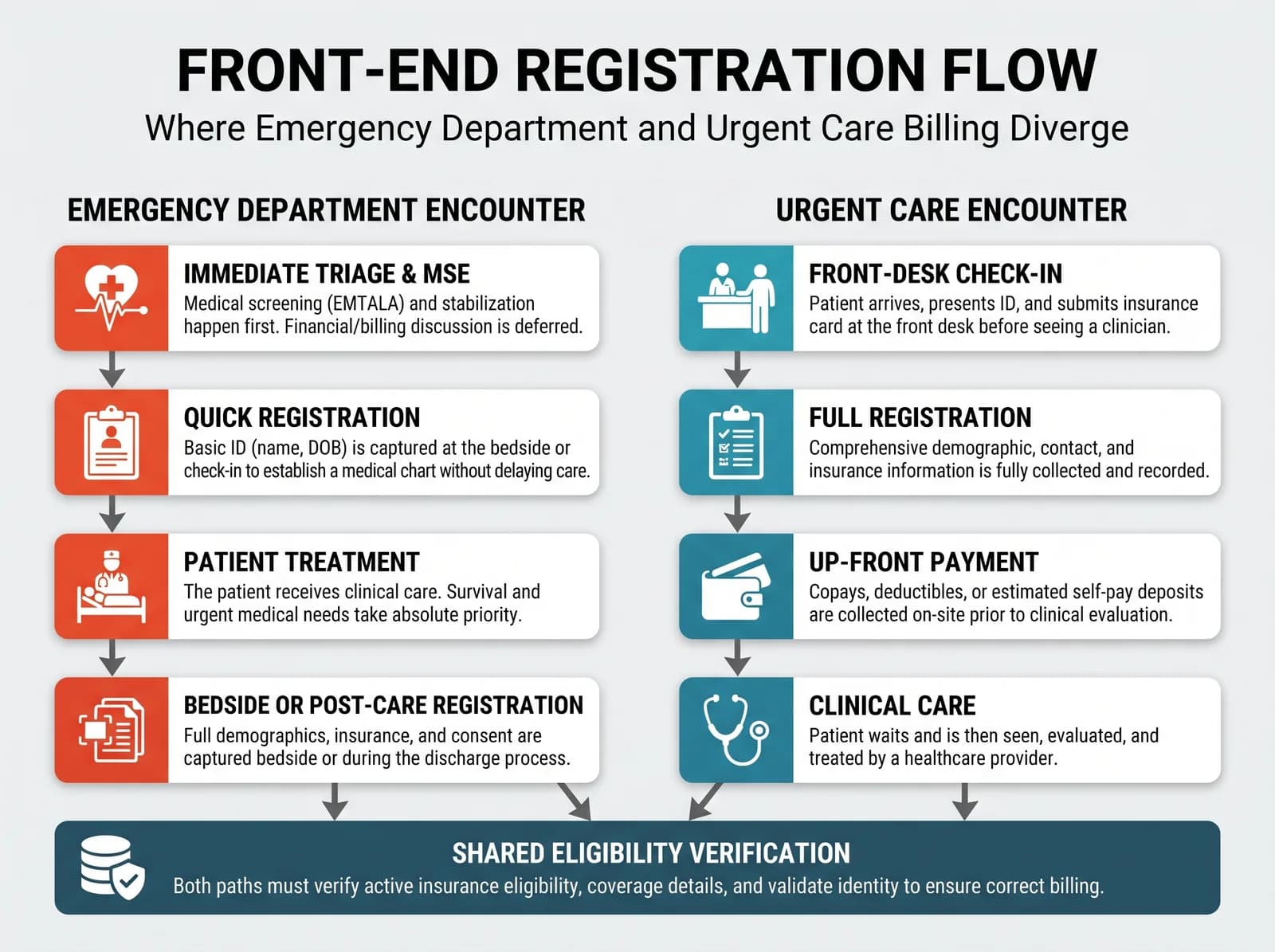 Revenue Cycle Management
Emergency Department and Urgent Care Billing: What Differs When One Organization Runs Both
A practical guide for revenue cycle leads running an emergency department and urgent care sites together: where the workflows diverge, what risks they share, and the questions to answer before consolidating billing.
Read article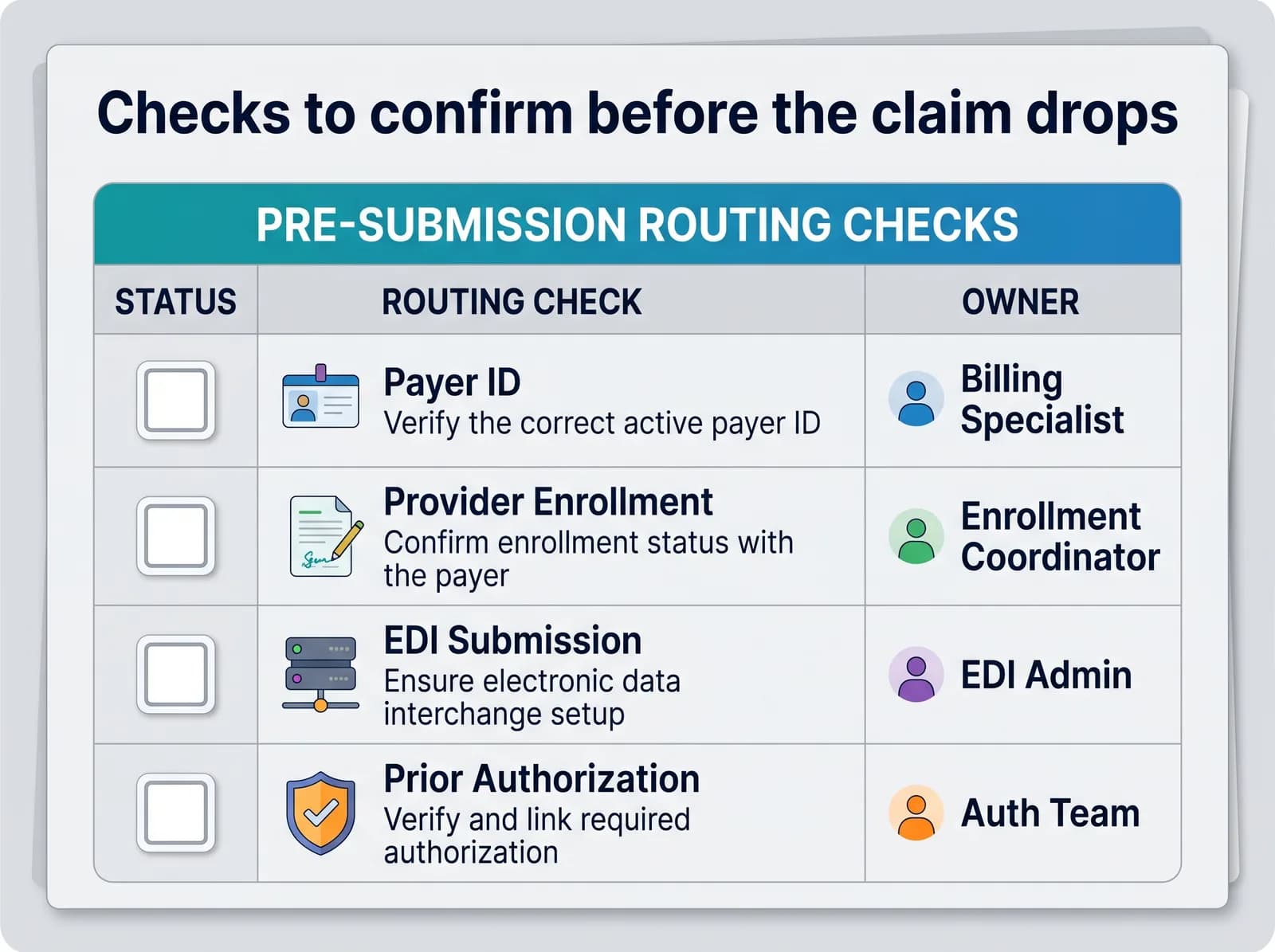 Revenue Cycle Management
Payer-Specific Claim Routing: What Independent Practices Should Verify
A practical pre-submission routine for independent practices: verify payer IDs, enrollment, EDI setup and payer-specific claim requirements before a claim leaves your system.
Read article