

Emergency Department and Urgent Care Billing: What Differs When One Organization Runs Both
A practical guide for revenue cycle leads running an emergency department and urgent care sites together: where the workflows diverge, what risks they share, and the questions to answer before consolidating billing.
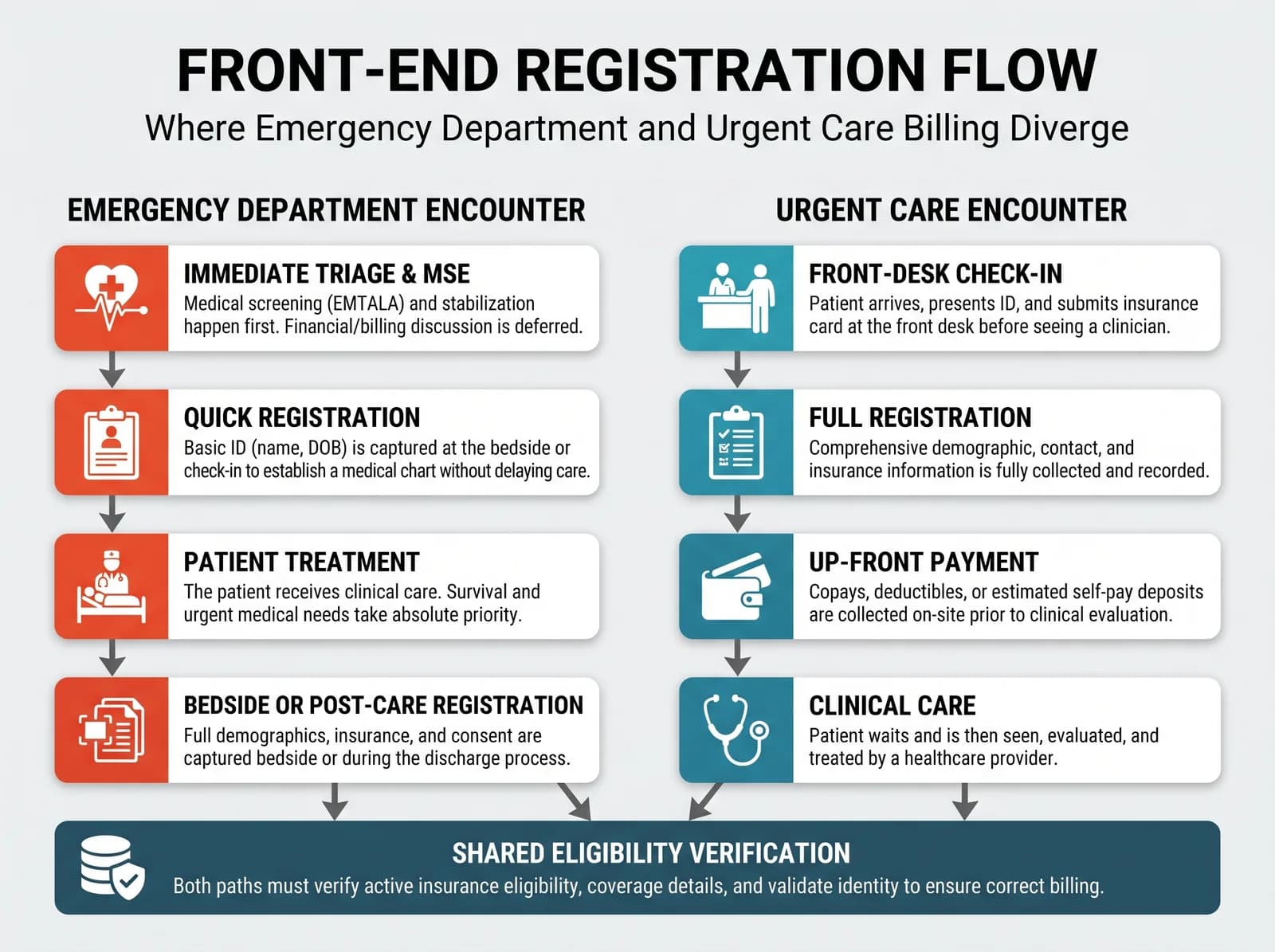
Running an emergency department and one or more urgent care sites under the same organization creates an emergency department and urgent care billing problem that is easy to underestimate: the two settings look similar on the surface and behave very differently underneath. Both see walk-in patients. Both generate facility and professional charges. Both depend on the same registration staff, the same payer contracts and often the same billing team. But the encounter type, the documentation that supports it, the payer rules that apply and the denial patterns that follow are not interchangeable. Organizations that treat them as one workflow tend to discover the gap in their denial reports months later.
This guide is written for the operations or revenue cycle lead responsible for both settings. It focuses on where the workflows diverge, what risks they share, and the questions to answer before deciding whether to consolidate billing processes or keep them separate.
Where emergency department and urgent care billing diverge
Encounter type and the front-end record
An emergency department encounter is, by definition, unscheduled and often arrives with incomplete information. Registration may happen at the bedside, eligibility may be unknown at the point of service, and the patient's condition can change the course of the visit after arrival. Urgent care encounters are also walk-in, but they tend to be shorter, more episodic and generally more likely to be resolved in a single visit with a defined disposition.
That difference shapes what the front-end record needs to capture. For the ED, the registration and eligibility workflow has to tolerate missing data and reconcile it later. For urgent care, the workflow can be tighter and more standardized across sites, which is an advantage when you operate several locations. The mistake is applying the urgent care template to the ED, or letting ED exceptions become the norm everywhere.
Documentation review and charge capture
The documentation that supports an ED encounter is reviewed differently from an urgent care visit. ED records generally involve a broader workup, multiple providers and a facility component that urgent care visits may not carry in the same way; these are general observations, not verified rules, and should be confirmed with coding leadership. Urgent care documentation is generally more contained, which can make charge capture more predictable but also more sensitive to missed items when volume is high; this is a general observation and should be verified against your own workflows.
This is a process distinction, not a coding instruction. The practical point for an operator is that the review step — who checks the record before the claim goes out, and against what standard — should be defined separately for each setting. Coding and leveling decisions must follow current official guidance and payer policy, and should be verified with your coding leadership rather than assumed from a template. If your team reviews both settings with one checklist, that checklist is probably too generic for at least one of them.
Payer mix and contract terms
ED and urgent care services may be reimbursed under different contract terms, even with the same payer; this is a general observation and should be verified against your specific contracts. Facility versus professional components, site-of-service considerations and network status can all differ. Before you assume a single contract rule applies across both settings, verify it against the current payer contract and published policy. Contract language changes, and a rule that was accurate at signing may not reflect today's fee schedule.
Shared risks across both settings
Despite the differences, the two settings fail in some of the same places. These are the areas where a shared process genuinely helps.
Eligibility and benefits verification
Both settings see patients whose coverage is unconfirmed at the point of service. A shared eligibility and benefits verification process — with clear rules for what happens when verification fails or is delayed — reduces rework on both sides. The ED will always have more exceptions; urgent care will always have more volume. The process should account for both.
Denial follow-up and root-cause tracking
Denials in the two settings often arrive for different reasons, but the follow-up discipline is the same. A single denial management workflow with setting-specific reason codes and root-cause categories gives you comparable data. Without that separation in reporting, ED denials and urgent care denials blur together and you lose the ability to fix either one.
Payment posting and A/R visibility
Cash posting errors and aging A/R can affect both settings. A consistent payment posting process and a shared view of receivables keep the picture honest. The risk is that high-volume urgent care payments crowd out slower, higher-value ED claims in the follow-up queue. Reporting should let you see each setting's A/R separately even when the work is done by one team.
Questions before consolidating billing workflows
Consolidation is not automatically right or wrong. It depends on your volume, your systems and how much the two settings actually share. Work through these questions before you decide.
- Do the two settings share payer contracts, or only payers? Shared payers do not mean shared terms. Confirm contract and fee schedule differences before merging any rule set.
- Can your system separate the settings in reporting? If you cannot report ED and urgent care performance independently, consolidation will hide problems rather than solve them.
- Who owns documentation review in each setting? If the answer is "the same person with the same checklist," define what each setting actually requires.
- Where do denials originate? Pull a sample from each setting and compare root causes before assuming one fix applies to both.
- What does the front-end need to tolerate? ED registration needs flexibility; urgent care needs consistency across sites. Decide which process absorbs which.
- Have you verified the rules? Any payer, coding or regulatory rule referenced in your workflow should be checked against current official guidance and the payer's published policy.
A useful middle path is common for organizations in this position: unify the back-end disciplines — eligibility, posting, denial follow-up and reporting — while keeping setting-specific standards for documentation review and charge capture. That gives you one accountable team without flattening the differences that drive reimbursement.
If you want a structured way to see where the two settings are leaking revenue, our revenue leak calculator is a starting point for identifying where revenue may be leaking, and our complete RCM services page describes how a single team can run both workflows with separate reporting.
A practical first step is to pull denial and A/R reports for each setting separately and compare them side by side. If the patterns look different, that is the signal to define setting-specific standards before consolidating further. If it would help to talk through your current setup, you can schedule a conversation about your ED and urgent care billing setup or contact our team with your questions. We will ask about your volume, systems and payer mix, and tell you plainly where a shared process makes sense and where it does not.
Sources and verification
No external sources or statistics were supplied for this article, and none have been cited. The observations here are drawn from general revenue cycle practice and the operational differences between emergency department and urgent care settings. Payer policies, contract terms, coding rules and regulatory requirements vary and change; verify any specific rule against current official guidance and the payer's published policy before applying it to your workflow.
Where this work connects
Related articles.
 Revenue Cycle Management
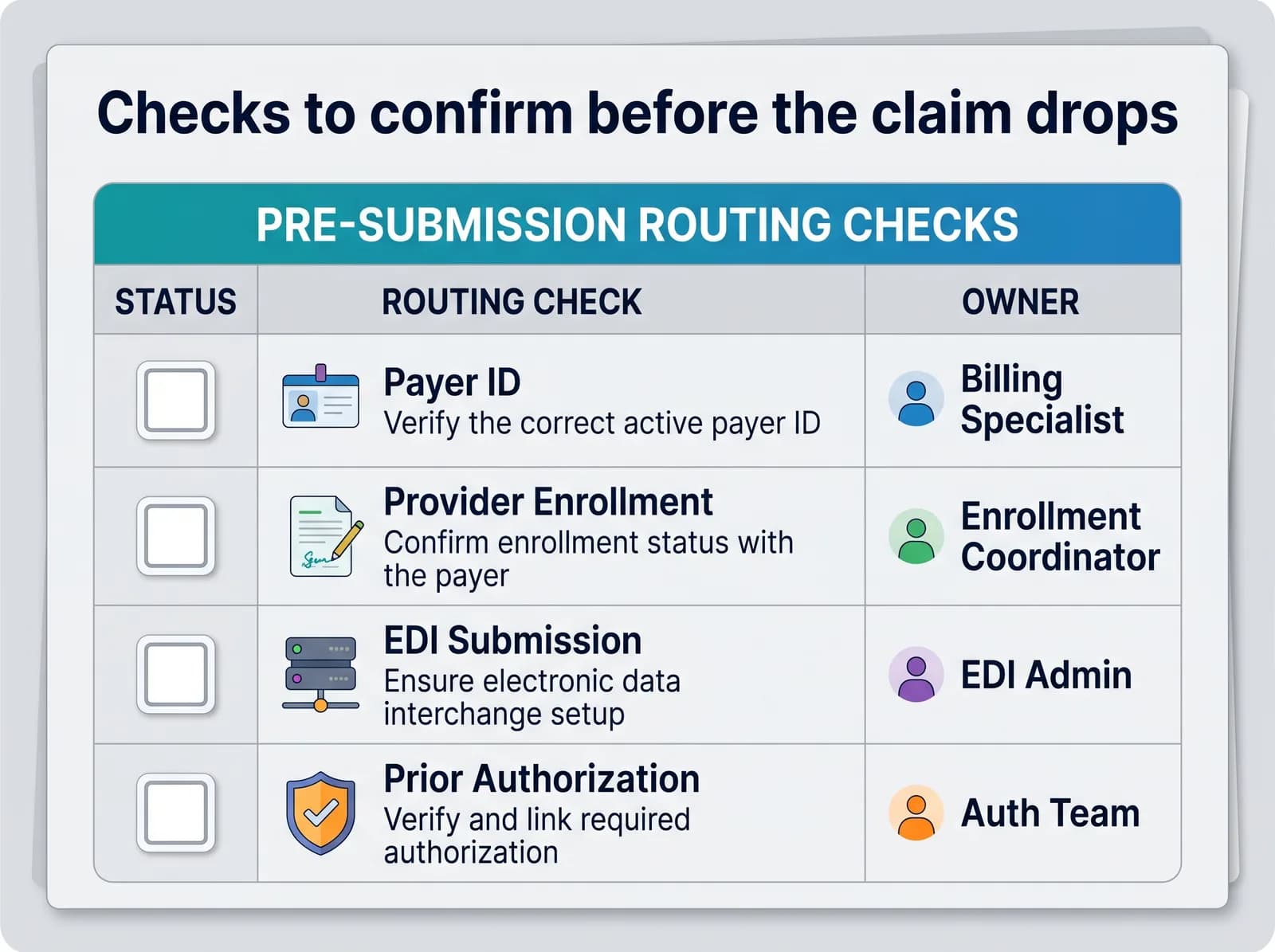
Payer-Specific Claim Routing: What Independent Practices Should Verify
A practical pre-submission routine for independent practices: verify payer IDs, enrollment, EDI setup and payer-specific claim requirements before a claim leaves your system.
Read article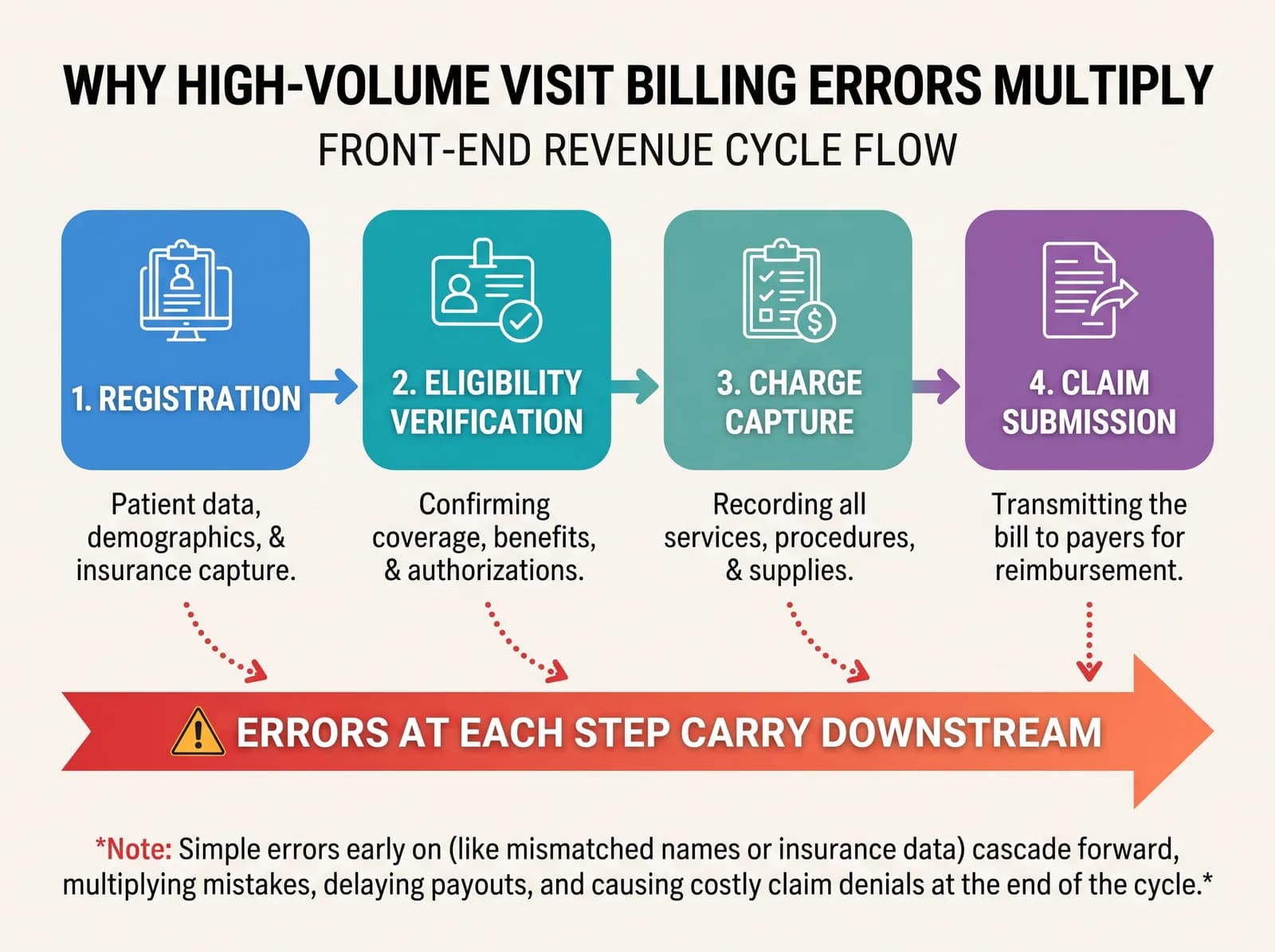 Revenue Cycle Management
High-Volume Visit Billing Errors: Where Small Front-End Mistakes Multiply
In busy urgent care and clinic settings, small front-end mistakes compound quickly. Learn where high-volume visit billing errors multiply and how to run a simple review routine.
Read article Revenue Cycle Management
What Changes in Billing When an Independent Practice Adds a Second Location
A second location changes provider enrollment, charge capture, coding consistency and reporting. Here is what to put in place before the new site opens.
Read article