

Payer-Specific Claim Routing: What Independent Practices Should Verify
A practical pre-submission routine for independent practices: verify payer IDs, enrollment, EDI setup and payer-specific claim requirements before a claim leaves your system.
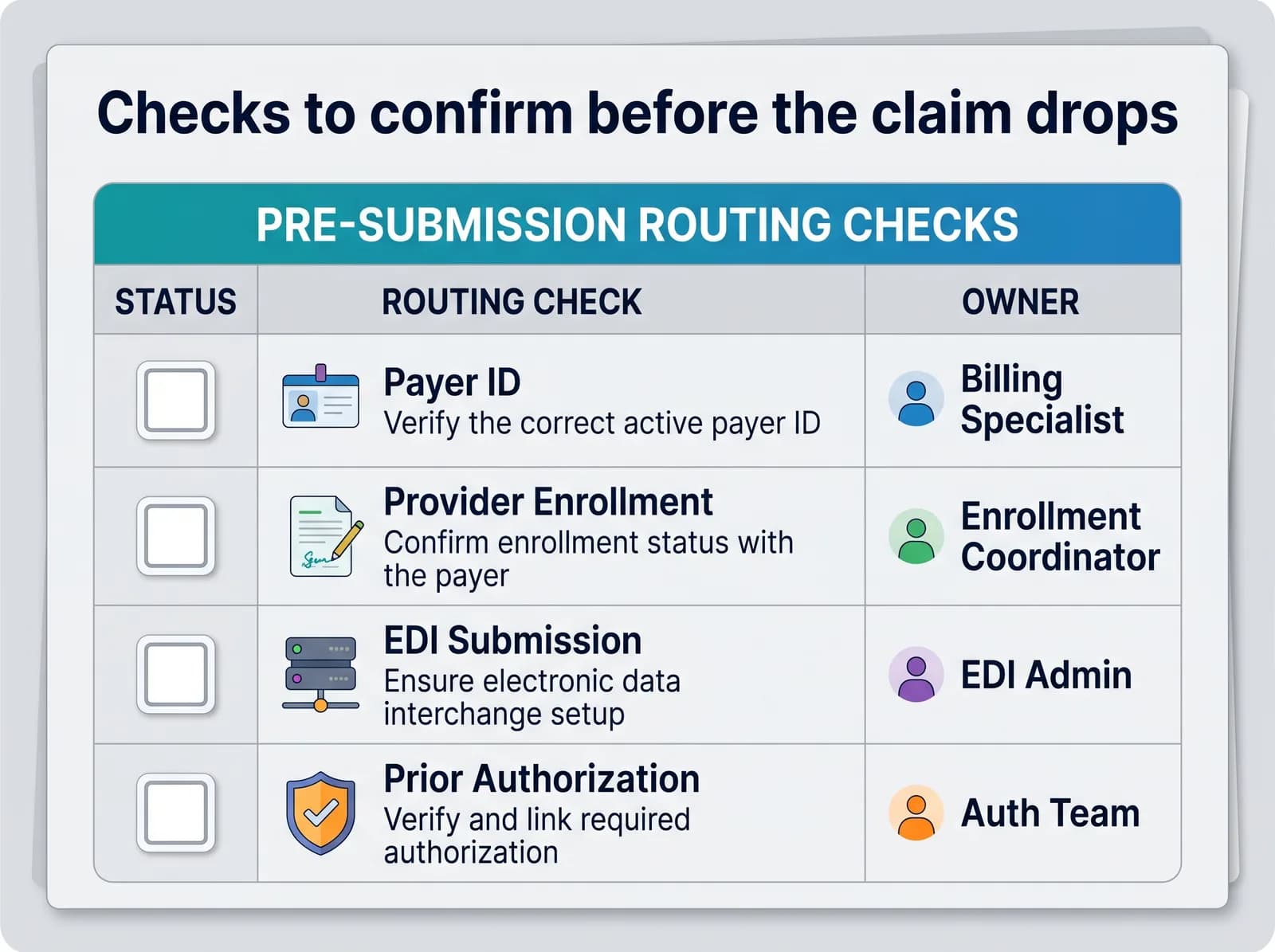
Many claim denials that a small practice blames on "the payer" are decided at the moment of submission — the claim went out the wrong way, to the wrong place, or with a detail that payer never accepts. Payer-specific claim routing is the discipline of getting those submission details right for each payer before the claim leaves your system. For an owner or practice manager billing a mix of commercial and government payers, it is a check worth owning, because it happens before money is at stake and before a denial clock starts. This article is for independent practices that bill multiple payers and want a repeatable pre-submission routine.
What payer-specific routing actually means
Routing is the set of decisions that determine how a claim travels from your practice management system to the payer and how the response comes back. It is not one setting but several, and they differ by payer:
- Trading partner and clearinghouse path. Each payer is reached through a specific electronic pathway. A claim sent down the wrong path may reject at the clearinghouse or, worse, be accepted and never adjudicated.
- Payer ID and submission format. Payers publish identifiers and accepted transaction formats. Using an outdated or incorrect identifier is an avoidable failure.
- Enrollment and EDI setup. Your practice must be enrolled and linked to the payer for electronic submission and for electronic remittance advice (ERA) and electronic funds transfer (EFT). Enrollment is payer-specific and often takes time.
- Claim-level requirements. Some payers require particular fields, attachments, or companion documentation. These are payer rules, not universal ones.
None of these can be assumed. Every payer's current requirements should be verified against that payer's own published provider guidance and your clearinghouse's payer list before you rely on them.
Checks to confirm before the claim drops
The goal is a short, repeatable pre-submission routine with a named owner for each check. Below is a practical set. Assign each check to either the practice or your billing partner — but assign it to someone.
1. Payer and plan identification
Confirm the payer on the claim matches the patient's actual coverage for the date of service, including the correct plan or product line. Government and commercial products under the same brand can route differently. Owner: front desk or eligibility staff, verified at scheduling and again at check-in.
2. Eligibility and benefits
Run eligibility before the visit and re-check when coverage is uncertain. Eligibility failures can look like routing failures later. See eligibility and benefits verification for how this fits the cycle.
3. Enrollment and EDI status
Confirm the rendering provider and the practice are enrolled with that payer for electronic claims, ERA, and EFT. New providers, new locations, and newly contracted payers are the usual gaps. Owner: credentialing or billing lead. Knight's EFT/ERA and EDI support covers this setup work.
4. Payer ID and clearinghouse mapping
Verify the payer ID and clearinghouse routing in your system against the payer's current published list. Recheck after any software update or payer merger. Owner: billing lead.
5. Payer-specific claim requirements
Check whether the payer requires specific fields, modifiers, or attachments for the service billed. Do not assume a rule carries across payers. Owner: coding or billing lead, with rules verified against current official guidance.
6. Authorization and referral linkage
Where a payer requires prior authorization, confirm the authorization number is on the claim and linked correctly. This is a separate check from routing but fails in the same place. See prior and retro authorization.
7. Clearinghouse rejection review
Review clearinghouse reports daily. A rejected claim has not been submitted; treat it as work in progress, not a submitted claim. Owner: whoever submits claims.
8. A routing log
Keep a simple internal record of each payer's confirmed routing details and the date last verified. This is a useful artifact for a small practice, because it survives staff turnover.
Where routing errors surface later
Routing mistakes often do not announce themselves; they tend to appear as patterns: claims that sit in "accepted" status without adjudication, denials citing missing or invalid information, duplicate submissions after a rejected claim was resubmitted incorrectly, and remittances that never arrive because ERA enrollment was never completed. Each of these costs staff time to trace and can push a claim past timely-filing windows — which vary by payer and contract and must be verified, not assumed.
Treat these as process expectations rather than guarantees. Getting routing right reduces avoidable rework; it does not guarantee payment, and it does not replace denial management when a payer denies for clinical or contractual reasons. Pair routing discipline with denial management and claims management so that what does go wrong is caught quickly.
Who owns each check
In a small practice, the honest answer is often "whoever has time" — and that is the risk. A workable split: front desk owns eligibility and plan identification; the billing lead owns enrollment, payer IDs, and clearinghouse mapping; the coding lead owns payer-specific claim requirements; and the practice manager owns the routing log and reviews rejection reports weekly. If billing is outsourced, the partner should own the technical checks and show you the log. Knight runs these functions inside the systems a practice already uses, and the Knight process and ownership model describes how ownership is divided.
What to do next
Start with the routing log. Pull your top payers by volume, confirm each payer's current submission details against official guidance, and note the date. If you would rather have a second set of eyes, contact Knight Medical Billing to discuss a pre-submission review of which checks your team owns and which could move to a partner. There is no obligation, and no claim that routing alone solves every denial.
Sources and verification
No external sources were supplied for this article, and no statistics, payer policies, or filing deadlines are asserted here. All payer-specific requirements — identifiers, formats, enrollment steps, attachments, and timely-filing limits — must be verified against each payer's current official provider guidance and your clearinghouse documentation before you rely on them. This article is process guidance, not legal, coding, or clinical advice.
Where this work connects
Related articles.
 Revenue Cycle Management
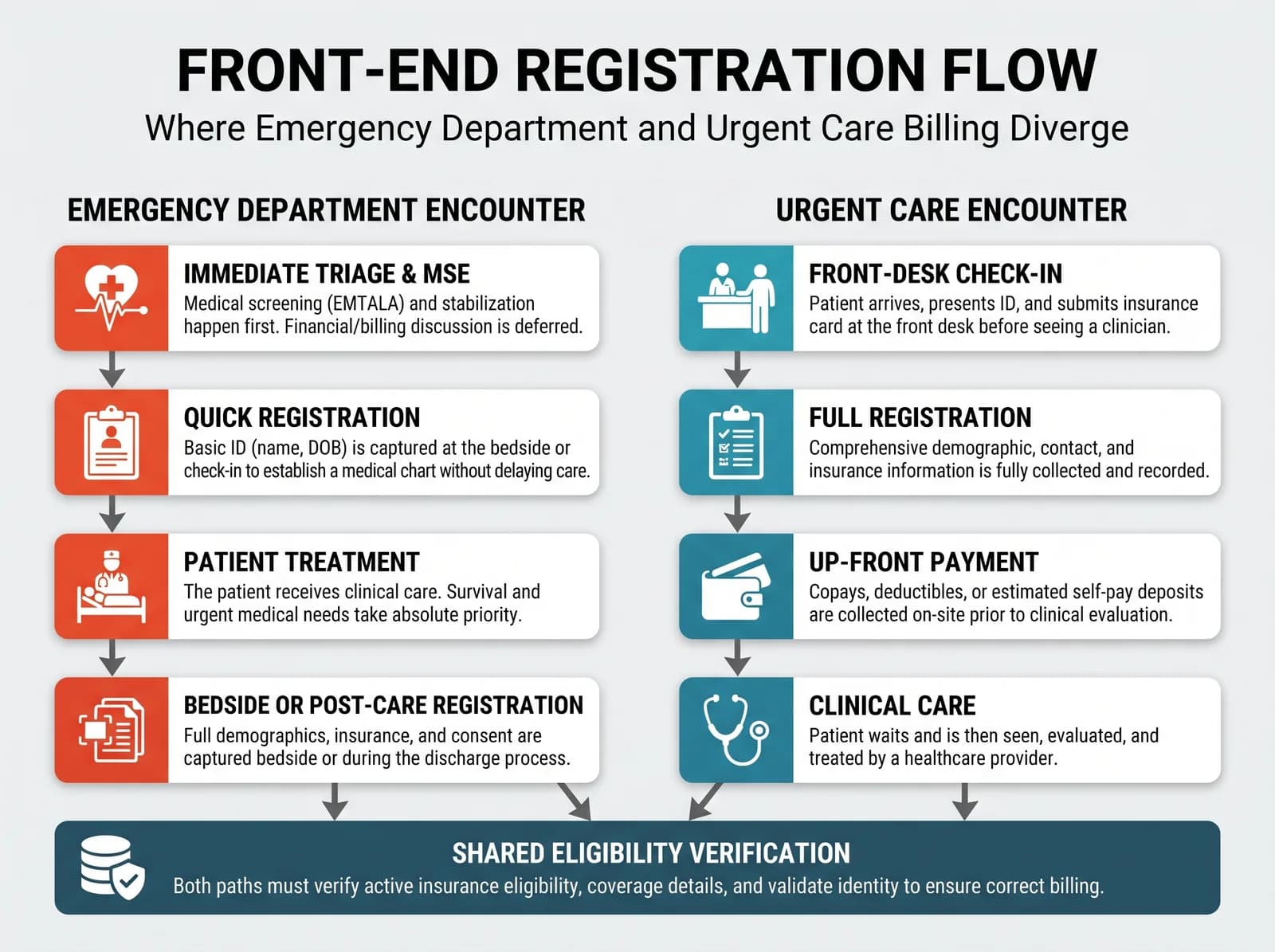
Emergency Department and Urgent Care Billing: What Differs When One Organization Runs Both
A practical guide for revenue cycle leads running an emergency department and urgent care sites together: where the workflows diverge, what risks they share, and the questions to answer before consolidating billing.
Read article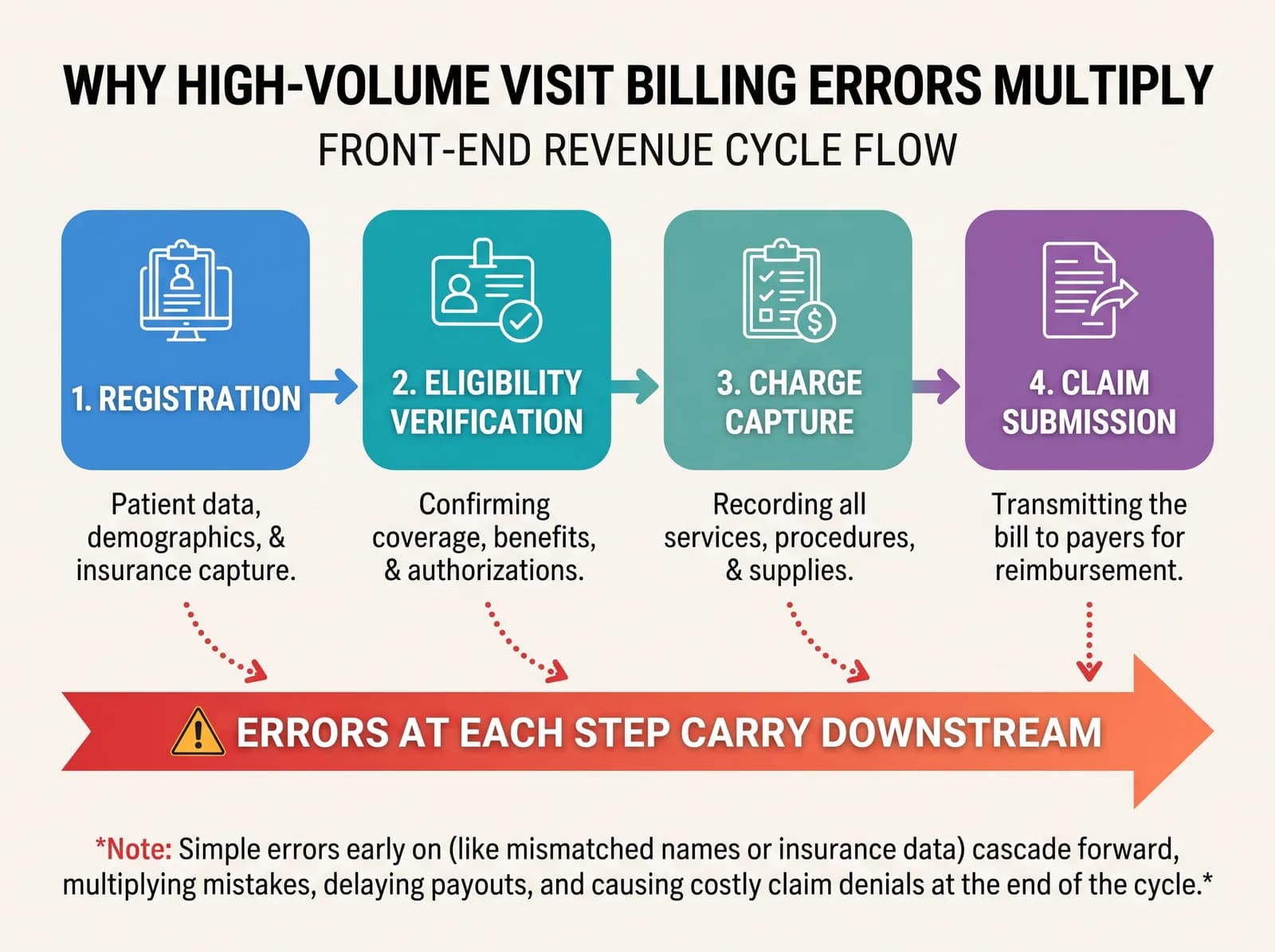 Revenue Cycle Management
High-Volume Visit Billing Errors: Where Small Front-End Mistakes Multiply
In busy urgent care and clinic settings, small front-end mistakes compound quickly. Learn where high-volume visit billing errors multiply and how to run a simple review routine.
Read article Revenue Cycle Management
What Changes in Billing When an Independent Practice Adds a Second Location
A second location changes provider enrollment, charge capture, coding consistency and reporting. Here is what to put in place before the new site opens.
Read article