

How to Evaluate a Medical Billing Company for a Massachusetts Independent Practice
A neutral checklist for Massachusetts independent practices comparing outsourced billing: confirm your payer mix, ask every vendor the same enrollment, eligibility, denial and reporting questions, and verify state and payer claims instead of accepting them.
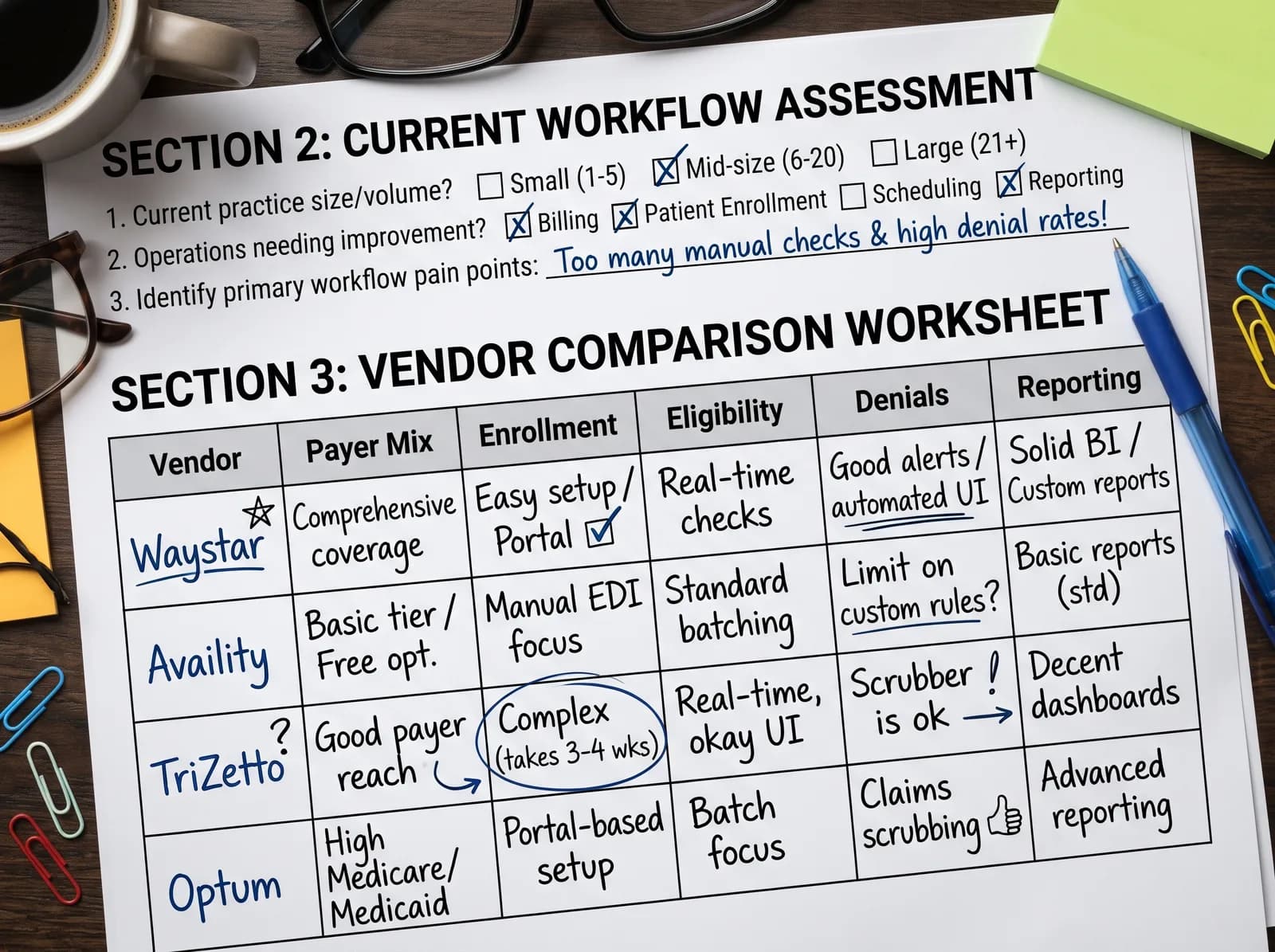
Most Massachusetts billing-company searches return the same thing: a ranked list of vendors and a stack of homepages that all promise clean claims and faster cash. What they rarely give you is a way to decide which vendor fits your practice. This guide is that missing piece: a neutral checklist for the owner or practice manager of a small independent Massachusetts practice who is comparing medical billing services in Massachusetts. It won't tell you which company to pick. It will help you ask better questions, ground the comparison in your payer mix, and verify vendor claims instead of accepting them.
1. Confirm your own payer mix before you shortlist
Vendor marketing is generic; your payer mix is not. Before you take a sales call, pull a recent 90-day picture of your practice and write it down. You are building the yardstick you'll measure every vendor against.
What to gather
- Payer distribution by charges and by collections. Commercial, Medicare, MassHealth (Medicaid), and any Medicare Advantage or managed-care plans you contract with. Note the percentage each represents — a vendor strong in commercial claims may be thin on MassHealth workflows.
- Your top denial reasons over the last two quarters, by payer. This tells you where your current process leaks and what you need a vendor to fix first.
- Your A/R aging — how much sits past 90 and 120 days, and with which payers.
- Your systems. Which EHR or practice management system holds your claims, and which clearinghouse you use. A billing partner should work inside the systems you already run, not force a migration you didn't plan for.
If you're unsure how to read your own numbers, a revenue leak calculator for medical practices can help you frame the conversation before you shortlist anyone.
Why this matters for Massachusetts specifically
Many Massachusetts practices carry a mix of commercial plans, Medicare, and MassHealth, and each brings its own enrollment, eligibility, and documentation expectations. A vendor that has never worked a MassHealth claim carries different risk than one that handles it routinely. You don't need to become a payer-policy expert; you need to know which payers dominate your revenue so you can ask pointed questions about them.
2. Questions to ask every vendor: enrollment, eligibility, denials, reporting
Use the same question set with every company so the answers are comparable. Group them by revenue cycle stage.
Enrollment and credentialing
- Who handles payer enrollment and revalidation, and how do you track deadlines? (Ask them to describe the process, not just say they do it.)
- How do you manage credentialing for new providers or a new location?
- What happens when a payer enrollment lags — who owns the follow-up?
Eligibility and benefits verification
- How and how often do you verify eligibility — batch, real-time, or both?
- How do you handle MassHealth eligibility and plan changes, and how do you confirm current MassHealth guidance from official sources such as mass.gov and CMS?
- What's your process when eligibility comes back uncertain at the time of service?
Claims and denials
- Walk me through your clean-claim checks before submission.
- How do you route claims by payer, and how do you handle payer-specific requirements?
- What's your denial workflow — who works denials, how quickly, and how do you appeal?
- How do you handle prior authorizations and retro-authorizations?
Payment posting and reporting
- How is payment posted, and how do you reconcile EFT/ERA?
- What reports do I get, how often, and can I see them by payer and provider?
- Who is my day-to-day contact, and what's the escalation path?
For a deeper version of this exercise, see our guide on how to choose a medical billing company for your practice. If you want to understand how the work is actually staffed inside your account, our overview of how our billing process works walks through it.
3. How to verify claims about state and payer experience
Every vendor will say they "know Massachusetts" and "handle MassHealth." Treat those as claims to check, not facts to accept.
Ask for specifics, then verify them
- Ask for the process, not the adjective. "We're experienced with MassHealth" is marketing. "Here's how we verify MassHealth eligibility and route those claims" is a process you can evaluate.
- Ask which payers they work with most and whether that matches your mix. A vendor whose book of business is mostly one payer type may not fit yours.
- Check references in your situation — same size, same specialty, similar payer mix. Ask what changed in their A/R after switching.
- Verify payer rules against official guidance. Enrollment steps, filing deadlines, and coverage rules change. Whatever a vendor tells you about a payer's requirements should be confirmed against that payer's current official guidance — for MassHealth, mass.gov, and for Medicare, CMS — and any applicable state or federal rules — not taken on faith from a sales deck.
Be wary of any vendor that guarantees payment, reimbursement, or audit outcomes. No billing partner controls payer decisions. What a good partner commits to is process: clean-claim checks, timely follow-up, transparent reporting, and clear ownership of denials. Distinguish those process commitments from outcome promises when you compare.
Watch for these red flags
- Vague answers about who actually works your claims.
- No sample reports, or reports that don't break out by payer.
- Pressure to switch systems before you've seen the workflow.
- Reluctance to put service terms and reporting expectations in writing.
What to do next
You don't have to run this evaluation alone, and there's no obligation to switch anything. A practical next step is to gather your 90-day payer mix, denial reasons, and A/R aging, then talk through them with someone who works inside practices like yours. If a conversation would help you shortlist with more confidence, you can schedule a billing consultation or contact our team. Bring your questions; we'll answer them directly.
Sources and verification
This article is evaluation guidance, not a ranking. The vendor-list and company pages reviewed for general context (not relied on for any specific claim, and from which no payer rules or statistics were drawn) were used only to understand the competitive landscape and common marketing claims, not as evidence for any statement in this article:
- Medical Billing Company | Medical Healthcare Solutions: https://medicalhealthcaresolutions.com/
- Top 10 Medical Billing Companies in Massachusetts: https://transcure.net/medical-billing/companies/massachusetts/
No payer rules, statistics, or performance figures are asserted here. Any enrollment, eligibility, coding, or filing requirement you discuss with a vendor should be verified against current official payer and regulatory guidance before you rely on it.
Where this work connects
Related articles.
 Medical Billing Vendor Selection
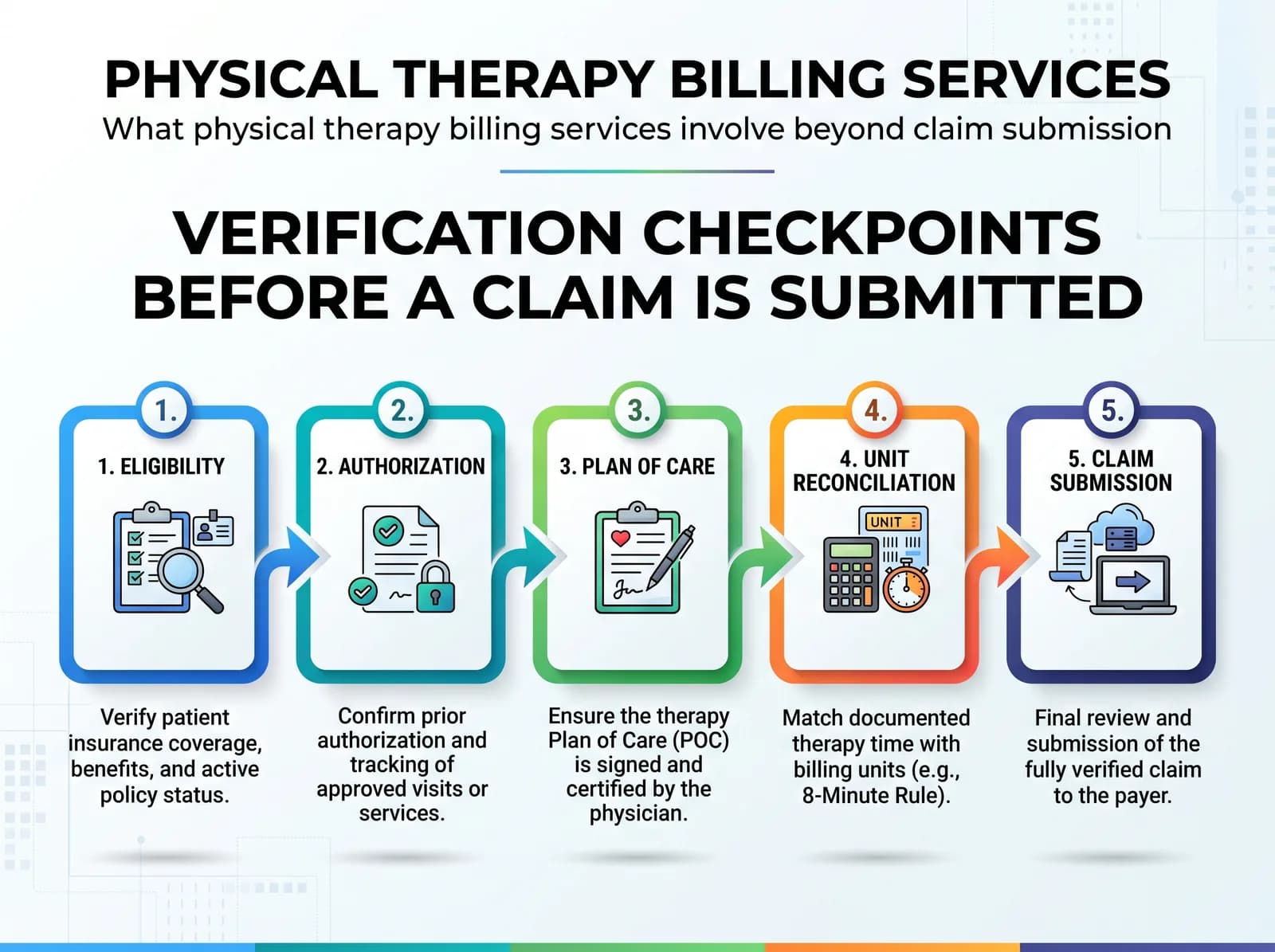
Physical Therapy Billing Services: What Independent PT Practices Should Verify
A practical guide for independent PT clinic owners on what to verify in claims, timed units, authorizations and A/R when evaluating physical therapy billing services.
Read article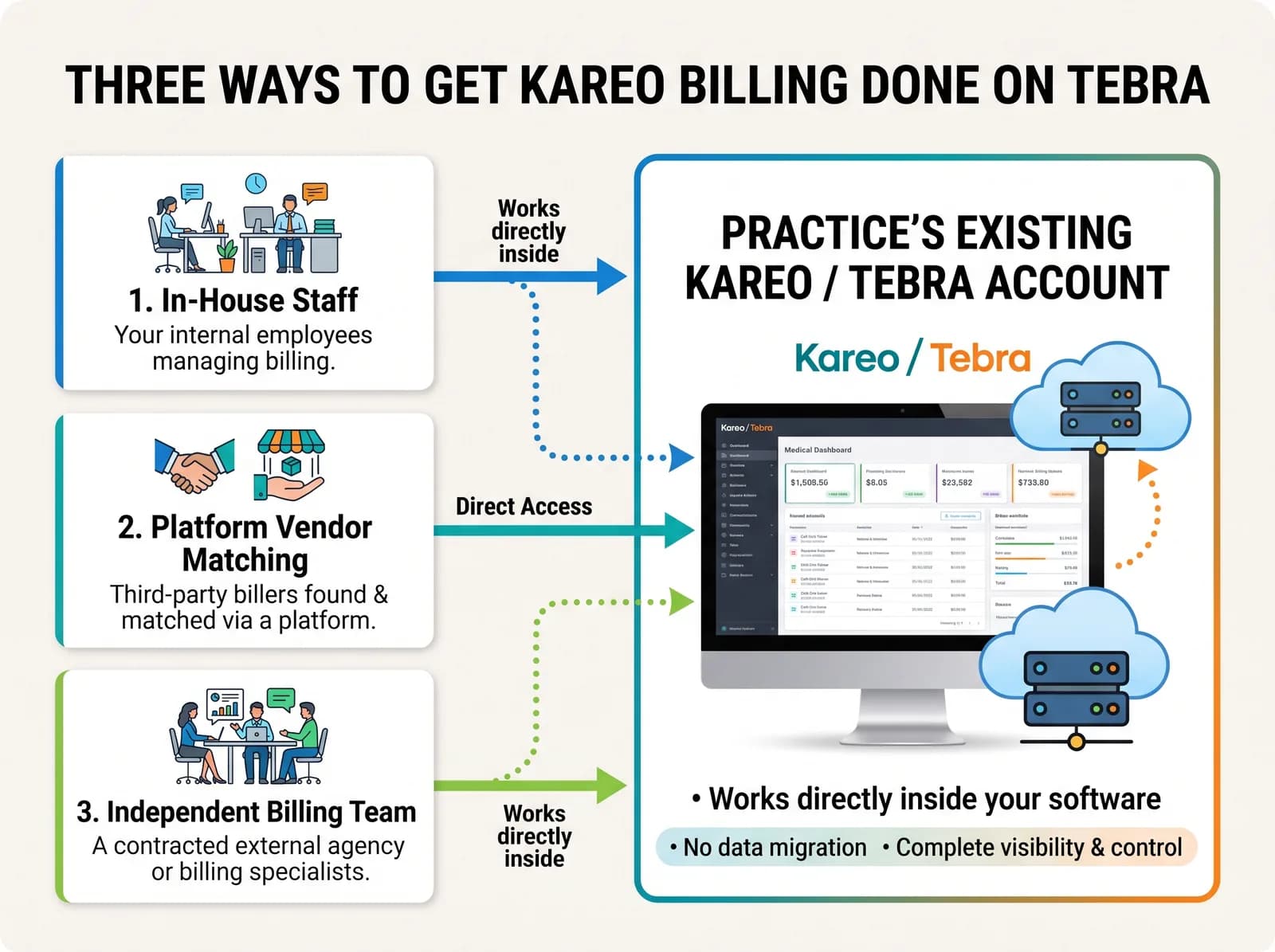 Medical Billing Vendor Selection
Kareo Billing Service: How Outsourced Billing Works Inside Your Account
Kareo is now Tebra, but practices still search the old name. Here is how an independent billing team works inside your existing Kareo/Tebra account, what stays with your practice, and what to verify before signing.
Read article Medical Billing Vendor Selection
Urgent Care Billing Services: A Buyer's Guide for High-Volume Clinics
A practical buyer's guide to urgent care billing services for high-volume clinics, covering eligibility, charge capture, denial follow-up and the questions to ask before you sign.
Read article