

Kareo Billing Service: How Outsourced Billing Works Inside Your Account
Kareo is now Tebra, but practices still search the old name. Here is how an independent billing team works inside your existing Kareo/Tebra account, what stays with your practice, and what to verify before signing.
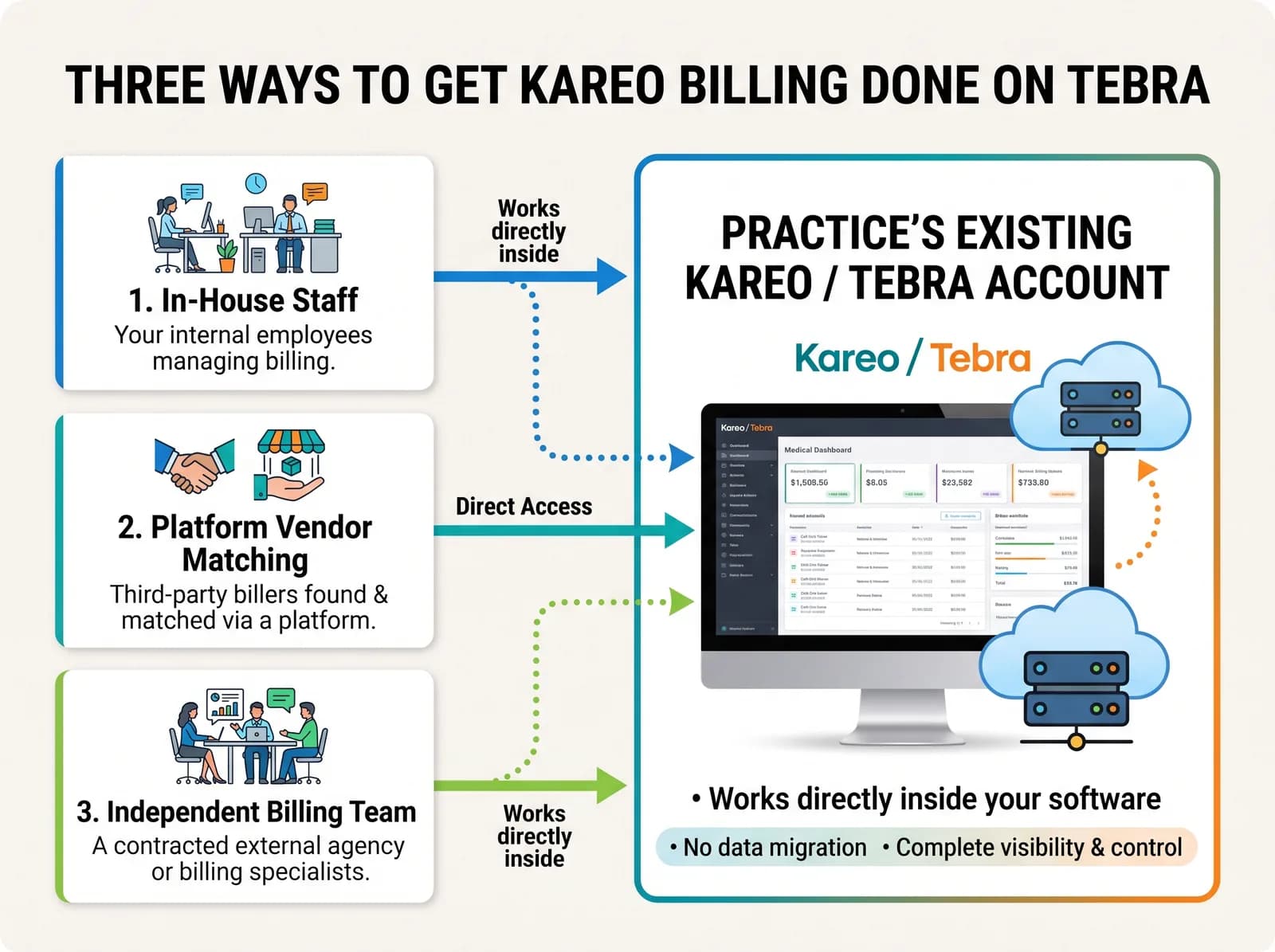
If you search for a "Kareo billing service," you are probably in one of two places: your practice already runs on Kareo (now branded Tebra) and the billing workload has outgrown the people doing it, or you are evaluating the software and want to know whether you can hand off the revenue cycle without ripping out the system you just learned. The short answer is yes — a third-party billing team can work inside your existing Kareo/Tebra account — but the details of how that works, and what to check before you sign, deserve careful attention.
What "Kareo billing service" means today
- A Kareo billing service is an independent team working inside your existing Kareo/Tebra account.
- You keep the software, data and reporting; the team handles charge entry, claims, posting and follow-up.
- Verify access, ERA/EFT routing, reporting and contract terms before signing.
Kareo is the legacy name for the practice management and clinical platform now marketed as Tebra. When practice managers say "Kareo billing service," they usually mean one of three things: the software subscription itself, a billing team that logs into their Kareo/Tebra account and does the revenue-cycle work, or a vendor that bundles software and staff together. This article focuses on the second meaning — an independent team performing billing inside the account your practice already owns.
That distinction matters. A billing service working inside your account is not selling you new software. It is taking over the operational work — charge entry, claim submission, payment posting, denial follow-up — while your practice retains the platform, the data and the reporting visibility. If a vendor cannot clearly explain which of the three models they are selling, that is worth clarifying before you proceed.
Kareo vs. Tebra: why the old name still appears in billing searches
The rebrand from Kareo to Tebra involved bringing practice management, clinical documentation and patient-facing tools under one brand. Search results, job postings, forum threads and even some vendor pages still use "Kareo" because that is what a large installed base of practices calls the product. Searching the old name is normal and does not mean you are looking at outdated information.
Because product names, feature sets and packaging can change, verify current platform details directly with Tebra rather than relying on any article — including this one. We are describing the operating model, not the software roadmap.
Three ways to get Kareo billing done on Tebra
1. In-house staff working in the software
Your front office or dedicated biller handles charges, claims, posting and follow-up inside Kareo/Tebra. You keep full control and direct oversight, but you carry hiring, training, coverage during vacations and turnover risk. For a small practice with steady volume, this can work well; for a growing one, it often becomes the bottleneck.
2. Tebra's own managed-billing matching
Tebra may offer ways to connect practices with billing support, including partner matching, but this should be confirmed directly with Tebra. If such an option exists, it can be convenient because it is coordinated through the platform vendor, but verify current offerings directly with Tebra. The tradeoff is that you are choosing from within one ecosystem, and the terms, scope and reporting you get depend on the specific arrangement. Ask exactly who will do the work, what system they use, and how you would exit if the fit is wrong.
3. An independent third-party billing team inside your account
An outside billing company is granted access to your Kareo/Tebra account and performs the revenue-cycle work there. You keep your software, your data and your reporting; the team brings billing labor and process. This is the model most practices mean by "Kareo billing service," and it is the one that requires the most careful vetting on access, data handling and contract terms.
What a billing team actually does inside your Kareo/Tebra account
The work is a sequence, and each step has a handoff you should be able to see. A Kareo billing service typically covers:
- Charge entry and coding review — charges entered accurately and matched to documentation, with coding questions routed back to the practice rather than guessed at.
- Claim scrubbing and submission — claims checked for common rejection causes before they go out. See claims management.
- Payment posting — payments and adjustments posted from ERAs and manual EOBs, with discrepancies flagged. See payment posting.
- Denial management — denials worked by category, with root causes tracked so the same denial does not repeat. See denial management.
- A/R follow-up — aging worked on a schedule, not only when cash gets tight. See A/R management.
These are process commitments, not guarantees of specific outcomes. No billing team can promise a specific payment or reimbursement outcome; what they can commit to is a defined workflow, reporting cadence and escalation path.
What stays with your practice with a Kareo billing service
With a Kareo billing service, you should aim to retain ownership of the Kareo/Tebra account, the underlying patient and financial data, and the reporting; confirm this contractually. The billing team gets role-based access to do the work. Clearinghouse connections, ERA/EFT enrollment and payer portals are often set up under the practice's identifiers, which can protect you if the relationship ends, but verify the actual setup in your contract. Ask for a written access map before anyone logs in. Our EFT/ERA and EDI support page describes how those connections are typically handled.
A verification checklist before you sign
- Who gets login access, at what permission level, and how is it revoked?
- How are ERAs and EFTs routed, and whose identifiers are on the enrollments?
- What reports will you receive, how often, and can you pull them yourself in Kareo/Tebra?
- How are denials and A/R aged and prioritized, and who escalates?
- What does the contract say about data ownership, termination and transition assistance?
- How is pricing structured — per claim, percentage, or flat fee — and what is excluded?
- How will the team confirm payer and regulatory details? They should point you to official payer guidance, not this article.
For a broader framework, see our guide on how to choose a medical billing company.
Red flags and honest limitations
Be cautious with guaranteed payment or reimbursement claims, vague "certified" language without documentation, pricing that hides per-claim fees, and any vendor that will not tell you who actually does the work. This article is not legal, coding or clinical advice; verify coding, payer and compliance questions against current official guidance.
What to do next
If you want to keep Kareo/Tebra and add a billing team, start with a conversation about your current workflow and where the revenue cycle stalls. You can schedule a consultation or run your numbers through the revenue leak calculator first. Related reading: our piece on in-house vs. outsourced medical billing.
Related articles.
 Medical Billing Vendor Selection
Urgent Care Billing Services: A Buyer's Guide for High-Volume Clinics
A practical buyer's guide to urgent care billing services for high-volume clinics, covering eligibility, charge capture, denial follow-up and the questions to ask before you sign.
Read article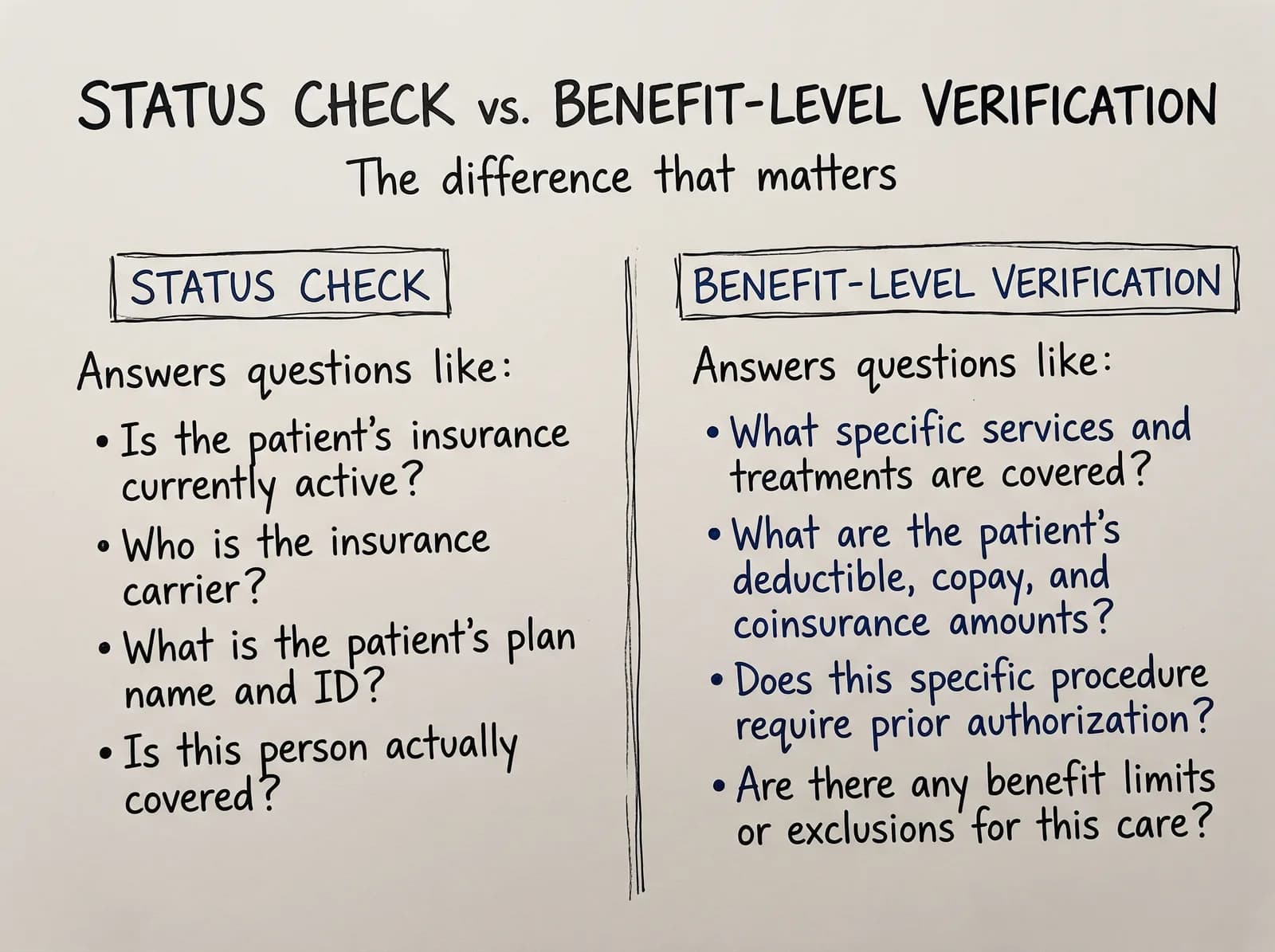 Medical Billing Vendor Selection
Outsource Insurance Eligibility Verification Services: A Practice Manager's Guide
A practical guide to outsourcing insurance eligibility verification: what benefits checks cover, status vs. benefit-level verification, vendor questions, and what to keep in-house.
Read article Medical Billing Vendor Selection
How to Evaluate Specialty Medical Billing Services: A Neutral Checklist
A neutral checklist for comparing specialty medical billing vendors on process, coverage, reporting and marketing claims, built for practices and groups that have outgrown one-biller oversight.
Read article