

How to Evaluate Specialty Medical Billing Services: A Neutral Checklist
A neutral checklist for comparing specialty medical billing vendors on process, coverage, reporting and marketing claims, built for practices and groups that have outgrown one-biller oversight.

Most "best medical billing services" lists rank vendors on price and star ratings. That tells you almost nothing about whether a vendor can run a multi-provider specialty group's revenue cycle without dropping claims, missing denials, or handing you reports you can't act on. If your practice has grown past the point where one biller knows every payer and every provider's quirks, the evaluation question changes: you are not buying a service, you are choosing an operating partner for the parts of the revenue cycle you no longer want to manage internally. This checklist is built for that decision: comparing specialty billing vendors on process, coverage and reporting rather than marketing language.
What "specialty billing" should actually cover
The phrase gets used loosely. Before you compare vendors, define the scope you are buying. A specialty billing engagement should be explicit about which of these it owns, and which stay with your staff:
- Coding and charge capture. Who reviews codes before claims go out, and how are specialty-specific coding questions escalated? Coding rules change; the vendor should describe a review process, not promise perfect coding.
- Claims submission and clearinghouse handling. Which clearinghouse, who fixes rejections, and how quickly.
- Eligibility and prior authorization. Whether these are included or billed separately — a common gap in specialty work.
- Payment posting and reconciliation. Who posts ERAs and EOBs, and how deposits are reconciled to claims.
- Denial management and A/R follow-up. The aging thresholds at which the vendor works accounts, and how appeals are tracked.
- Reporting. What you receive, how often, and whether it is tied to your specialty's actual denial patterns.
For a multi-provider group, add one more: how the vendor handles provider-level and location-level reporting so you can see which clinicians or sites are driving write-offs. If a vendor can't describe this in plain language, that is your first data point.
Checklist: questions that separate vendors
Use these as a scripted comparison. Ask every vendor the same questions and write down the answers; the differences will be obvious.
Process and coverage
- Which revenue cycle functions are in scope, and which cost extra? Get the boundary in writing.
- How do you handle a specialty-specific denial that your team hasn't seen before? Ask for the escalation path.
- What is your process for eligibility checks and authorizations, and who owns them?
- How do you manage claims that require attachments or medical records?
- What happens when a payer changes a policy mid-year — how do you find out and adjust?
Staffing and accountability
- Will the same team work our account month to month, or is it pooled?
- Who is our named point of contact, and what is the response-time expectation?
- How are errors caught before claims leave your system?
Reporting and visibility
- Show a sample monthly report. Does it break out denials by reason, payer and provider?
- Can we see A/R aging by bucket and by payer?
- Do you report on clean claim rate and days in A/R, and how are those defined?
- Can we access the practice management system directly, or only through your reports?
Systems and transition
- Which PM and clearinghouse systems do you work in? Do you work inside ours, or require a migration?
- What does onboarding look like, and how long until you are handling claims end to end?
- What happens to open A/R and denials at the point we switch?
On that last point, our own in-house vs. outsourced comparison and switching guide walk through the transition risks worth raising in the sales conversation. For a broader view of how scope maps to services, see complete RCM services.
Red flags in vendor marketing claims
Specialty medical billing services vendors compete on claims that are difficult for buyers to verify. Treat these as prompts to ask for evidence, not reasons to walk away automatically:
- "We increase collections by X%." Ask for the baseline, the timeframe and whether the figure comes from a documented client case study. Without that, it is a marketing number.
- "We're certified / accredited / a preferred partner." Ask which body issued it and request documentation. In our view, certifications that can't be produced on request should be discounted.
- "We guarantee payment." Billing vendors do not control payer coverage decisions. A vendor that guarantees reimbursement outcomes is overpromising; in our view, a credible one commits to process: timely submission, follow-up within defined windows, and transparent reporting.
- "We specialize in everything." Ask what share of their book is your specialty, and ask for the names of the coders or account managers who will touch your claims.
- Vague reporting promises. "Real-time dashboards" means little if you can't see denial reasons by provider. Ask for a sample report before signing.
Any payer policy, coding rule or filing deadline a vendor cites should be verified against current official payer or regulatory guidance — including your own state and payer mix. Vendors should welcome that check, not deflect it.
What to do next
You don't need to decide today. A useful next step is to run this checklist against your current setup — in-house or outsourced — and note where the answers are thin. If you want a second set of eyes, Knight Medical Billing can walk through your scope, reporting needs and transition questions. (This is a vendor offer; the checklist above stands on its own.) Start with our buyer's guide, then contact us or schedule a consultation when you're ready to compare notes.
Sources and verification
This article draws on general revenue cycle process knowledge. The following sources are provided as background context on how billing services are marketed and compared, not as support for specific claims:
- Medical Billing Company | Medical Healthcare Solutions: https://medicalhealthcaresolutions.com/
- 10 Best Medical Billing Services Reviewed for 2026: https://themedicalpractice.com/services/best-medical-billing-services/
No statistics, rankings or vendor performance figures are cited here. Payer policies, coding rules and filing deadlines vary and should be verified against current official guidance before you rely on them.
Where this work connects
Related articles.
 Medical Billing Vendor Selection
Specialty Medical Billing Services: How to Evaluate a Partner for Your Practice Workflow
A practical guide to evaluating specialty medical billing partners on coding workflow, payer mix, denial handling, reporting, and contract terms.
Read article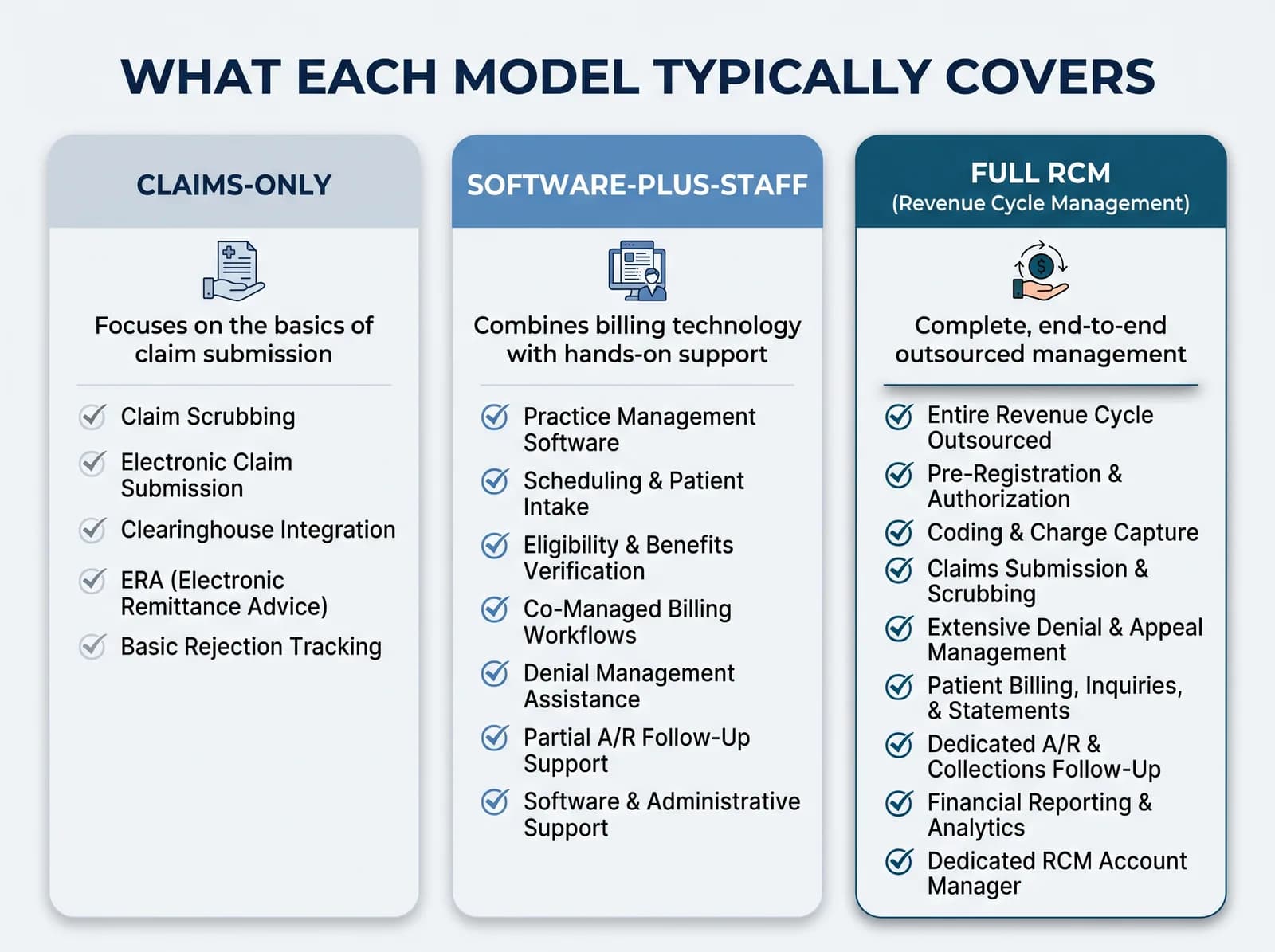 Medical Billing Vendor Selection
Billing Service Models Compared: Full RCM, Claims-Only and Software-Plus-Staff
A plain comparison of claims-only billing, full revenue cycle management and software-plus-staff, with scope tables and questions to ask before choosing a model for a growing practice.
Read article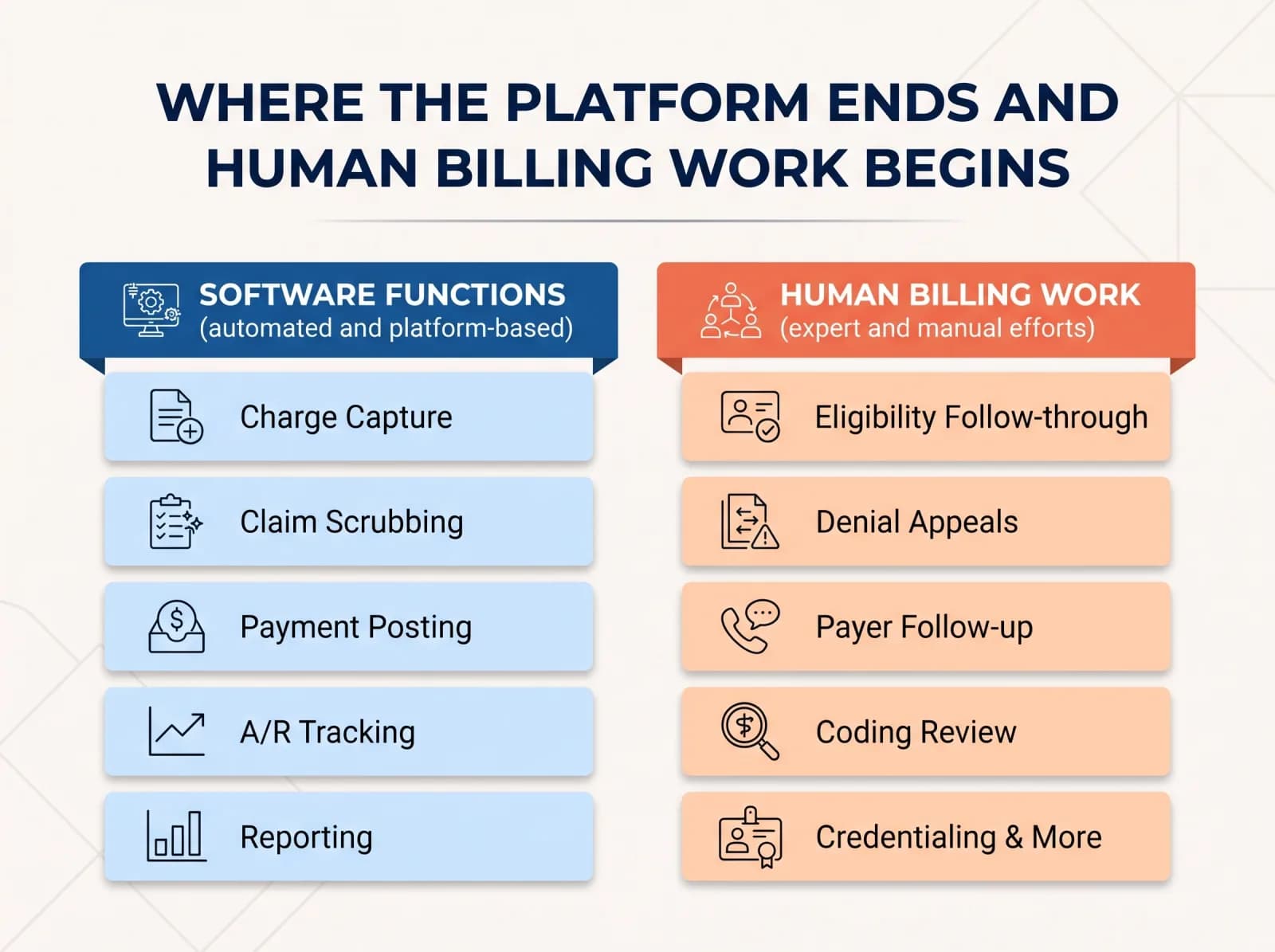 Medical Billing Vendor Selection
Tebra Billing: Software, Services, and How to Staff the Work
Tebra billing can mean the platform's billing module or a service that works inside Tebra. This guide separates the two and explains where software ends and human billing work begins.
Read article