

Billing Service Models Compared: Full RCM, Claims-Only and Software-Plus-Staff
A plain comparison of claims-only billing, full revenue cycle management and software-plus-staff, with scope tables and questions to ask before choosing a model for a growing practice.
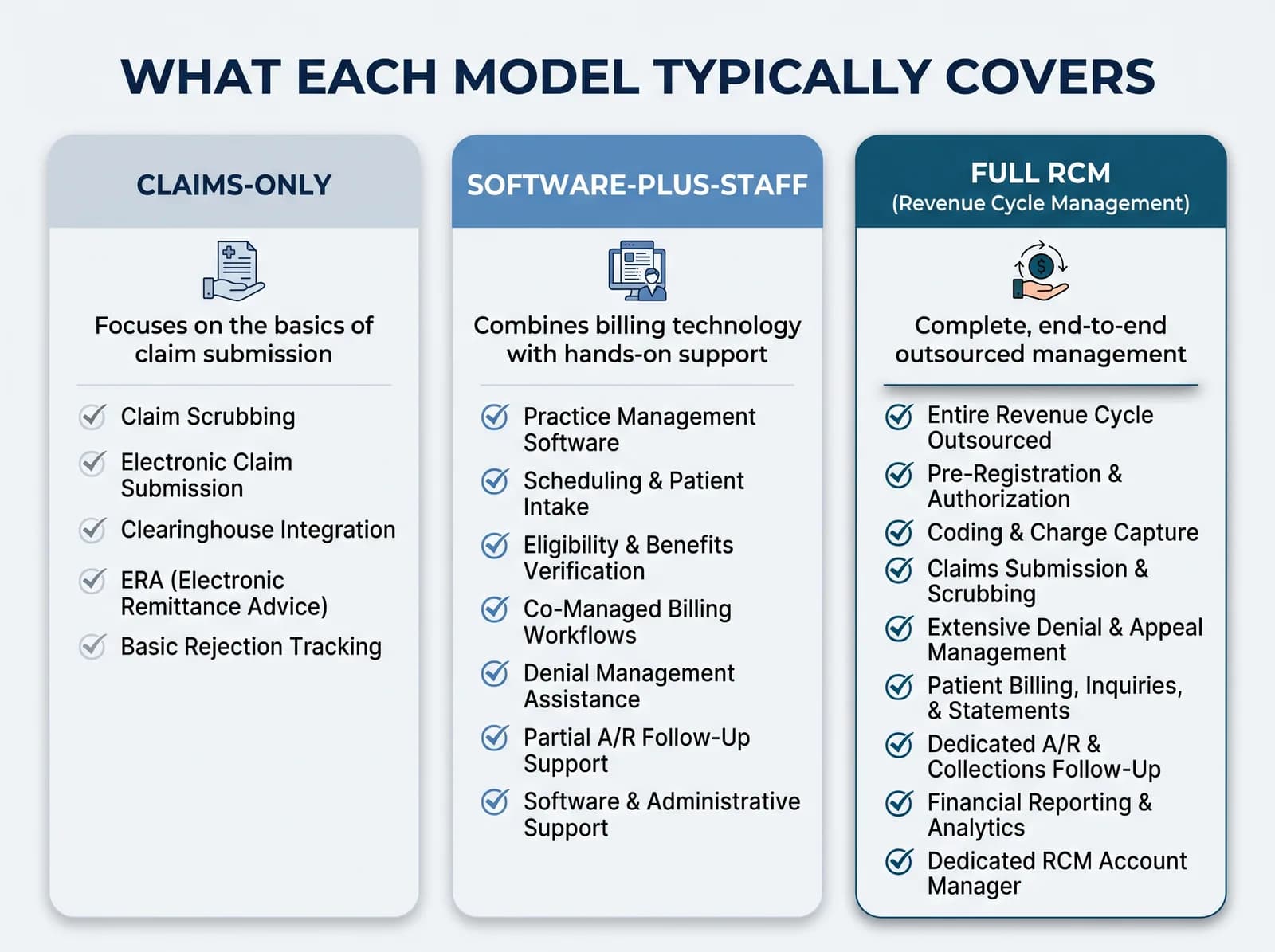
Billing service models compared: full RCM, claims-only and software-plus-staff
Once a practice adds a second, third or fourth provider, billing stops being a task someone squeezes in and becomes a workflow with handoffs. That is usually when the question changes from "should we outsource?" to "how much of the revenue cycle should we hand over?" The answer depends less on vendor marketing than on where your current process actually breaks. Below is a plain comparison of the three models growing practices most often weigh, framed as process scope rather than promises.
The three common billing service models
Claims-only
A claims-only arrangement covers the back half of the cycle: charge entry from your documentation, claim scrubbing and submission, and often basic rejection handling. Eligibility checks, prior authorization, payment posting, patient balances and denial appeals may sit outside the scope or be priced separately. It may suit a practice with a strong front office and an in-house biller who wants overflow capacity or after-hours claim submission.
Full revenue cycle management (RCM)
Full RCM typically takes responsibility for the cycle end to end: eligibility and benefits verification, authorization support, charge entry, claims, payment posting, denial management, A/R follow-up and reporting. The practice still owns clinical documentation and the clinical decisions behind coding, but the administrative chain from scheduling to collections is managed by the billing partner inside the systems the practice already uses. Multi-provider practices often consider this model when their denials and aging A/R have become a management problem rather than a staffing problem.
Software-plus-staff
Here the practice buys billing software and either hires staff to run it or contracts for a la carte support. Control stays in-house; so does the hiring, training and coverage risk. It may work well for a practice that wants to build an internal billing team and treat the platform as infrastructure. It is the least "done for you" of the three, and the total cost includes recruiter fees, turnover and the learning curve, not just the subscription.
What each model typically covers
The table below maps core revenue cycle functions to each model as a process commitment—what the partner says it will do—not a guarantee of payment or reimbursement. The qualifiers shown are typical contract patterns, not standards or payer rules. Scope varies by contract, so confirm each line in writing.
| Function | Claims-only | Full RCM | Software-plus-staff |
|---|---|---|---|
| Eligibility and benefits verification | Usually excluded | Typically included | Practice staff |
| Prior authorization support | Usually excluded | Often included | Practice staff |
| Charge entry and coding review | Included | Included | Practice staff |
| Claim submission and scrubbing | Included | Included | Practice staff |
| Payment posting and reconciliation | Often excluded | Included | Practice staff |
| Denial management and appeals | Limited or add-on | Included | Practice staff |
| A/R follow-up and aging review | Limited or add-on | Included | Practice staff |
| Reporting and performance review | Basic | Included | Whatever the software provides |
Two practical notes: first, "claims-only" is not a standard product; ask exactly where the handoff occurs and who owns rejections after day 30. Second, software-plus-staff shifts risk to you: if a biller leaves, the cycle pauses until you replace them. Full RCM can shift that coverage risk to the partner, depending on contract terms, which may cost more per claim but less per hour of management attention.
How to match a model to practice size and workflow
Use these criteria rather than headcount alone:
- Denial volume and aging A/R. If denials are climbing or a large share of receivables sits past 90 days, claims-only is unlikely to fix the upstream causes. A denial management services scope is the relevant question.
- Front-office capacity. Multi-provider practices often lose eligibility checks first. If your front desk is also handling scheduling and intake, full RCM or at least eligibility and benefits verification services support is worth pricing.
- Payer mix and specialty complexity. Behavioral health, physical therapy and podiatry each carry distinct authorization and documentation patterns. Match the model to the specialty workflow, not just the size of the practice.
- Management bandwidth. Count the hours a physician-owner spends reviewing billing reports. That is a real cost of software-plus-staff.
- Growth plans. If you expect to add providers within 12 months, choose a model that scales without renegotiating scope every quarter. Growing practices may start with claims-only and migrate to complete RCM services once volume justifies the broader scope.
What to ask providers in each model
A neutral question set works across all three:
- Which functions are included, and which are add-ons? Get the boundary in writing.
- Who owns each step after day 30, and what is the escalation path?
- How is performance reported, and how often? Ask to see a sample report.
- What happens to our data and access if we leave?
- How is pricing structured — percentage of collections, per-claim, hourly or subscription? Structures vary widely and are not directly comparable without normalizing scope. Our medical billing pricing guide explains the trade-offs.
- Which systems do you work in, and will you work inside ours?
Treat projected revenue gains with caution as a selection criterion unless the provider can show a verified case study. Ask instead for process commitments: turnaround times, denial follow-up cadence and reporting schedule.
What to do next
Before requesting proposals, write a one-page scope: functions you want covered, systems in use, provider count and specialty mix. Then ask two or three providers to respond to the same page. If you want a neutral read on which model fits your current workflow, schedule a billing model consultation — no obligation, and we will give you a straight assessment of whether claims-only may be the better fit.
Sources and verification
This article draws on general revenue cycle process knowledge and the following supplied sources for general context: Medical Billing Company | Medical Healthcare Solutions and 10 Best Medical Billing Services Reviewed for 2026. No statistics, rankings or client results are cited here. Payer policies, coding rules and filing deadlines change; verify any specific requirement against current official payer or regulatory guidance before acting.
Where this work connects
Related articles.
 Medical Billing Vendor Selection
How to Evaluate Specialty Medical Billing Services: A Neutral Checklist
A neutral checklist for comparing specialty medical billing vendors on process, coverage, reporting and marketing claims, built for practices and groups that have outgrown one-biller oversight.
Read article Medical Billing Vendor Selection
Specialty Medical Billing Services: How to Evaluate a Partner for Your Practice Workflow
A practical guide to evaluating specialty medical billing partners on coding workflow, payer mix, denial handling, reporting, and contract terms.
Read article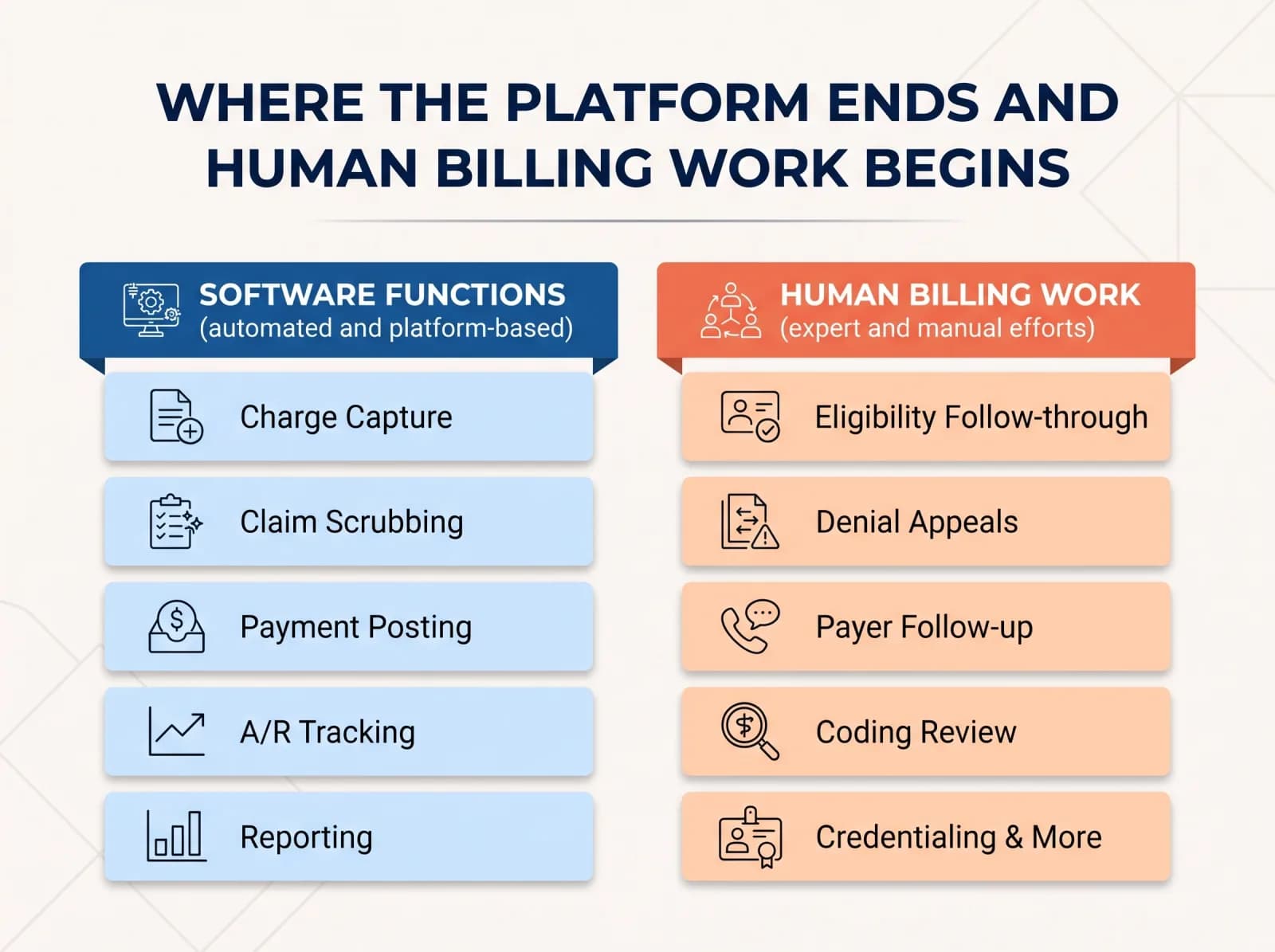 Medical Billing Vendor Selection
Tebra Billing: Software, Services, and How to Staff the Work
Tebra billing can mean the platform's billing module or a service that works inside Tebra. This guide separates the two and explains where software ends and human billing work begins.
Read article