

Specialty Medical Billing Services: How to Evaluate a Partner for Your Practice Workflow
A practical guide to evaluating specialty medical billing partners on coding workflow, payer mix, denial handling, reporting, and contract terms.

If you run a small independent practice — one specialty or a handful of providers across several locations — you have probably already noticed that most "specialty medical billing services" pages say the same things. They list your specialty in a dropdown, promise clean claims and faster payments, and never explain what they actually do differently for your workflow. The real question is narrower: does this partner understand how your specialty generates charges, where its claims tend to break, and who owns the follow-up when they do? This guide gives you a way to judge that before you sign.
What "specialty billing" should actually mean
Specialty fit is not a marketing label. It shows up in three concrete places:
- Coding and charge workflow. How charges are captured (encounter form, EHR template, superbill, procedure documentation), which code sets dominate, and where modifiers or documentation requirements routinely cause problems. A partner should be able to describe your charge flow back to you accurately.
- Payer mix and routing. Which payers you bill most, how claims and eligibility checks are submitted, and how authorizations are tracked. Authorization and visit-limit patterns can vary by specialty and payer, so confirm the specifics against current payer policy rather than taking them on faith.
- Reporting that matches your decisions. You need reporting by provider, payer, procedure and denial reason — not a generic dashboard. Ask what a monthly report would actually show for your practice.
If a vendor can't speak to all three in your specialty's terms, the "specialty" label is not meaningful.
Criteria to compare partners on
Compare candidates on verifiable process questions rather than promises. Ask each one the same set of questions and write down the answers.
EHR and system access
Will they work inside the EHR and practice management system you already use, or require a migration? Who holds the login, who can export data, and what happens to your records if you leave? A partner that runs the revenue cycle inside your existing systems reduces switching risk; one that insists on its own platform should explain why and what it costs to unwind.
Denial handling and A/R ownership
Ask who works denials, within what timeframe, and how appeals are documented. Ask who owns aged A/R — for example, what happens to older claims and whether follow-up is included or billed separately. Get the answer in writing. Ask candidates to describe their denial management and A/R management processes in the same level of detail.
Reporting and transparency
Request a sample report and a sample client dashboard. Ask how often data refreshes, whether you can see claim-level status, and how they report on denials by reason. Vague "real-time insights" claims are not a substitute for a sample.
Contract and exit terms
Check term length, notice period, fees for setup or data extraction, and who owns the billing records. These terms matter more than a slick sales deck.
Red flags in specialty billing marketing
Watch for these when you review proposals and websites:
- Unverifiable outcome claims. Percentage revenue gains or clean-claim figures with no named, approved case study behind them. Ask for the underlying client reference; if none can be shared, discount the number.
- Credentials you can't check. Certifications, accreditations or "preferred partner" status with no issuing body or documentation. Ask who granted it and when.
- Specialty lists with no depth. A page that names twenty specialties but can't answer a workflow question about yours is a lead-generation page, not a specialty service.
- Guarantees of payment or audit outcomes. Be wary of any partner that guarantees reimbursement or audit results.
- No named point of contact. Ask who your account manager will be and how escalations work.
For a broader set of buyer questions, see our guide on how to choose a medical billing company.
Matching partner size to practice size
The right partner profile depends on your scale and complexity, not on who has the biggest logo.
- Solo and small single-specialty practices. You likely need a named contact, predictable pricing and someone who will handle eligibility, claims and posting without a long onboarding. Ask how many accounts one manager carries.
- Growing practices. You need a partner that can absorb new providers and locations without renegotiating everything. Ask how credentialing and enrollment are handled when you add a provider — see our credentialing and contracting services.
- Multi-provider and multi-specialty groups. You need reporting by provider and specialty, clear division of work between your staff and theirs, and a process for handling different payer rules across service lines. Ask for an example of how they segment reporting for a group like yours.
Smaller partners can be excellent fits for small practices; larger firms may suit groups with complex payer mixes. Neither is automatically better. What matters is whether the partner's staffing model matches the volume and variety of your work.
What to do next
Before you take a meeting, write down your top three workflow pain points — for example, denials on a specific procedure, slow eligibility checks, or aged A/R you can't clear. Then ask each candidate to walk through how they would handle those three items specifically. If you want a second opinion on your current process, you can schedule a consultation or review our process to see what working together looks like.
Verification note
This article draws on general revenue cycle practice and the following sources:
- Medical Billing Company | Medical Healthcare Solutions: https://medicalhealthcaresolutions.com/
- 10 Best Medical Billing Services Reviewed for 2026: https://themedicalpractice.com/services/best-medical-billing-services/
No competitor performance data or search metrics were supplied for this article. Any payer policy, coding rule, filing deadline or authorization requirement mentioned here must be verified against current official payer and regulatory guidance before you rely on it.
Where this work connects
Related articles.
 Medical Billing Vendor Selection
How to Evaluate Specialty Medical Billing Services: A Neutral Checklist
A neutral checklist for comparing specialty medical billing vendors on process, coverage, reporting and marketing claims, built for practices and groups that have outgrown one-biller oversight.
Read article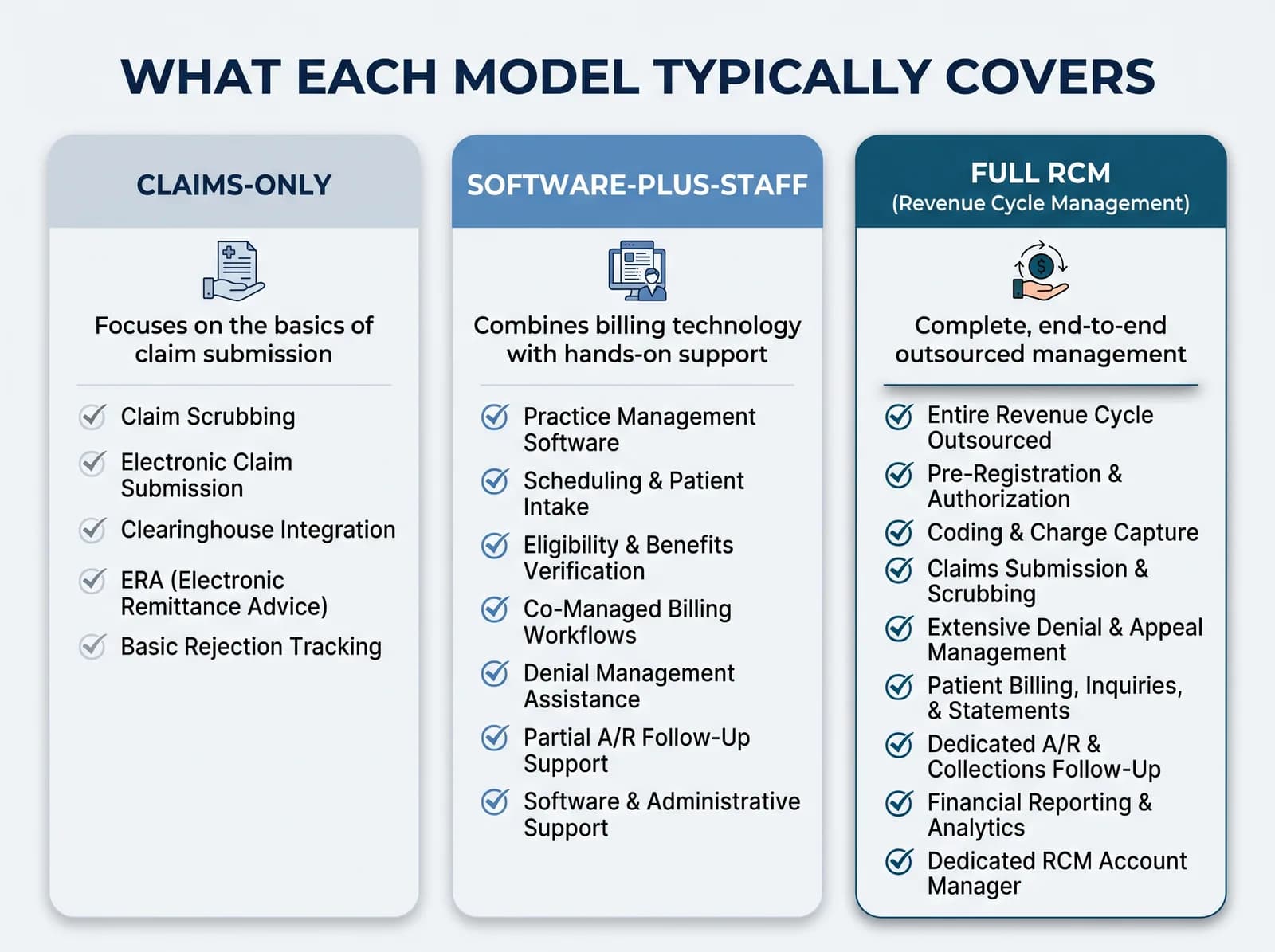 Medical Billing Vendor Selection
Billing Service Models Compared: Full RCM, Claims-Only and Software-Plus-Staff
A plain comparison of claims-only billing, full revenue cycle management and software-plus-staff, with scope tables and questions to ask before choosing a model for a growing practice.
Read article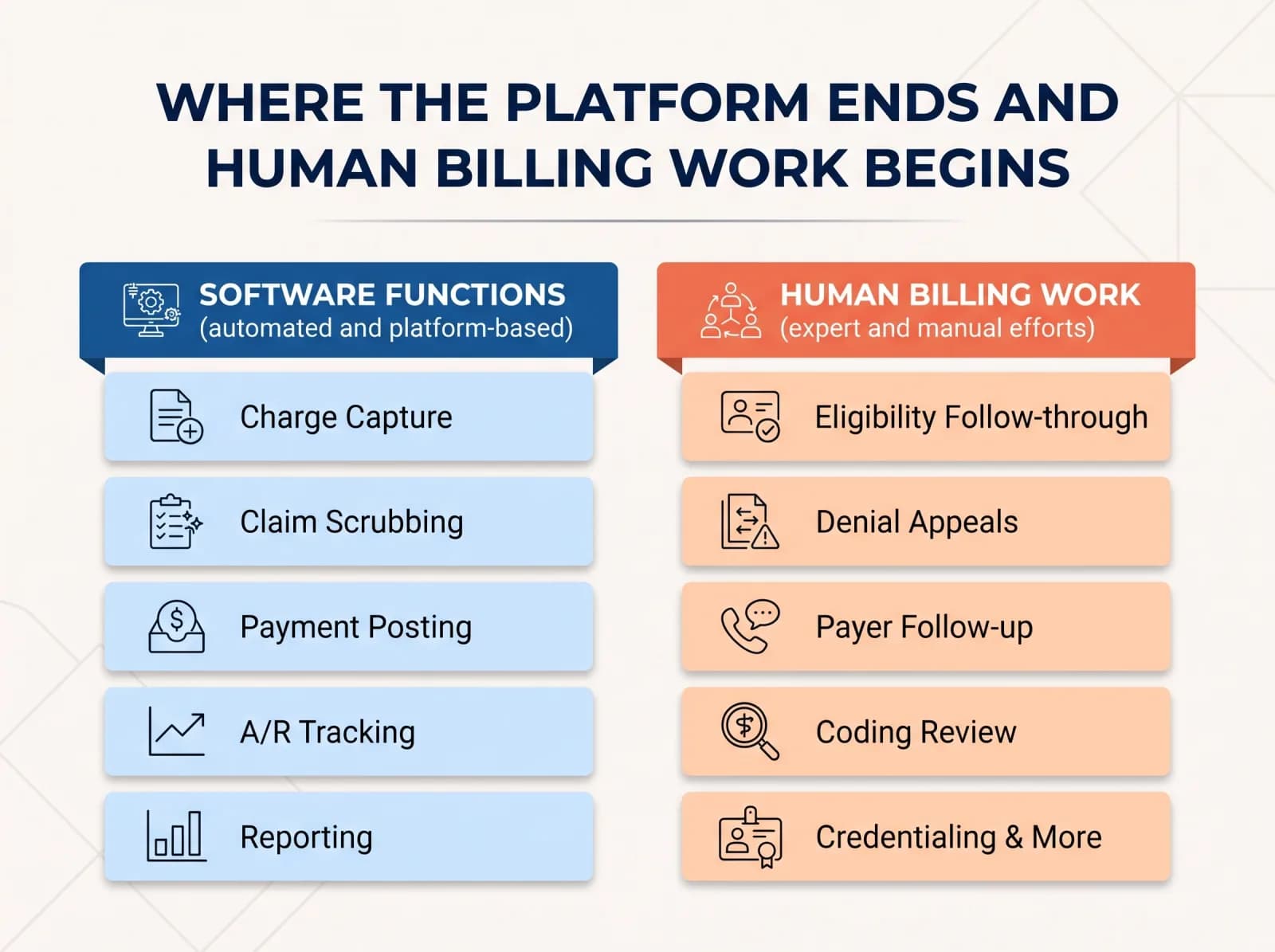 Medical Billing Vendor Selection
Tebra Billing: Software, Services, and How to Staff the Work
Tebra billing can mean the platform's billing module or a service that works inside Tebra. This guide separates the two and explains where software ends and human billing work begins.
Read article