

Outsource Insurance Eligibility Verification Services: A Practice Manager's Guide
A practical guide to outsourcing insurance eligibility verification: what benefits checks cover, status vs. benefit-level verification, vendor questions, and what to keep in-house.
If your front desk spends Monday morning with one phone on hold with a payer and the other hand checking in a walk-in, you already know where eligibility verification goes when the schedule gets busy: it gets done last, or it gets done as a status check. Outsourcing eligibility verification is worth considering when the work has outgrown the time your staff actually has — not because they are doing it wrong, but because eligibility is a queue-based, payer-by-payer task that competes with everything else happening at the window.
This guide is for practice managers and owners at independent practices deciding whether to outsource, what scope to buy, and how to tell a real benefits verification from a status ping.
What eligibility verification actually covers
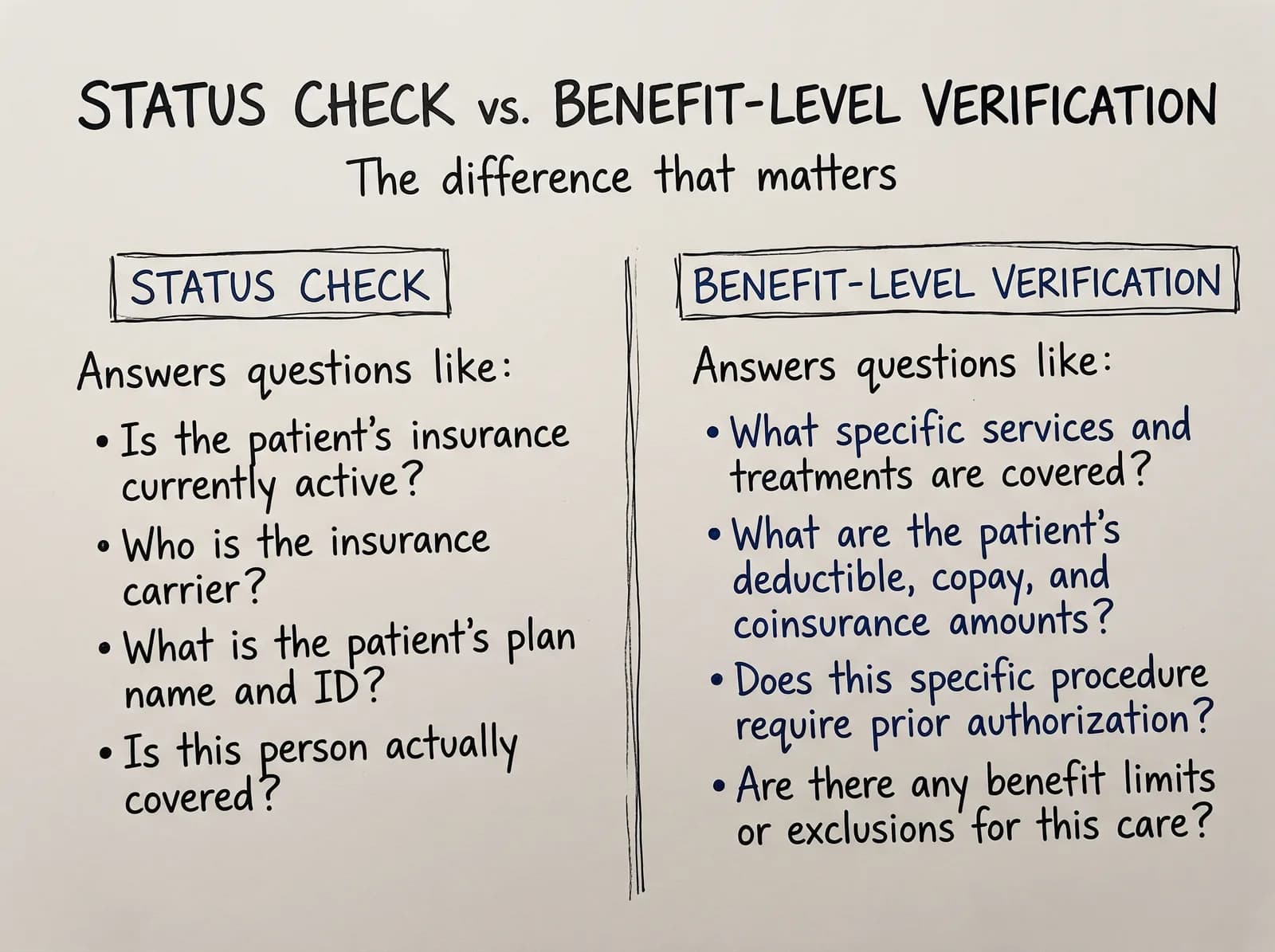
A status check answers one question: is the plan active on the date of service? A benefits verification answers the questions that help determine whether the visit gets paid and what the patient may owe, though what any payer returns can vary. A credible scope typically includes the following, though payer rules and plan structures vary and should be verified against current official guidance and the patient's plan documents:
- Coverage status and plan/product type — active, inactive, or terminated, and which product line (for example, a commercial plan versus a Medicare Advantage plan).
- Effective dates — including whether coverage begins or ends around the appointment date.
- Deductible and accumulator status — what has been met and what remains, where the payer makes it available.
- Copay and coinsurance — the patient's cost-share for the scheduled service category.
- Referral and authorization requirements — whether the payer requires a referral or prior authorization for the visit or service.
- Coordination of benefits — whether another payer is primary and which plan should be billed first.
Payer rules, filing requirements and benefit structures change and vary by plan. Anything a vendor or your staff reports should be verified against the payer's current official guidance and the patient's plan documents — not treated as a permanent rule. The items above are general industry practice, not a guarantee of what any specific payer will provide.
Why front-desk verification breaks down in a small practice
In a small office, the same person who verifies benefits also answers the phone, checks patients in, collects copays, and handles the schedule. Payer hold times are unpredictable. Portal logins differ by payer, and some portals time out or require separate credentials for each product line. A patient reschedules at 4:45 p.m. and the verification you did last week no longer applies.
This is a capacity and workflow problem, not a performance problem. The fix is usually to separate eligibility work from the front-desk queue — either by dedicating time and a defined process internally, or by handing the work to a service that does it on a schedule.
What an outsourced eligibility service should do
Ask any vendor to describe their process in plain terms. A credible service should be able to explain the items below; the eligibility and benefits verification service page is a useful reference for what a defined process looks like.
- How patient lists are received — a scheduled export, a shared file, or a report from your practice management system, and how often.
- Which sources are checked — electronic 270/271 transactions where available, payer portals, and phone verification when the electronic response is incomplete.
- How results are documented — a per-patient benefits summary that shows what was checked, what the payer returned, and the date checked.
- How exceptions are escalated — who is notified when coverage is inactive, a deductible is unmet, or an authorization is required, and how quickly.
- How turnaround is defined — for example, verification completed a set number of business days before the appointment, with a process for add-on and same-day patients.
Be cautious with any vendor that promises a specific reduction in denials or a percentage improvement in collections without tying those figures to a cited source and your own circumstances. Those outcomes depend on your payer mix, specialty, scheduling patterns and the rest of your revenue cycle. A service can commit to a process; it should not guarantee a payment result.
Status check vs. benefit-level verification: the difference that matters
This is the question that separates vendors, and it is worth raising early when you compare in-house and outsourced options. A status-only service is often less expensive because it is largely automated: a 270/271 transaction may return "active," and the file is closed. That answer is true but incomplete. It may not tell you that the patient has an unmet deductible, that the plan requires a referral, or that a secondary payer is primary. Payer responses and portal behavior vary, so confirm what a given transaction actually returns against current payer documentation; the description here is illustrative, not a rule.
Benefit-level verification typically takes longer because it requires reading the payer response, following up by portal or phone when the electronic response is thin, and documenting the details your front desk needs at check-in. When you compare quotes, ask directly: Does your standard service include deductible, copay, coinsurance, authorization requirements and coordination of benefits, or only active/inactive status? Ask to see a sample benefits summary with patient identifiers removed. If a vendor cannot produce one, that is a relevant consideration.
How eligibility work connects to scheduling and patient responsibility
Verification output is only useful if it changes what happens next; where an authorization is required, see prior and retro authorization. A completed benefits summary should feed three decisions: whether the appointment can proceed as scheduled, whether a referral or prior authorization needs to be started before the visit, and what the front desk should tell the patient about cost-share at check-in. Practices that verify early enough may be able to move a patient to the right provider, start an authorization, or have a cost conversation before the patient arrives — rather than discovering a problem at the window. Keep cost conversations factual and based on the payer's response; they are not a quote or a guarantee of what the patient will owe.
Questions to ask an eligibility verification vendor
- Which data sources do you use, and what happens when the electronic response is incomplete?
- What does the documentation look like, and how is it delivered to my staff?
- Who do you contact when coverage is inactive or an authorization is required, and how fast?
- What is your turnaround commitment, and how do you handle add-on or same-day appointments?
- How are your staff trained on payer portals and plan changes, and how do you keep that current?
- What HIPAA safeguards apply to patient data in transit and at rest?
- What reporting do I receive — volume verified, exceptions found, turnaround — and how often?
- How do you handle payer policy or portal changes?
Verify vendor claims independently: ask for references, check whether their described process matches the sample documentation, and confirm any compliance statements directly. The questions above overlap with the process items in the earlier section; use both together when comparing vendors. You can also review our guide to choosing a medical billing company for a broader evaluation framework. Statements about 270/271 transactions, payer portal behavior and coordination of benefits ordering are general and illustrative, not citable rules, and should be checked against current payer and CMS guidance before you rely on them; no external citations are provided here.
What to keep in-house and what to hand off
Outsourcing does not have to be all or nothing. Some practices hand off all front-end verification; others start with new patients only, or use a service as overflow during busy weeks. The right scope depends on your volume, your payer mix and how much of the work your staff can reliably complete before the appointment. Typical in-house tasks include patient check-in, cost-share conversations and same-day schedule changes, while outsourced tasks often include scheduled eligibility checks, benefits documentation and exception escalation. If you are still deciding whether to outsource at all, our in-house vs. outsourced comparison walks through the trade-offs.
How Knight Medical Billing handles eligibility and benefits verification
Knight Medical Billing runs eligibility and benefits verification as part of the revenue cycle, working within the systems your practice already uses. Our eligibility and benefits verification service is built around a defined process: patient lists are received on a schedule, coverage is checked through electronic transactions, payer portals and phone verification where needed, and results are documented per patient with exceptions escalated to your staff. We describe this as a process commitment, not a guarantee of payment or reimbursement, and outcomes depend on your payer mix, specialty, scheduling patterns and the rest of your revenue cycle. We do not promise specific denial reductions or collection improvements. Related front-end work, including prior and retro authorization, can be scoped alongside verification if your payers require it.
Next steps for practice managers
Before you call vendors, do three things: document your current verification volume and where it breaks down (hold times, missed checks, last-minute schedule changes); gather two or three sample benefits summaries from your own staff or a vendor; and write down the scope you need — status only, or benefit-level detail. Then schedule a workflow conversation. There is no obligation, and the goal is to compare your current process against a defined one. You can contact us or schedule a conversation when you are ready.
Where this work connects
Related articles.
 Medical Billing Vendor Selection
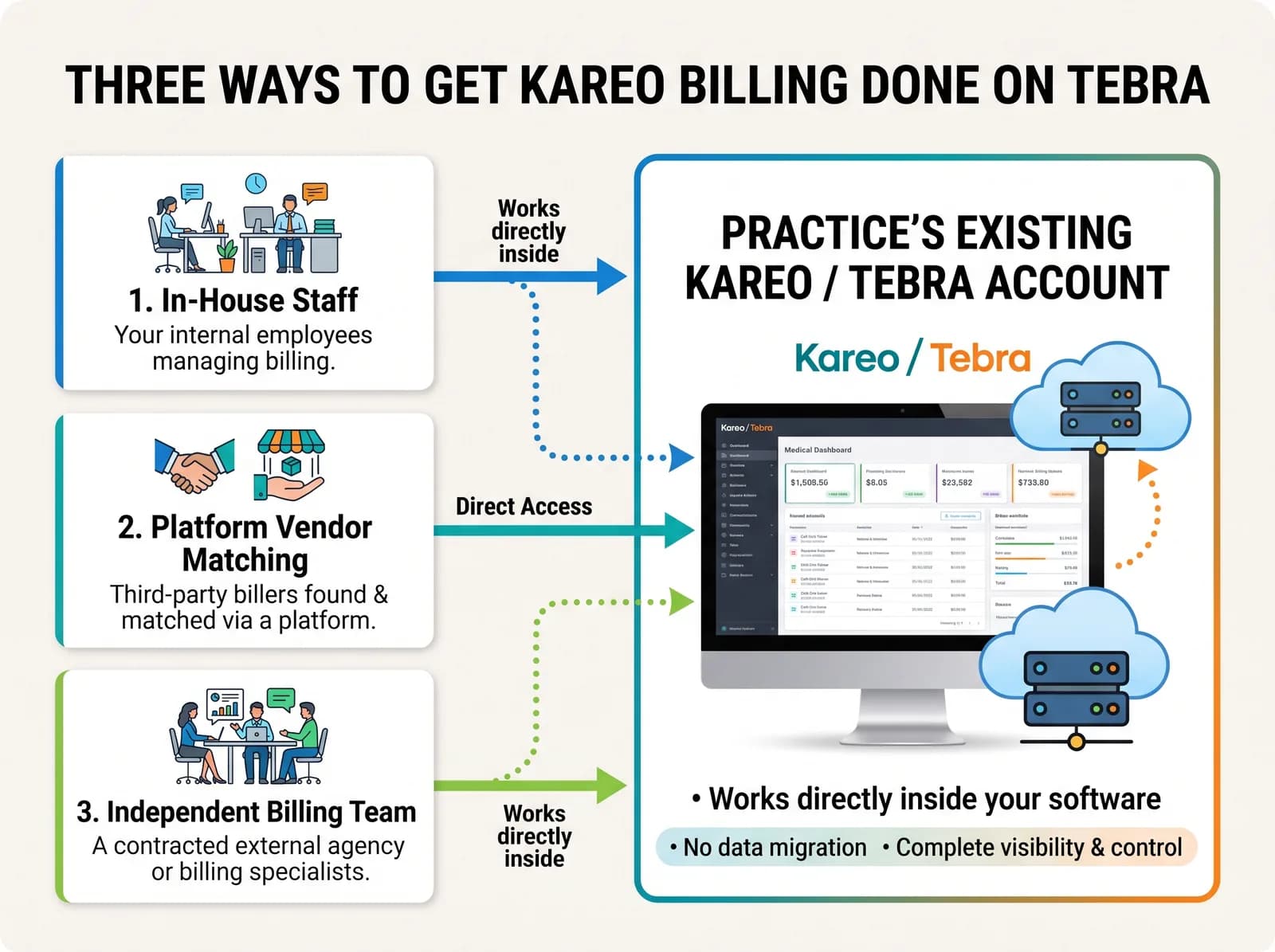
Kareo Billing Service: How Outsourced Billing Works Inside Your Account
Kareo is now Tebra, but practices still search the old name. Here is how an independent billing team works inside your existing Kareo/Tebra account, what stays with your practice, and what to verify before signing.
Read article Medical Billing Vendor Selection
Urgent Care Billing Services: A Buyer's Guide for High-Volume Clinics
A practical buyer's guide to urgent care billing services for high-volume clinics, covering eligibility, charge capture, denial follow-up and the questions to ask before you sign.
Read article Medical Billing Vendor Selection
How to Evaluate Specialty Medical Billing Services: A Neutral Checklist
A neutral checklist for comparing specialty medical billing vendors on process, coverage, reporting and marketing claims, built for practices and groups that have outgrown one-biller oversight.
Read article