

Medical Billing Software vs. Billing Service: Which Fits?
A practical comparison of in-house medical billing software and outsourced billing services, covering what each includes, how costs differ, and the staffing questions practices often overlook.
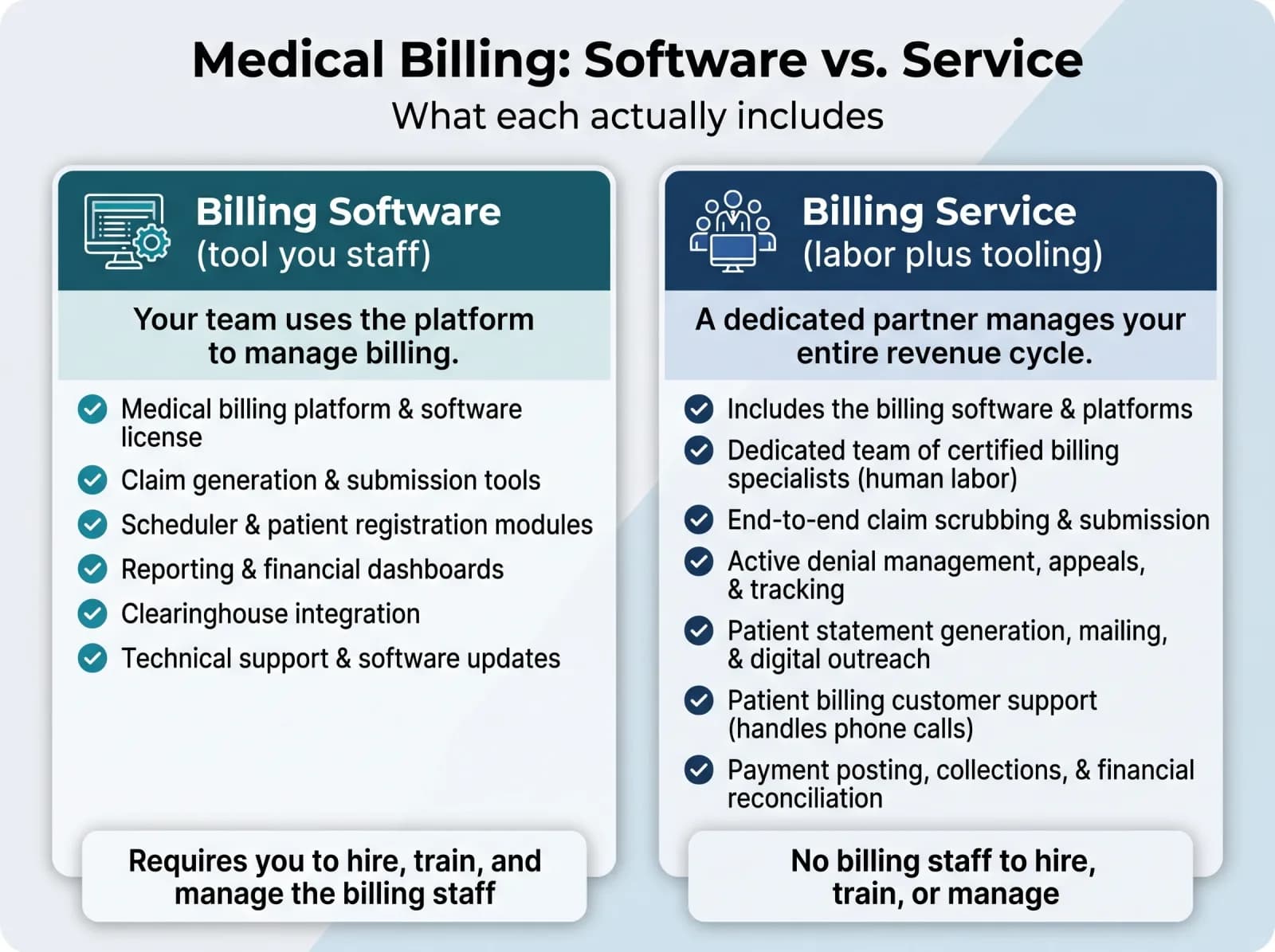
Most independent practices eventually reach the same fork in the road: keep billing in-house with medical billing software, or hand the work to a billing service. The question is rarely about which option is better in the abstract. It is about which one fits your patient volume, your payer mix, your staff, and how much of your week you want to spend managing the revenue cycle instead of the practice. This guide compares medical billing software vs. a billing service: what each option actually includes, how the costs compare, and the staffing realities that software marketing tends to leave out.
Medical billing software vs. billing service: what each actually includes
The single most common mistake in this decision is comparing a software subscription to a billing service as if they were the same kind of purchase. They are not.
Billing software is a tool
When you buy medical billing software, you are buying a platform: claim creation, clearinghouse connectivity, payment posting screens, an aging report, and usually a patient statement module. What you are not buying is the labor to operate it. Someone on your team still has to enter charges, scrub claims, work denials, call payers, post payments, and chase the aging report every week. The software makes that work possible; it does not do it.
A billing service is labor plus tooling
An outsourced billing company brings its own practice management and clearinghouse stack, plus the people who run it. A full-service arrangement typically covers charge entry, claim submission, denial management, payment posting, and accounts receivable follow-up. Many also offer eligibility and benefits verification and credentialing support, though you should confirm exactly what is included rather than assume it.
The practical distinction is this: with software, you buy capacity you must staff; with a service, you buy an outcome someone else is accountable for delivering.
Cost structures to compare
Pricing models differ enough that a straight line-item comparison is misleading. Here is how the common structures work, without quoting specific rates, since those vary by specialty, volume, and contract terms.
Percentage of collections
The billing company takes a percentage of what it collects. The appeal is alignment: the service earns more when you collect more. The tradeoff is that the percentage applies to all collections, including clean claims that required little work. Ask what happens to patient payments, self-pay balances, and out-of-network collections, because those are sometimes treated differently.
Per-claim or per-encounter pricing
You pay a flat amount per claim or encounter submitted. This is predictable and easy to budget, but it can penalize you if your claims require heavy follow-up, and it may create an incentive to submit volume rather than resolve denials. Ask how reworked or resubmitted claims are billed.
Subscription or license fees for software
Software is usually a monthly subscription, sometimes tiered by provider count or features, plus clearinghouse fees and possibly implementation costs. The subscription is only part of the true cost, because it excludes the salary, benefits, and management time of the staff who operate it.
For a fuller breakdown of how these structures interact, see our guide to how medical billing pricing works. Whatever model you are quoted, ask for the total cost of ownership over twelve months, including software, clearinghouse, staff time, and any fees for statements, portals, or special projects.
Staffing, training and turnover considerations
This is where in-house software decisions most often go wrong. The subscription looks affordable because the labor is invisible on the invoice.
Billing is a skilled role. A competent biller needs to understand payer-specific rules, claim edits, denial reason codes, and appeal processes, and that knowledge takes months to build. If your biller leaves, you are hiring and retraining while claims age. An unfilled billing position can stall cash flow, and the aging report does not pause while you recruit.
Consider the full labor picture before deciding:
- Coverage during absence. Who works denials when your biller is on vacation or out sick?
- Cross-training. Can a front-desk staffer step in, or does the work simply wait?
- Payer rule changes. Who tracks policy updates and adjusts workflows? This is ongoing work, not a one-time setup.
- Management overhead. Someone has to supervise, audit, and hold the biller accountable, and that is usually the practice manager or owner.
- Software maintenance. Upgrades, clearinghouse changes, and configuration issues consume time that is easy to underestimate.
None of this means in-house billing is wrong. A practice with steady volume, a stable and experienced biller, and a manager who understands the revenue cycle can run it well. But the decision should account for the labor honestly, not just the subscription line.
Questions to ask before choosing
Use this checklist to pressure-test either direction. Write down your answers; the gaps will tell you where you need more information.
About your own operation
- What is our current days-in-A/R, and how has it trended over the last six months?
- What percentage of our claims are denied, and how many are we actually appealing?
- Do we have a biller we trust, and what is our plan if they leave?
- How many hours per week does the owner or manager currently spend on billing issues?
- Is our volume growing enough that today's workflow will not scale?
About the software or service
- Exactly which tasks are included, and which are extra?
- How are denials and appeals handled, and who owns follow-up?
- What reporting will we receive, and how often?
- What are the contract term, notice period, and termination terms?
- How is data migrated if we switch, and who owns the data?
- Can you show references from practices similar to ours in size and specialty?
For a structured comparison framework, our in-house vs. outsourced billing comparison and buyer's guide to choosing a billing company go deeper on evaluation criteria. If you want to quantify what poor billing may be costing you today, the revenue leak calculator is a reasonable starting point.
What to do next
There is no universal right answer here, and anyone who tells you otherwise is selling something. The right choice between medical billing software and a billing service depends on your volume, your payer mix, your staff stability, and your appetite for managing the work.
If you would like a second opinion, we are happy to review your current setup and talk through the tradeoffs without a sales pitch. You can schedule a conversation or contact us with questions. If you are leaning toward outsourcing, our complete RCM services page outlines what a full-service arrangement typically covers.
Disclaimer and verification
This article is a practical planning guide based on general revenue cycle operations. It does not cite external statistics, and no specific pricing figures, payer policies, or coding rules are asserted here. Any payer-specific requirement, filing deadline, or coding rule you encounter should be verified against current official payer and regulatory guidance before you act on it. Pricing structures and contract terms vary by vendor and specialty; confirm details directly with any software provider or billing company you evaluate.
Where this work connects
Related articles.
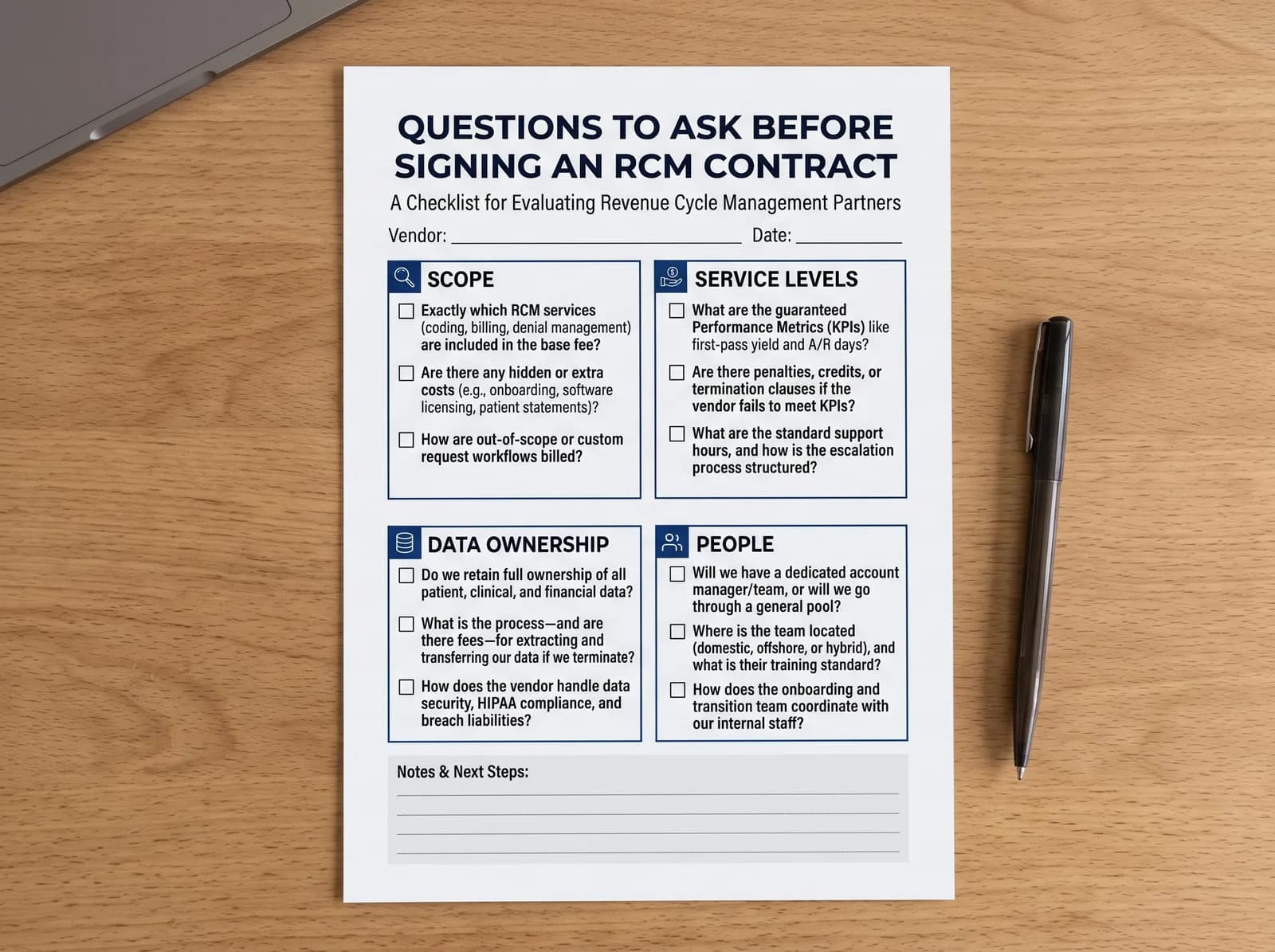 Medical Billing Vendor Selection
How to Compare Revenue Cycle Management Companies for Independent Practices
A neutral framework for comparing revenue cycle management companies side by side, from reporting and denial handling to contract questions and red flags.
Read article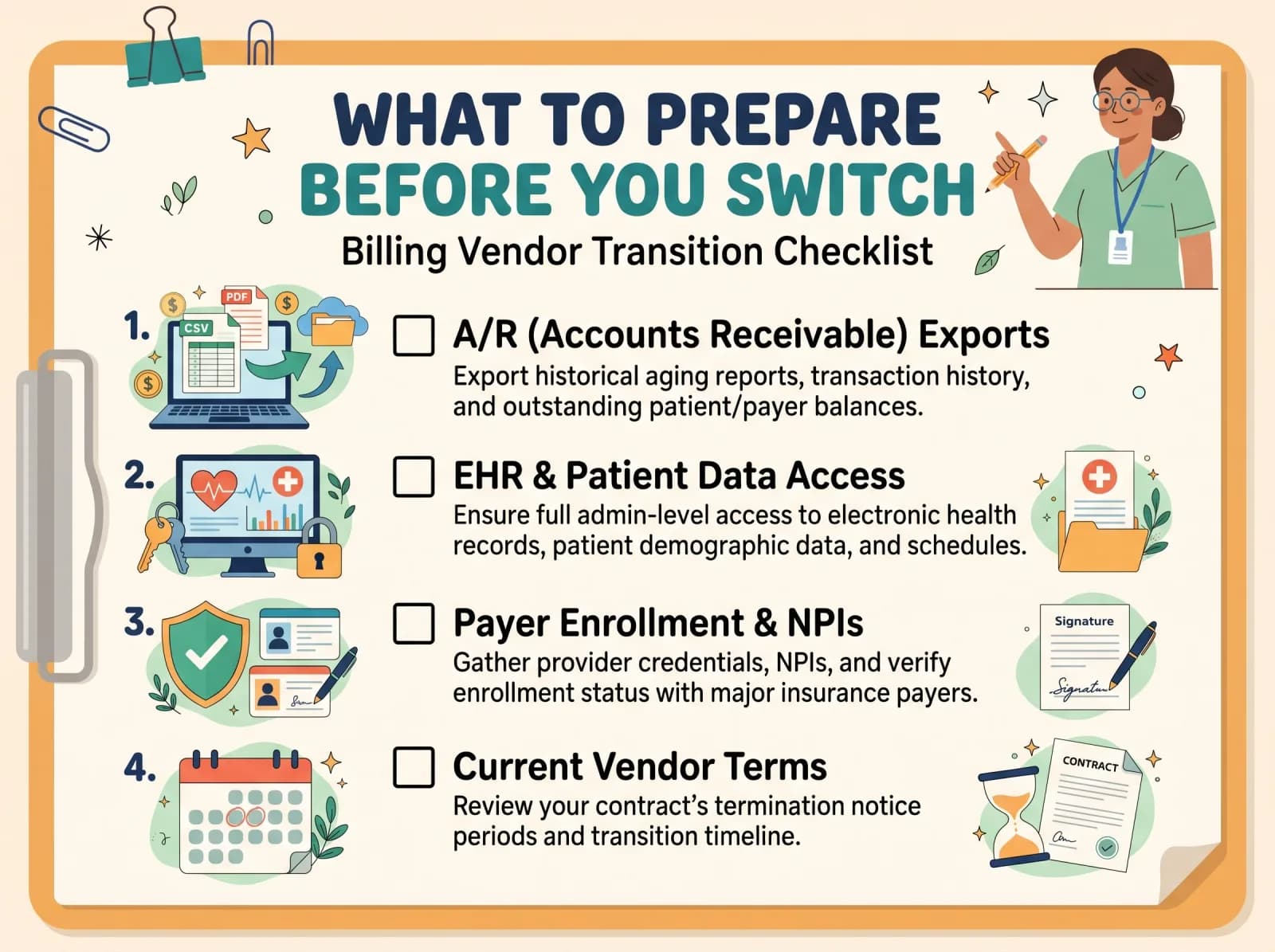 Medical Billing Vendor Selection
Medical Billing Outsourcing: A Practical Guide for Independent Practices
Read article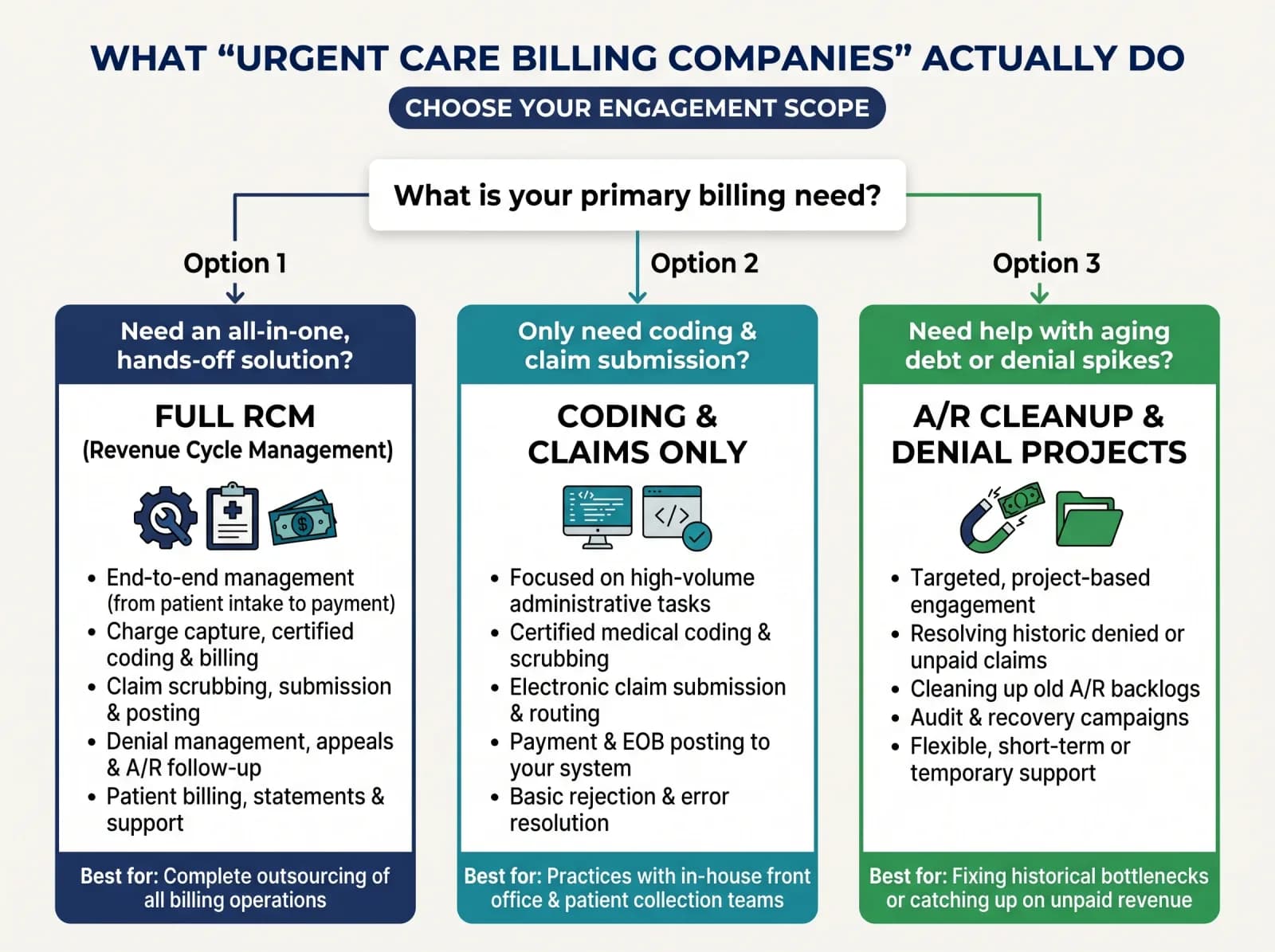 Medical Billing Vendor Selection
Urgent Care Billing Companies: A Buyer's Guide
A practical buyer's guide to urgent care billing companies: what these vendors actually do, which coding and claim questions to ask, how to read 'top 10' lists, and how to evaluate, price and transition a partner.
Read article