

Signs Your Practice Has Outgrown In-House Billing
A practical self-diagnostic for independent practices: spot the structural warning signs that in-house billing has outgrown its capacity, and decide whether to invest internally or change model.
If you run billing in-house and something feels off — cash is tighter than the schedule suggests, denials keep landing on the same codes, your biller is buried — the instinct is often to assume someone isn't working hard enough. In most independent practices, that's the wrong diagnosis. Growth in providers, payers, and visit volume can strain staffing and tooling before it strains effort. The question worth asking isn't "who's failing?" but "has the work outgrown in-house billing's structure?"
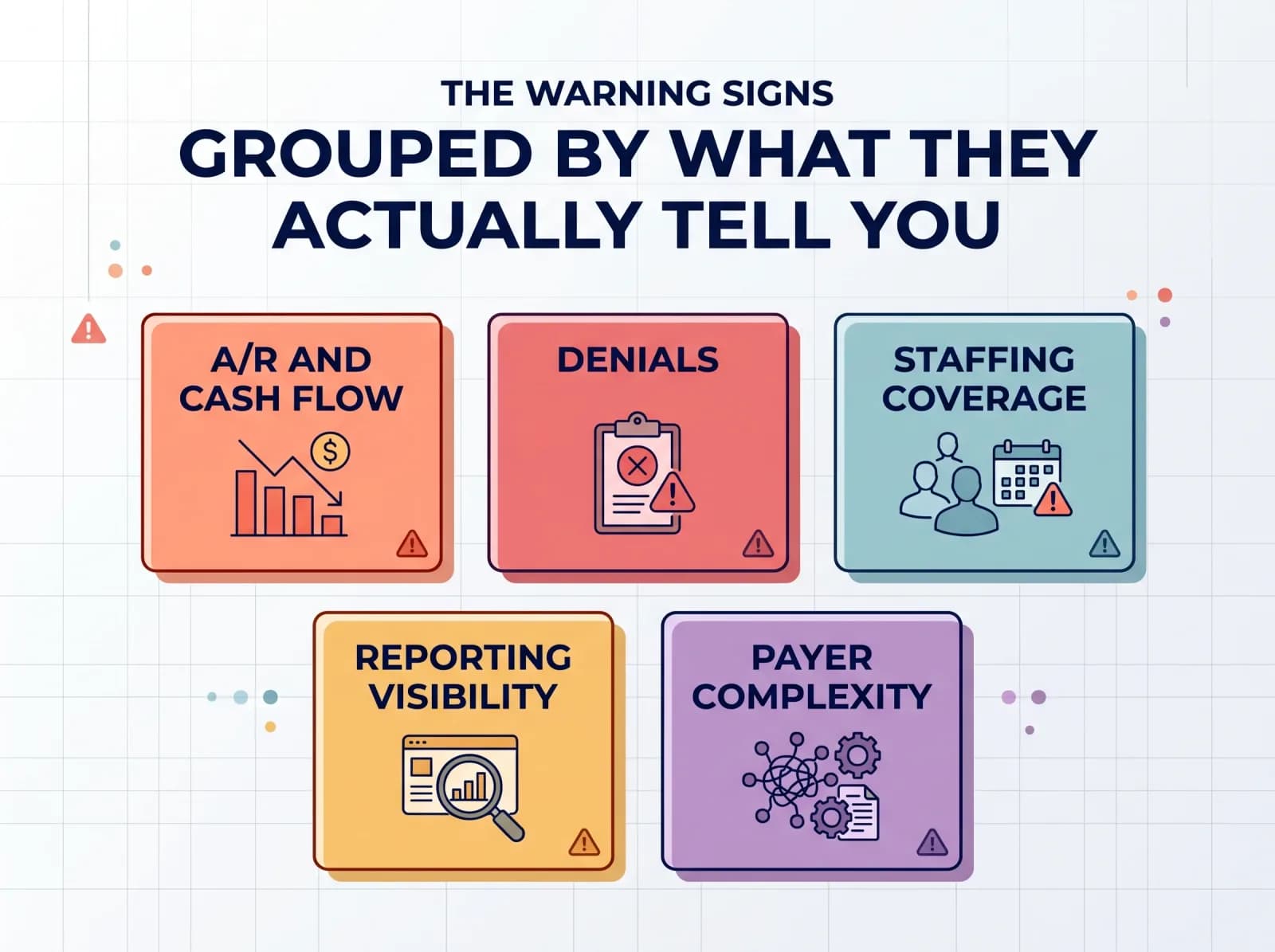
This is a self-diagnostic. It won't tell you to outsource. It will help you decide whether the problem is fixable internally or a signal to change model — and give you something concrete to bring to your partners. The warning signs fall into five categories: cash-flow and A/R signals, denial and rejection patterns, staffing and coverage, reporting visibility, and process and payer complexity.
Why "outgrowing" billing is usually structural, not a staff failure
A billing operation built for two providers and a handful of payers is a different machine from one serving eight providers across a dozen contracts. The work multiplies in ways that aren't obvious from the outside: more eligibility checks, more prior authorizations, more payer-specific denial patterns, more credentialing upkeep, more reporting to reconcile — all of which can strain a small team. A single experienced biller may absorb some of that through sheer effort — until they can't, and the cracks can show up as aging A/R, not as a performance review problem.
Reframing the issue this way matters. It keeps you from replacing a competent person when the real gap is capacity, and it keeps you from assuming a new hire alone will fix a tooling or process-coverage problem.
The warning signs, grouped by what they actually tell you
A flat checklist of symptoms is easy to skim and hard to act on. Grouping signals by root cause helps you map what you're seeing to what's actually broken.
Cash-flow and A/R signals
Money that's slow, stuck, or quietly written off. These point to follow-up capacity and posting accuracy.
Denial and rejection patterns
Rising or clustered denials, repeat root causes, slow appeals. These point to bandwidth and payer-specific process coverage.
Staffing and coverage
Key-person dependency, gaps during vacation or illness, turnover. These point to structural fragility.
Reporting visibility
No timely, reliable view of collections, denials, or payer mix. This limits any model, in-house or outsourced.
Process and payer complexity
New contracts, new specialties, or new payers may outpace the team's ability to keep up with payer policy changes.
Cash-flow and A/R signals that suggest outgrown in-house billing capacity
You don't need external benchmarks to spot a trend — compare against your own history. Pull these from your practice management system:
- Aging distribution. Is the share of A/R sitting in older buckets creeping up quarter over quarter? A growing tail can be a sign that follow-up is falling behind.
- Days in A/R trend. Track it monthly against your own prior year. A steady climb, rather than a single bad month, may be the signal.
- Unapplied payments. A growing unapplied cash balance can indicate that posting is backlogged or reconciliation is breaking down.
- Write-offs. Are you writing off balances that were collectible but simply aged out? That may be a capacity symptom disguised as a policy decision.
None of these numbers has a universal "good" value. What matters is direction and whether you can explain the movement.
Denial and rejection patterns that suggest in-house billing capacity is strained
Denials happen in every practice. The pattern is what tells you something. Watch for denials clustering on the same handful of codes or payers, repeat root causes that never get fixed, and appeals that sit untouched because no one has time. Those can suggest the team lacks bandwidth or payer-specific process coverage — not that they don't care. For a deeper look at why denials happen and how to trace them, see our in-house vs. outsourced medical billing comparison and our denial management services for independent practices.
Staffing, coverage, and key-person risk in in-house billing
Ask a blunt question: if your primary biller were out for two weeks, what happens? If the honest answer is "everything stops," you have key-person risk regardless of how good that person is. Other structural signals can include turnover that forces repeated retraining, difficulty keeping pace with payer policy changes, and a team so consumed by daily work that no one has time to document processes or fix root causes. These can be signs that the operation depends on individuals rather than a system.
Reporting blind spots: when in-house billing can't see the problem
If you can't get a timely, reliable report on collections, denials, and payer mix, that's a signal in itself. You can't manage what you can't see, and this limitation follows you into any model. A practice that outsources without fixing its reporting expectations simply moves the blind spot. Reliable reporting is often a prerequisite, not a nice-to-have — see our revenue performance reporting services.
A simple self-assessment: scoring what you find about in-house billing
Note how many of the five categories above apply to you, and note severity — occasional, recurring, or chronic. There is no universal scoring instrument or published threshold that says "at four categories, outsource." The cutoff is your own judgment, informed by how much the issue is costing you in cash timing and management attention. Treat the score as a conversation starter, not a verdict.
Your options if you recognize outgrown in-house billing
There are three forks, and none is automatically right:
- Invest internally. Add a hire, add tooling, document processes, and build redundancy. This preserves control but takes time to recruit and train, and the capacity ceiling returns as you grow.
- Outsource. Shifts operational load and payer expertise to a partner. Requires clear reporting expectations and a clean transition plan.
- Hybrid. Keep some functions in-house and move others — often denials, A/R follow-up, or credentialing — to a partner.
For a neutral side-by-side, read in-house vs. outsourced medical billing. If you're weighing a partner, our guide to choosing a medical billing company covers what to compare.
How to build the internal case for changing in-house billing
Bring your partners the trend data, not a complaint: the A/R aging shift, the denial clusters, the key-person exposure. Present the three options with their tradeoffs and timelines. Before committing, verify payer-specific rules and any regulatory requirements against current official guidance, and confirm your own numbers are complete. This article is general operational guidance, not coding, legal, or clinical advice.
What to do next if in-house billing has outgrown your practice
If this checklist confirmed a suspicion, the next step is a low-pressure conversation — not a sales pitch. We're happy to review your A/R and denial trends with you and talk through whether in-house, outsourced, or hybrid fits where you're headed. Contact us or schedule a consultation when you're ready.
Related articles.
 Revenue Cycle Management
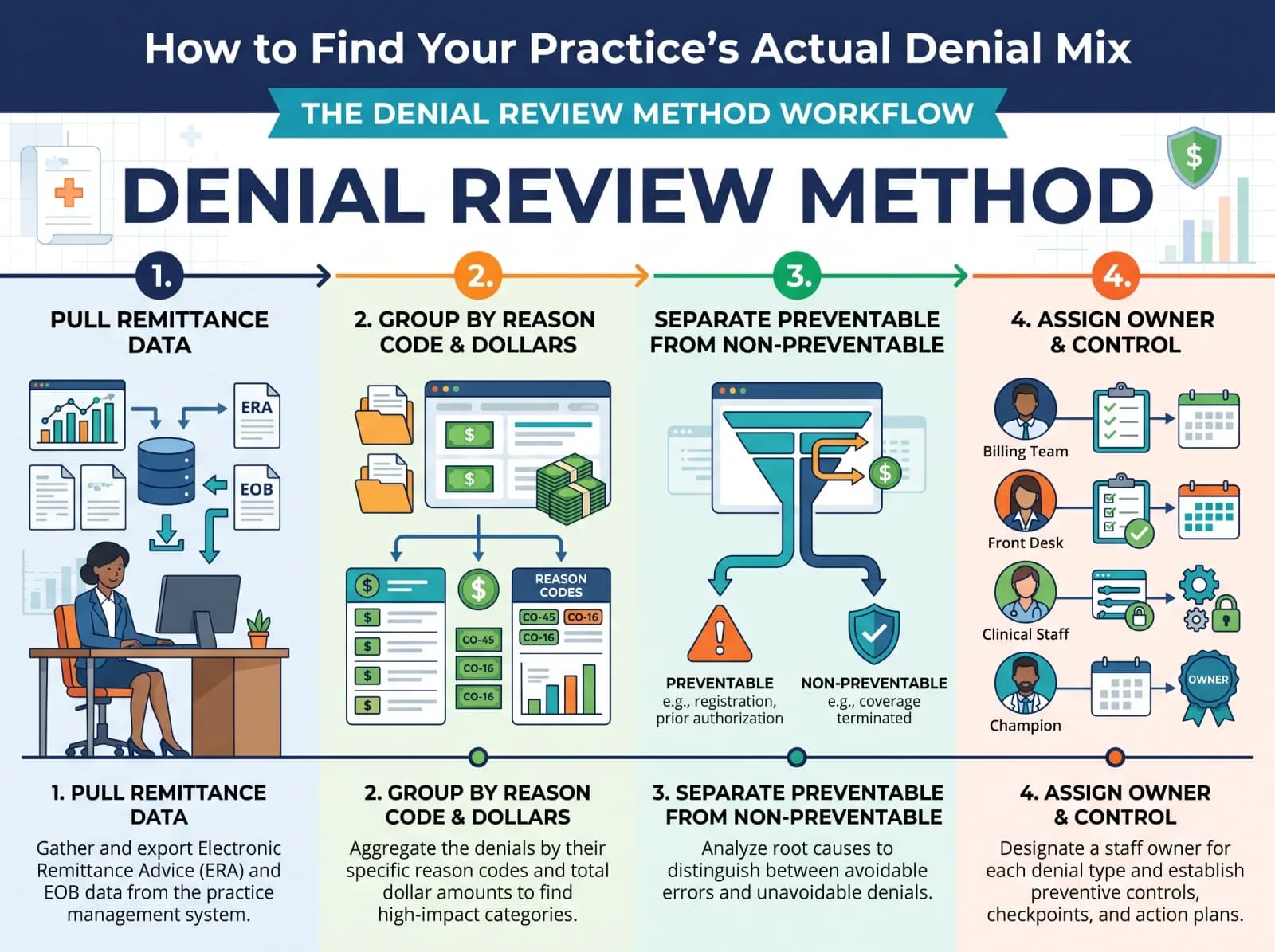
What Causes Medical Billing Denials? A Revenue Cycle Guide
A practical guide to the front-end, mid-cycle, and payer-side causes of medical billing denials, plus a method for finding your practice's own denial mix and assigning owners, controls, and metrics.
Read article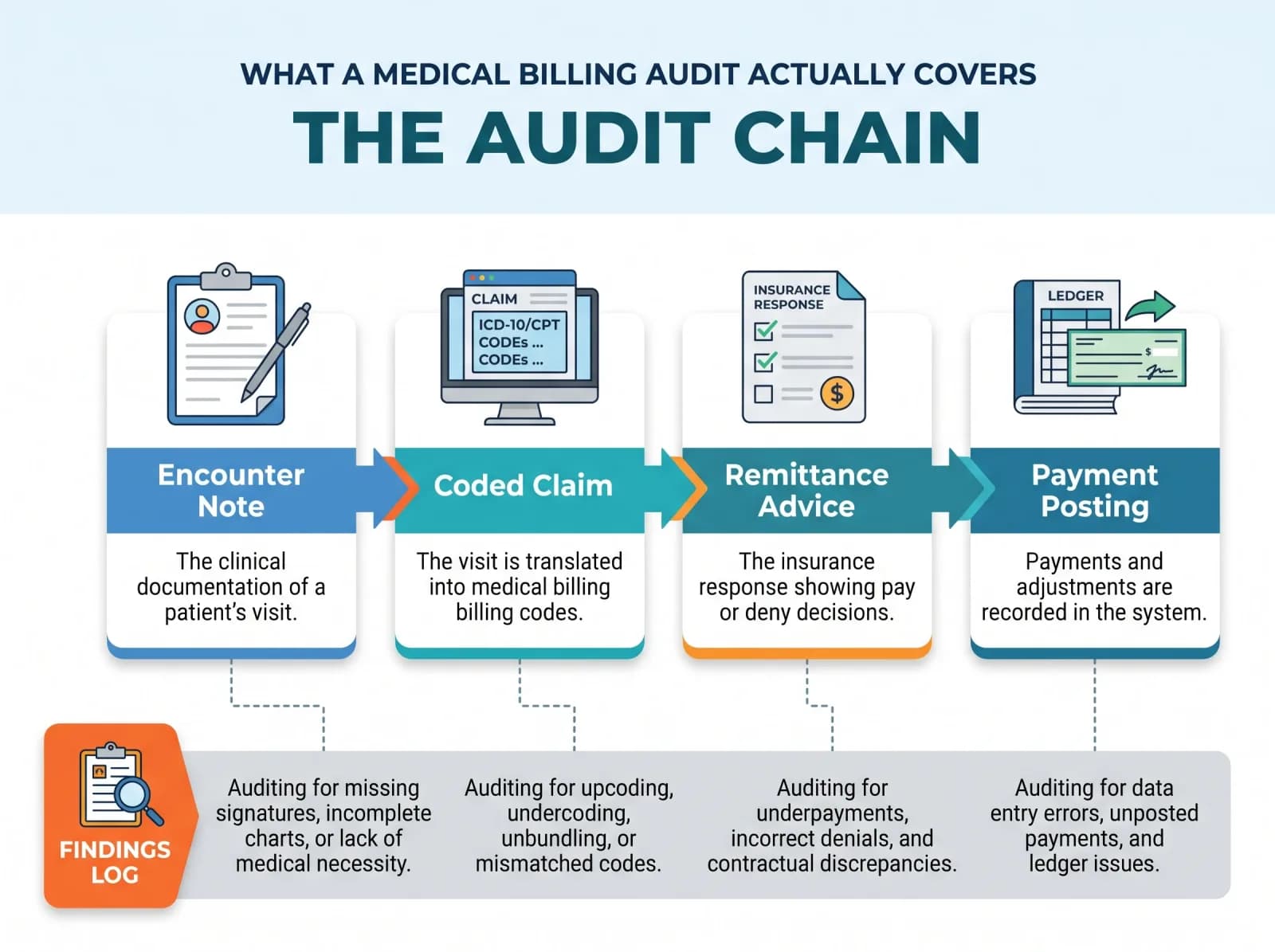 Revenue Cycle Management
Medical Billing Audit: A Practical Guide for Independent Practices
A practical guide to medical billing audits for independent practices: what an audit covers, how to build a repeatable internal process, and how to respond to payer requests.
Read article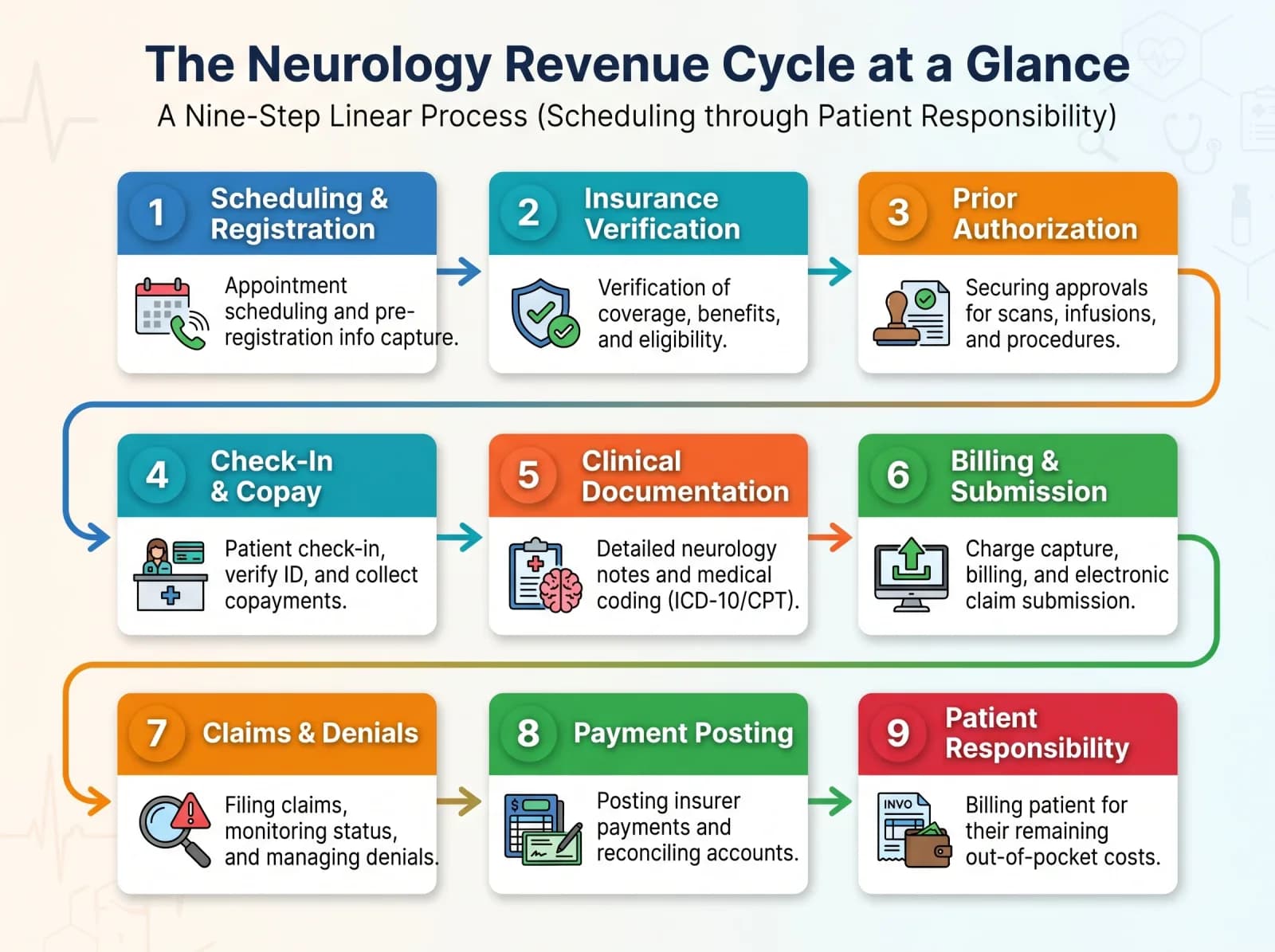 Revenue Cycle Management
Neurology Medical Billing: A Practical Process Guide
A practical map of the neurology revenue cycle, from eligibility and authorization through charge capture, denial review, and patient collections, with process checks a practice manager can own.
Read article