

How to Compare Revenue Cycle Management Companies for Independent Practices
A neutral framework for comparing revenue cycle management companies side by side, from reporting and denial handling to contract questions and red flags.
Most independent practices start comparing revenue cycle management (RCM) companies by asking "what's your percentage?" That single number tells you little about which vendor will actually collect more of what you are owed. Two companies can quote the same rate and still produce very different results depending on how they handle denials, eligibility checks, credentialing and reporting. This guide offers a neutral framework for comparing RCM vendors side by side, so you can shortlist fairly before you sit down for consultations.
What to compare beyond price per claim when evaluating RCM companies
Price matters, but it's one line in a much longer comparison. Build a criteria checklist and score every vendor against the same criteria. That way you are comparing like with like instead of reacting to whichever sales pitch was most polished.
Reporting and transparency
Ask what reports you will receive, how often, and whether you can see the underlying detail. A vendor that only sends a monthly summary may be harder to hold accountable than one that shows charges, payments, adjustments, denials, and aging by payer. Look for reporting that ties to your own practice management system so you can reconcile independently. Our revenue performance reporting page shows the kind of metrics worth requesting.
Denial handling
Denials are where revenue quietly leaks. Ask how denials are worked, who appeals them, how quickly appeals are filed, and whether appeal work is included or billed separately. A vendor that treats denial follow-up as an add-on may leave more revenue uncollected. Compare how each company describes its denial management process and whether it tracks denial reasons over time.
EHR and software fit
Does the vendor work inside your existing EHR, or require you to switch? Can they pull data directly, or will you be exporting spreadsheets? Integration friction can be a real cost. If you are unsure whether you need software, a service, or both, our guide on in-house vs. outsourced billing is a useful starting point.
Credentialing and contracting support
Reimbursement generally depends on being properly credentialed and contracted. Ask whether credentialing, payer enrollment and revalidation are in scope, and whether they are included or priced separately. Compare how each vendor handles credentialing and contracting, including who owns the paperwork and timelines.
Eligibility and front-end checks
Clean claims generally start before submission, with accurate front-end data. Ask how the vendor verifies eligibility and benefits, and whether that happens before or after the visit. Front-end verification may help reduce denials downstream, so it belongs in your comparison even if it feels like a back-office detail.
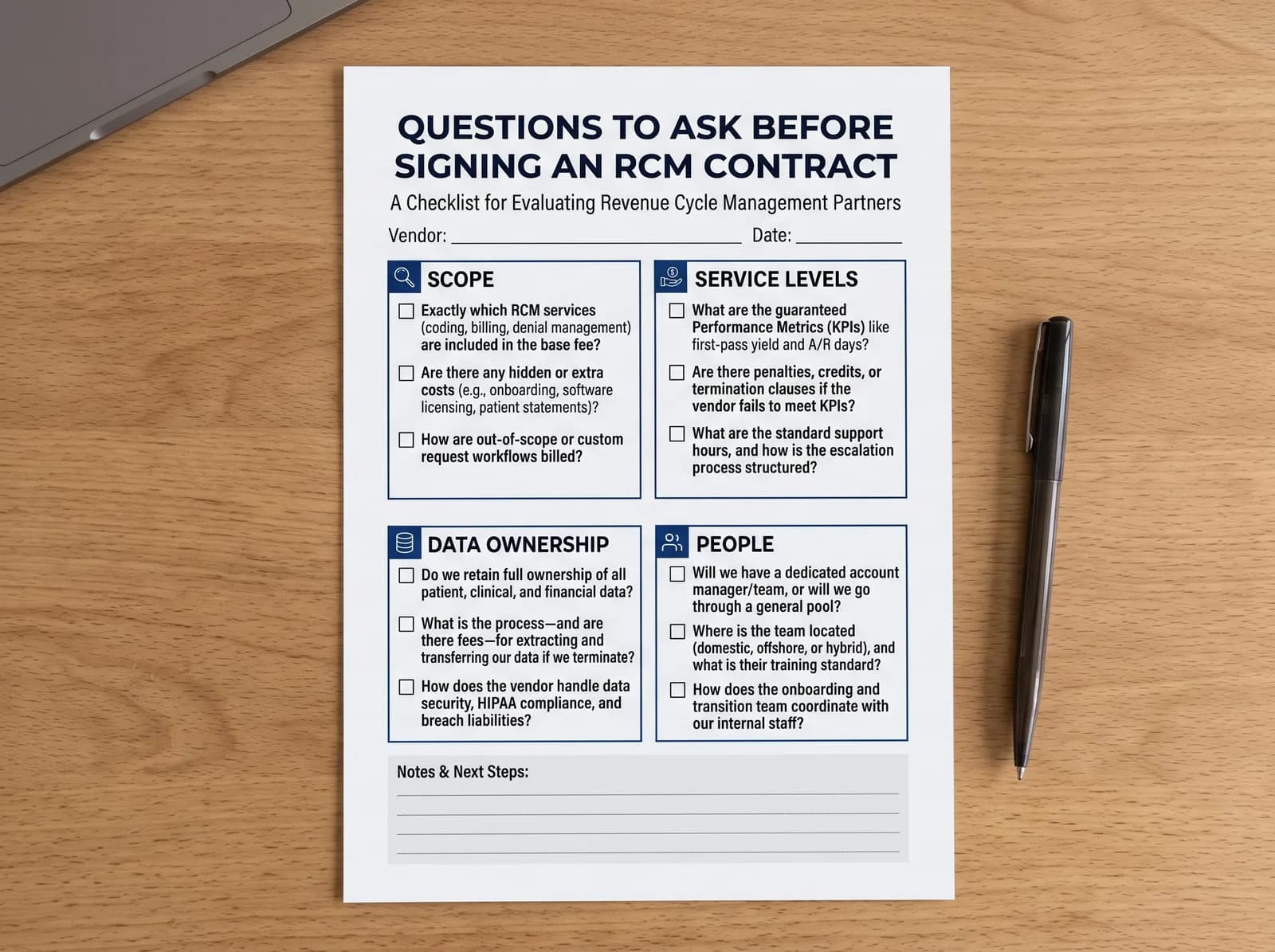
Questions to ask before signing an RCM contract
Bring the same question list to every vendor and write down the answers. Consistency is what makes a comparison fair.
Scope and exclusions
- Which services are included, and which cost extra? (Appeals, patient statements, credentialing, prior authorization, out-of-network negotiation.)
- What happens to claims already in progress when we start?
- Who handles patient phone calls about bills?
Service levels and accountability
- What turnaround times do you commit to for claim submission, denial follow-up and payment posting?
- How do you measure and report on those commitments?
- What happens if targets are missed — is there a remedy, or just a conversation?
Data ownership and exit
- Who owns the data, and can I get a full export if we part ways?
- How much notice is required to terminate, and are there exit fees?
- Will you return clearinghouse and payer portal access to us?
People and process
- Will I have a named account manager, and how do I reach them?
- How are coding questions handled, and who reviews them?
- How do you stay current on payer policy changes?
For a deeper walkthrough of contract terms, see our buyer's guide to choosing a medical billing company.
Red flags in vendor claims
Sales language is designed to sound reassuring. Your job is to separate process commitments from guaranteed outcomes.
Guaranteed results
Be cautious of promises of specific collection increases or guaranteed clean claim rates; such guarantees are difficult to support and should be treated with skepticism. Vendors generally do not fully control payer behavior, patient payment or coding accuracy on the practice side. A credible vendor typically describes what it will do — verify eligibility, scrub claims, follow up on denials — rather than promising a specific financial result. Ask for the process behind any number before you rely on it.
Vague pricing
If a quote is a single percentage with no detail on what is included, ask for a written breakdown. Pricing structures vary widely, and comparing them fairly takes some translation. Our overview of how medical billing pricing works explains the common models.
No references or case detail
A vendor should be able to describe its process and, where permitted, share client experiences or references. Treat anonymous testimonials and unverifiable statistics with skepticism. Ask specific questions about practices similar to yours in size and specialty.
Pressure to switch systems
If a vendor insists you abandon your EHR or clearinghouse before you have seen a contract, that is worth questioning. Ask whether the vendor can work with your existing tools where practical.
Unclear compliance posture
Ask how the vendor handles HIPAA obligations, business associate agreements, and data security. Any payer, coding, or regulatory detail a vendor cites should be verified against current official guidance rather than taken at face value.
What to do next when comparing RCM companies
You do not have to choose a vendor today. A useful next step is to build your own comparison sheet using the criteria above, then request consultations with two or three companies and score their answers side by side. If it helps, you can schedule a conversation with our team to walk through your current revenue cycle and the questions worth asking. You can also review our complete RCM services to see how we describe scope and process.
Sources and verification
This article is a general evaluation framework and does not cite external statistics or vendor rankings. No competitor data was supplied for this piece, so the criteria above are drawn from general revenue cycle practice rather than a specific market survey. Any payer policy, coding rule, filing deadline or regulatory requirement you encounter during vendor evaluation should be verified against current official payer and regulatory guidance before you rely on it.
Where this work connects
Related articles.
 Medical Billing Vendor Selection
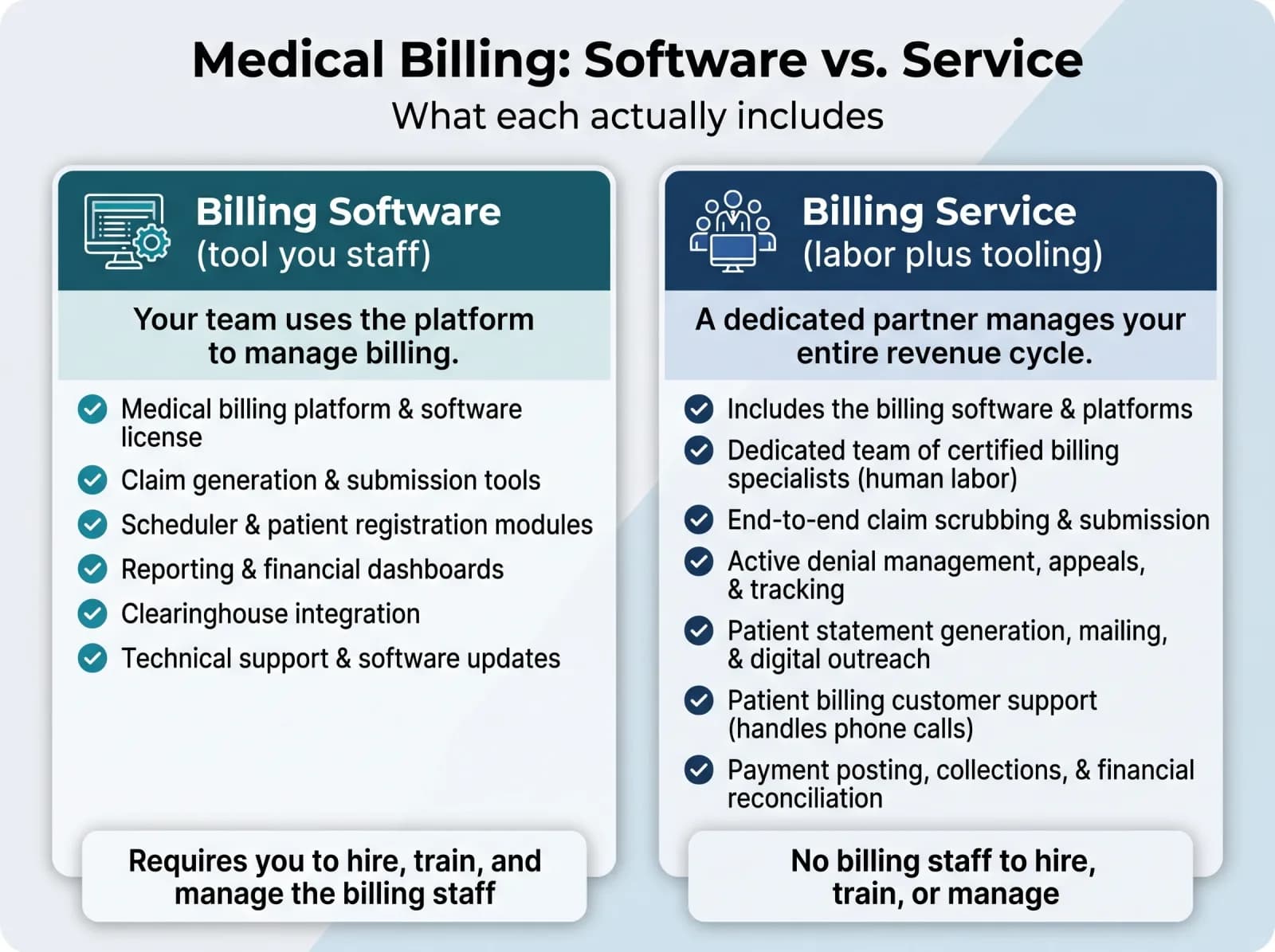
Medical Billing Software vs. Billing Service: Which Fits?
A practical comparison of in-house medical billing software and outsourced billing services, covering what each includes, how costs differ, and the staffing questions practices often overlook.
Read article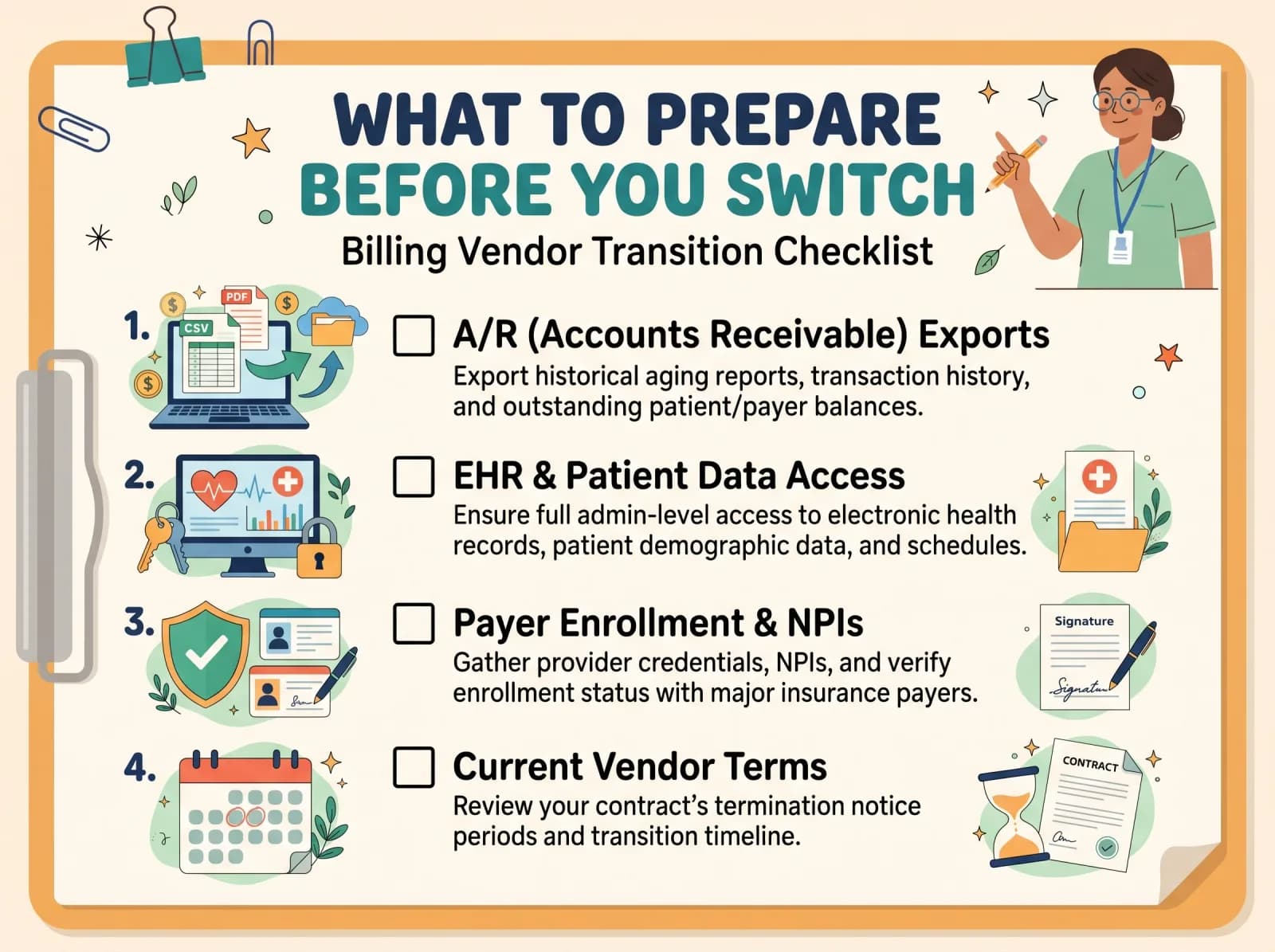 Medical Billing Vendor Selection
Medical Billing Outsourcing: A Practical Guide for Independent Practices
Read article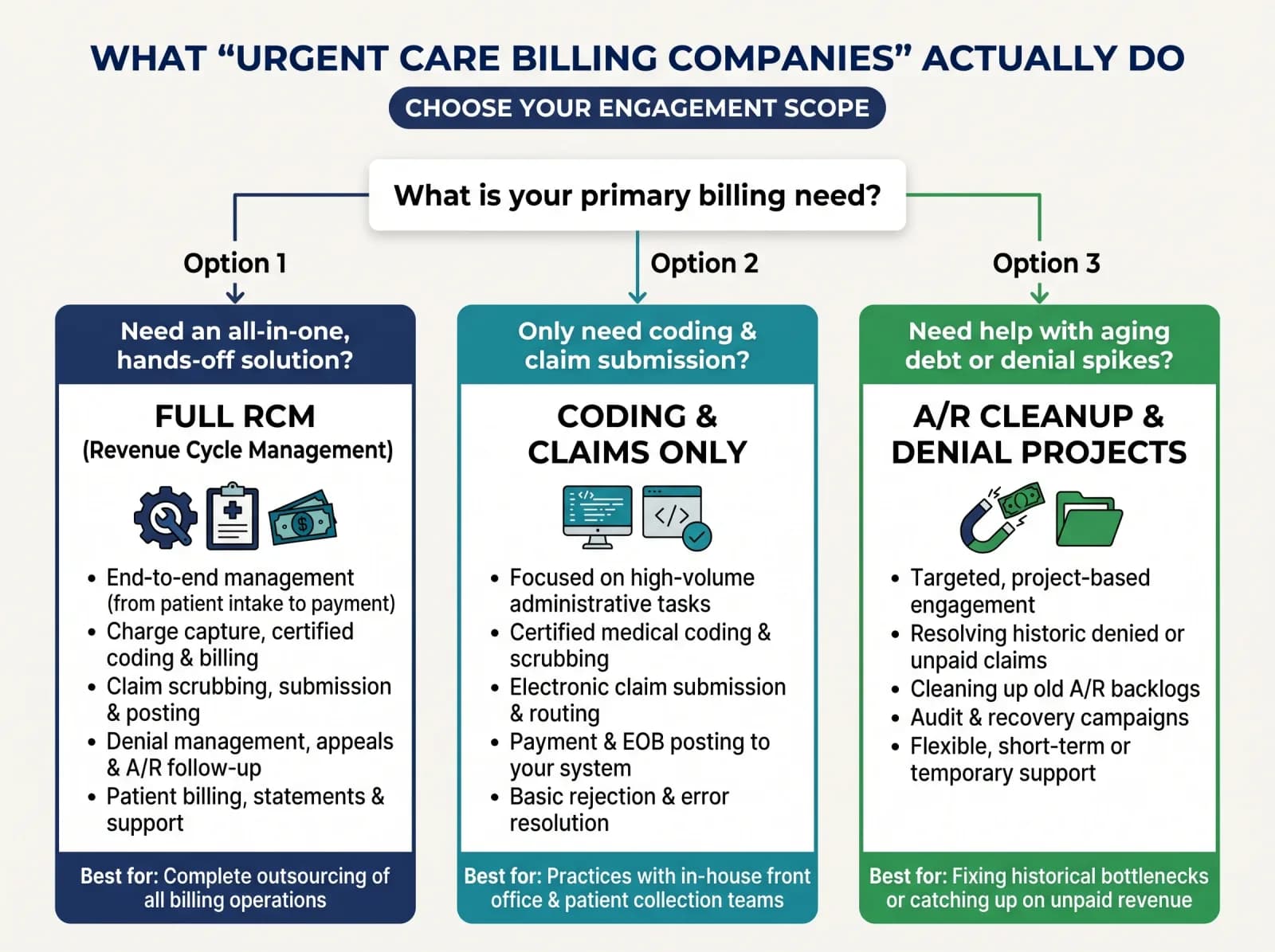 Medical Billing Vendor Selection
Urgent Care Billing Companies: A Buyer's Guide
A practical buyer's guide to urgent care billing companies: what these vendors actually do, which coding and claim questions to ask, how to read 'top 10' lists, and how to evaluate, price and transition a partner.
Read article