

Medical Billing Outsourcing: A Practical Guide for Independent Practices
Medical billing outsourcing means handing some or all of the revenue cycle to an outside team while your practice keeps clinical control and, ideally, full visibility into the numbers. Outsourced medical billing arrangements vary widely, so the key is to define what you need from a billing partner. The decision is less about whether an outside team can key claims and more about which parts of the workflow you want to own, what data access you require, and how you will know the arrangement is working. This guide walks through scope, fit, transition and oversight so you can evaluate a partner with a clear head rather than a sales deck.
What outsourced medical billing actually covers
Outsourcing is not one product. Vendors bundle different slices of the revenue cycle, and the bundle matters more than the label. Scope varies by vendor, so treat the lists below as examples rather than norms.
Commonly in scope (varies by vendor)
- Charge entry and claim scrubbing, then submission through a clearinghouse
- Coding support or coding review, depending on the arrangement
- Payment posting, including electronic remittance advice (ERA) and paper EOBs
- Denial management and accounts receivable follow-up
- Patient statements and, in some arrangements, patient collections
- Recurring performance reporting
Commonly stays with the practice (varies by vendor)
- Clinical documentation and the encounter itself
- Front-desk eligibility checks and patient registration, unless you contract for them
- Credentialing decisions and payer contract negotiations, though some vendors may support these
- Final accountability for coding accuracy and compliance
Ask any candidate to put the in-scope and out-of-scope lists in writing. Ambiguity here is where disputes start. Knight's complete RCM services page shows one way to structure the full scope of outsourced revenue cycle management; a narrower engagement may fit better.
When outsourcing makes sense for an independent practice
There is no universal threshold. Fit usually comes down to a few practical questions:
- Staffing: Is your biller a single point of failure? Are you recruiting for a role that is hard to fill locally?
- Volume and mix: Does claim volume justify dedicated staff, and is your payer mix complex enough to need specialty knowledge?
- Denial patterns: Are denials concentrated in a few fixable causes, or spread across coding, eligibility and timely filing?
- Management bandwidth: Does anyone have time to supervise billing quality, or does it get whatever attention is left after clinic hours?
If denials are driven by front-end issues like eligibility or registration, outsourcing alone will not fix them. A neutral comparison of the tradeoffs is covered in in-house vs. outsourced medical billing.
How outsourced revenue cycle management works week to week
A realistic cadence looks something like this, though timing varies by vendor and specialty:
- Daily: Encounters close and charges flow to the billing team; eligibility and authorization issues surface before claims go out.
- Within a few business days: Claims are scrubbed and submitted; rejections from the clearinghouse are worked immediately.
- Weekly: Payments post, denial queues are worked, and aging buckets above a set threshold get attention.
- Monthly: You receive a reporting package and hold a review call on denials, A/R and collections.
Ask each vendor to describe their actual turnaround targets for posting and denial follow-up, and how they escalate claims approaching filing deadlines. Filing deadlines vary by payer and plan, so confirm them against current official payer guidance rather than relying on a vendor's summary.
What to prepare before you switch
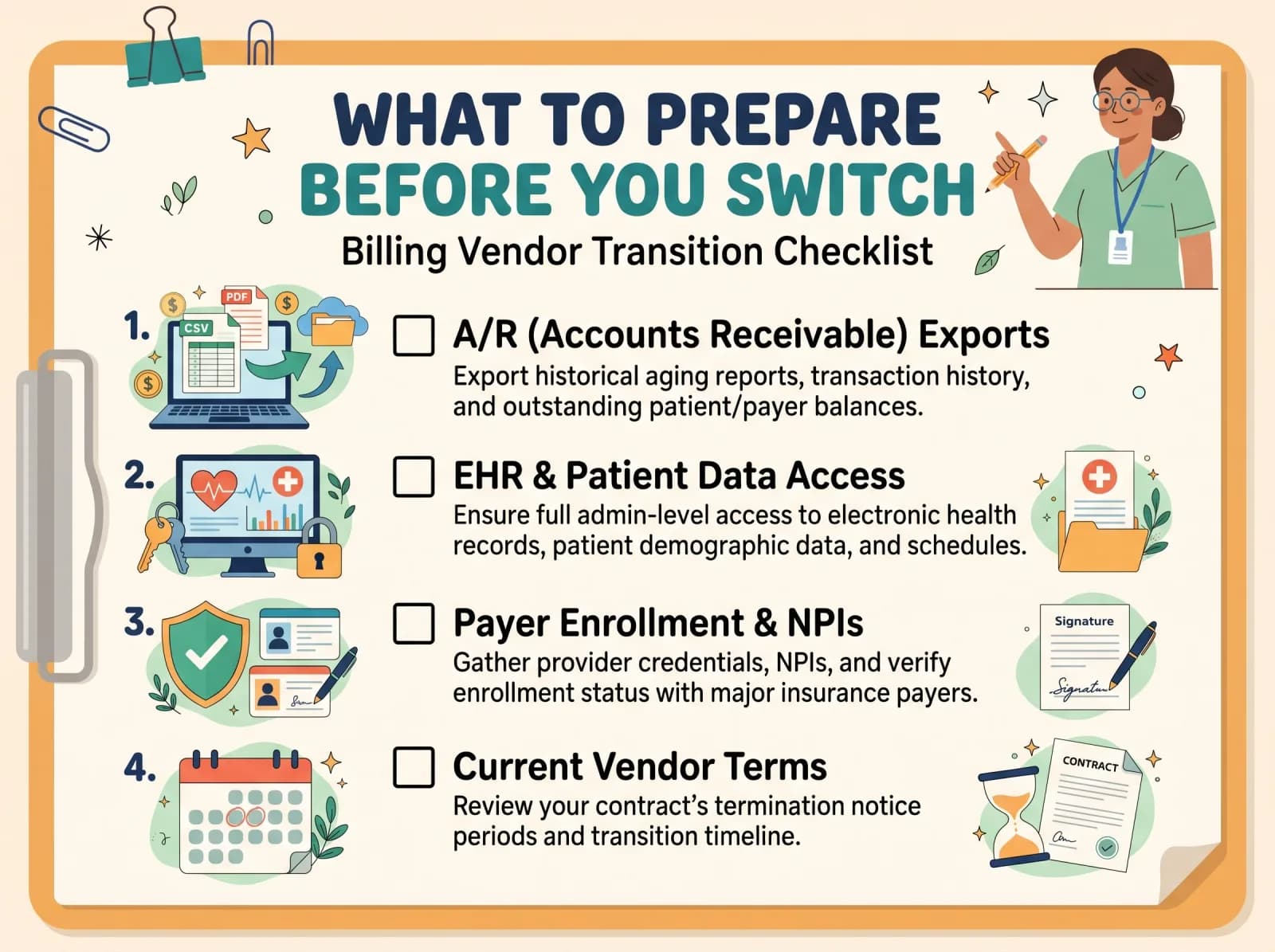
Most transition problems are preparation problems. Build a readiness checklist:
- Export current A/R reports, aging detail and open denial worklists
- Confirm EHR access levels and clearinghouse credentials for the new team
- Verify payer enrollment and EDI/ERA setup so payments route correctly
- Confirm credentialing status for every provider
- Document current workflows, including who does what and when
- Plan staff role changes and communicate them early
Knight's switching medical billing page outlines a billing transition checklist you can adapt.
How to evaluate and vet an outsourced medical billing partner
Use a consistent framework across candidates:
- Scope clarity: Written in-scope and out-of-scope lists, with pricing tied to them
- Specialty experience: Ask how they handle your specific coding and payer patterns
- Reporting transparency: Can you see claim-level detail, or only summary dashboards?
- Data ownership: Confirm the practice owns its data and can export it on exit
- Audit rights: Can you audit claims and coding, and how often?
- Security practices: Ask about access controls, training and breach procedures
- References: Speak with practices of similar size and specialty
Have counsel review contract terms, including termination, transition assistance and liability. A structured buyer's guide is available at how to choose a medical billing company.
Transition and go-live: sequencing to protect cash flow
A phased approach reduces risk. Common sequencing: start with new charges while the outgoing team or your staff finishes older A/R, then move A/R follow-up in tranches. Decide explicitly who owns claims in flight on cutover day. A short parallel run can catch setup errors, but it doubles work, so define its end date in advance.
How to measure outsourced billing performance
Track a small set of metrics monthly and review them on a call:
- Clean claim rate and first-pass acceptance
- Days in A/R and aging distribution
- Denial rate and denial resolution time
- Posting timeliness
- Patient collections and statement cycle
Agree on definitions up front so numbers are comparable month to month. Knight's revenue performance reporting describes one reporting approach.
Risks, controls and questions to ask
Common risks include loss of visibility, unclear data access, and fuzzy accountability for coding accuracy and compliance. Controls: contractual reporting requirements, audit rights, named escalation contacts and a documented exit plan. Questions to ask: Who owns the data? What happens at termination? Who is accountable for coding errors? How are payer policy changes communicated? Verify any payer, coding or regulatory requirement against current official guidance before relying on it.
What to do next
Start by documenting your current scope, denial patterns and reporting needs, then compare two or three partners against that document. If it helps to talk it through, you can schedule a conversation with no obligation to move forward.
Related articles.
 Medical Billing Vendor Selection
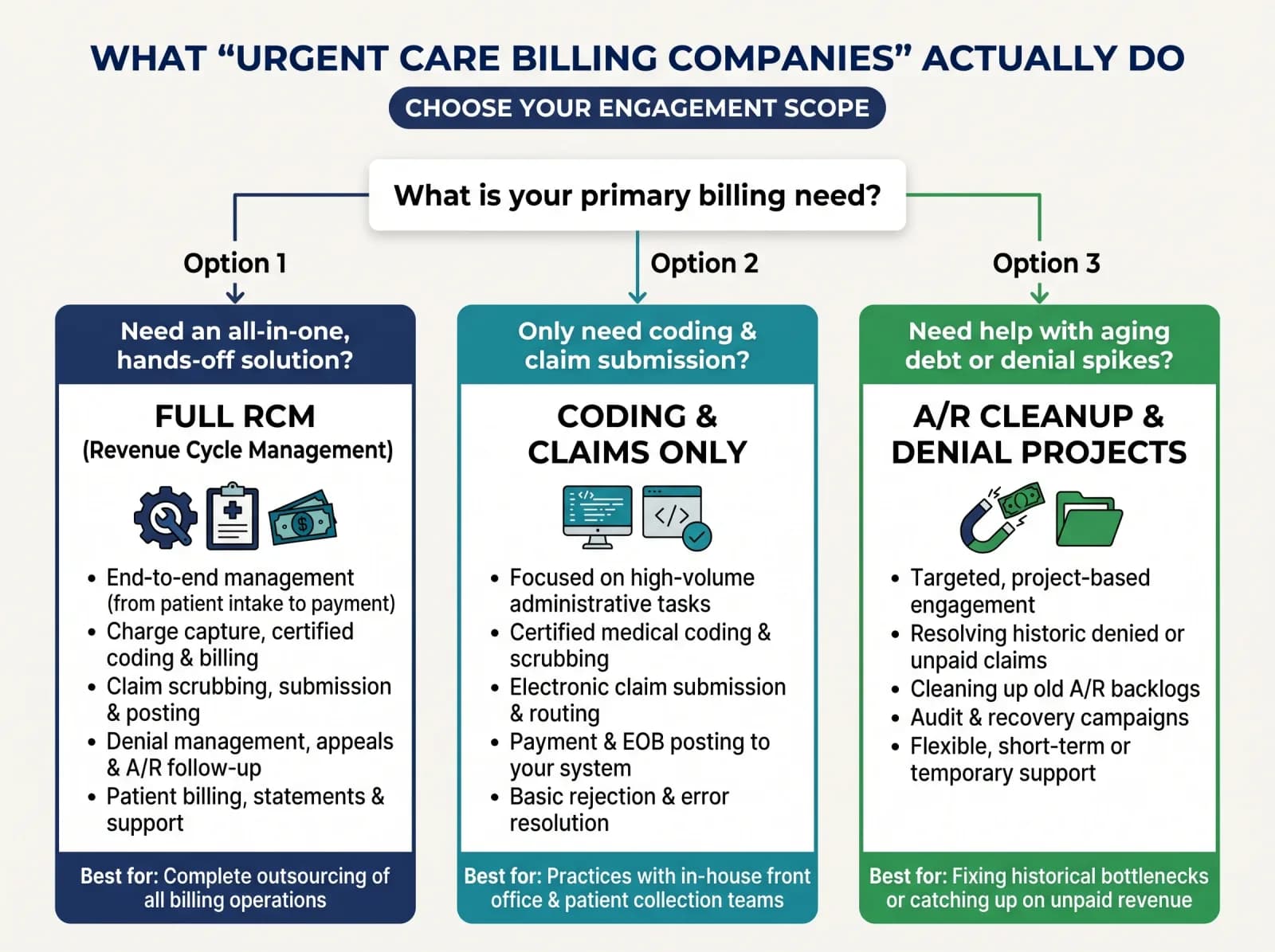
Urgent Care Billing Companies: A Buyer's Guide
A practical buyer's guide to urgent care billing companies: what these vendors actually do, which coding and claim questions to ask, how to read 'top 10' lists, and how to evaluate, price and transition a partner.
Read article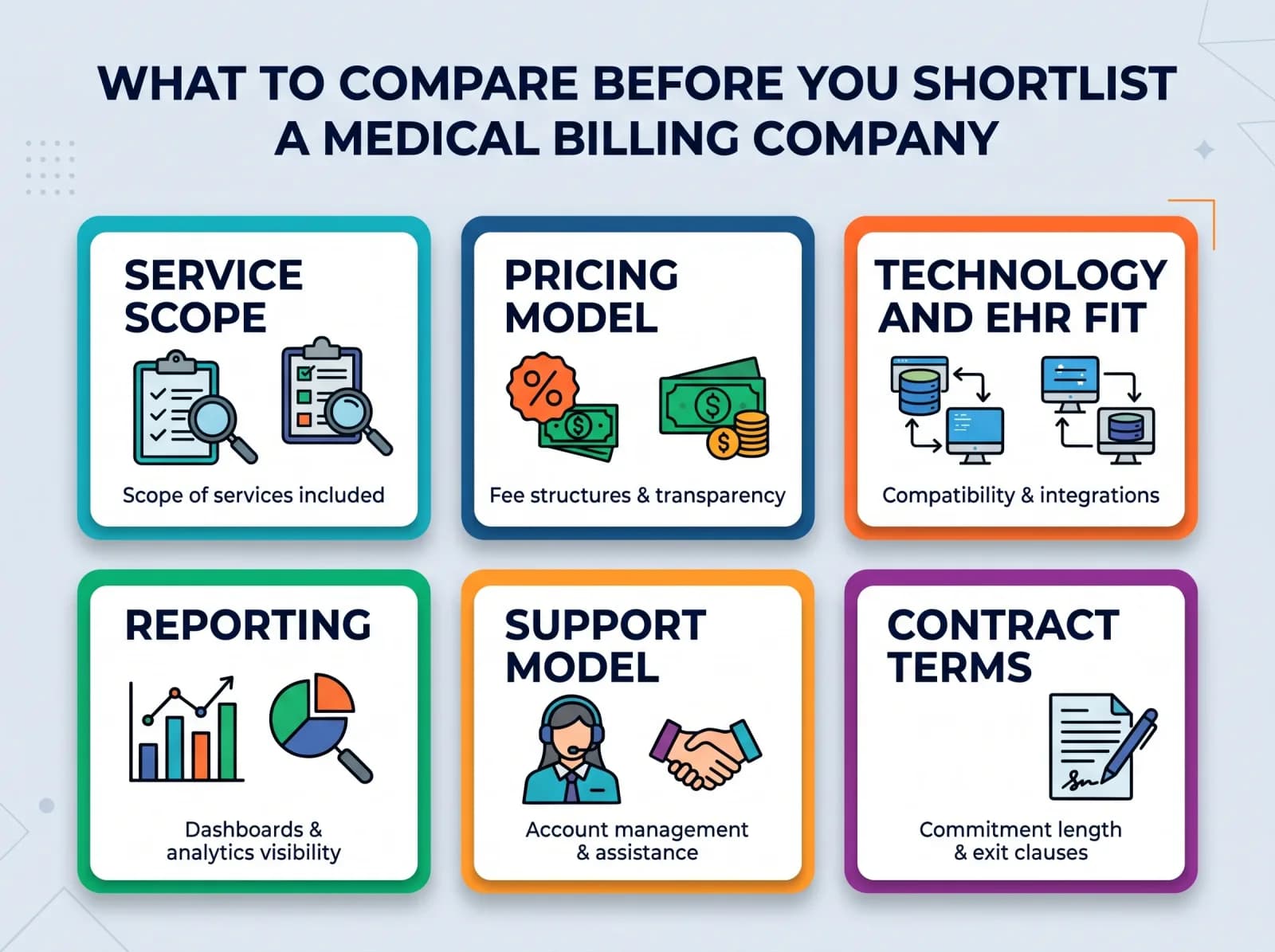 Medical Billing Vendor Selection
Medical Billing Companies for Small Practices: How to Compare
A practical framework for comparing medical billing companies for small practices, covering service scope, pricing, EHR fit, reporting, support, and contract terms.
Read article Medical Billing Vendor Selection
Medical Billing in Massachusetts: What Independent Practices Should Verify
A practical guide for Massachusetts independent practices on evaluating billing partners by payer familiarity, MassHealth and commercial mix, and accountability — with questions to ask and claims to verify rather than assume.
Read article