

Medical Billing Companies for Small Practices: How to Compare
A practical framework for comparing medical billing companies for small practices, covering service scope, pricing, EHR fit, reporting, support, and contract terms.
If you have spent an afternoon searching for "medical billing companies for small practices," you have probably noticed that most of what ranks is either a comparison listicle or a software ad. Neither tells you how to compare providers on the things that actually affect a small practice: who touches your claims, how the fee is calculated, what happens when a payer denies, and how you get your data back if you leave. This page gives you a comparison framework you can run yourself, without a spreadsheet full of vendor marketing.
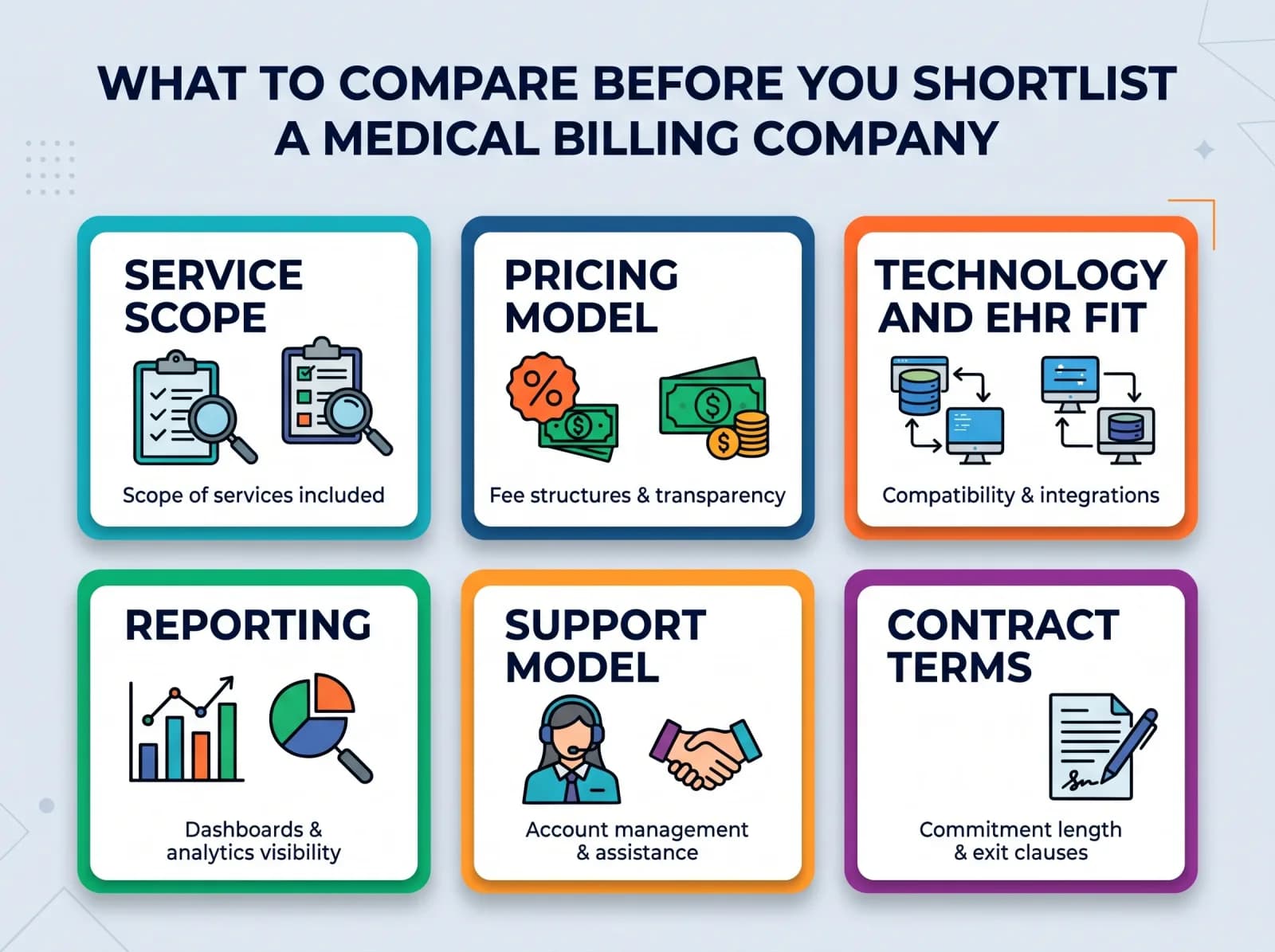
What to compare before you shortlist a billing company
Before you request quotes, decide what you are actually buying. A billing company can mean anything from a full revenue cycle partner to a claims-submission service that leaves most of the work with your front desk. Compare every candidate on the same six dimensions.
Service scope
Ask exactly which steps of the revenue cycle are included: eligibility and benefits verification, prior authorization, charge entry, coding support, claim submission, payment posting, denial management, patient statements, and A/R follow-up. A low fee on "billing" often means claims go out the door and the rest is yours. Write down what is in scope and what is not, line by line.
Pricing model
Percentage of collections, flat monthly fee, per-claim pricing, and hybrid models behave very differently at small volumes. A percentage model is often described as aligning incentives on collections, but depending on the vendor and your claim mix, it may make small-dollar claims uneconomic. A flat fee is often described as predictable but may not scale as you grow. Confirm how each model behaves at your volume with each vendor. Ask what is excluded from the fee (clearinghouse charges, statement postage, credentialing, coding audits) and get the answer in writing.
Technology and EHR fit
Ask which practice management and EHR systems the company works in today, and whether it will work inside yours or expect you to migrate. Migration is a real cost and a real disruption. If they use their own platform, ask how you access reports and whether you can export your data.
Reporting
You should be able to see, at minimum, charges, payments, adjustments, days in A/R, denial rates by payer, and aging buckets. Reporting norms vary by vendor and contract, so verify expectations against your own quotes. Ask for a sample report pack and how often it is delivered. If reporting is "available on request," that is a warning sign.
Support model
Who is your day-to-day contact? Is there a named account manager or a shared queue? What are the response times, and how do you reach them when a claim is stuck? For a small practice, a named human who knows your payers matters more than a portal.
Contract terms
Ask about term length, notice period, termination for cause, and what happens to work in progress at exit. Fee structures and contract terms vary by vendor, so verify these against your own quotes. These are the terms that decide how painful a bad fit becomes.
Questions that separate a good fit from a bad one for a small practice
Use discovery calls to test how a company thinks, not just what it sells. These questions work for any vendor and do not assume anything about a specific one. Score the answers on the same 1–5 scale you will use for the full comparison below.
- "Walk me through what happens to a claim from the day of service to the day it is paid — who touches it at each step?"
- "How do you handle a denial? Who works it, and what is your process for appeals?"
- "Which payers do you work with most in my specialty, and where do you see the most denials?"
- "What does onboarding look like in the first 30, 60, and 90 days, and who does the work?"
- "Can you show me a sample report for a practice my size?"
- "What is your average days in A/R, and how do you define it?"
- "What happens if a claim is denied because of something on my end — coding, eligibility, or missing information?"
Listen for specifics. A company that answers in generalities about "maximizing revenue" may not have thought about your workflow. A company that asks about your EHR, your top payers, and your front-desk process before quoting is doing the work you want done on your claims.
Red flags and things to verify in writing
These are items to verify, not legal advice. Have your own advisor review any contract before you sign.
- Data ownership. Confirm in writing that your patient and claims data belongs to you and that you can export it in a usable format at any time.
- Transition and termination. Ask what notice is required, what happens to claims in flight, and whether there is an exit fee. Get the answer in the contract, not the sales call.
- Fee creep. Ask which services are billed separately and whether those fees can change mid-term.
- Compliance questions. Ask how the company handles HIPAA, business associate agreements, and access controls. Verify any payer or regulatory requirement against current official guidance rather than a vendor's summary.
- References. Ask for practices of similar size and specialty, and call them.
If a vendor will not put a term in writing, treat that as a warning sign.
How to run a fair comparison
Score each candidate on the six dimensions above using a simple 1–5 scale, and weight the dimensions that matter most to your practice. A practice with heavy prior authorization volume should weight scope and payer knowledge higher; a practice with thin margins should weight pricing transparency higher. Keep the scores and the notes you took on each call — they are more useful than a brochure.
For deeper background, our guide to choosing a medical billing company covers the evaluation process in more detail, and our article on medical billing pricing explains the structures you will see in quotes. If you are weighing staying in-house, our comparison of in-house versus outsourced medical billing lays out the tradeoffs.
What to do next
If you want a second set of eyes on your comparison, we are happy to talk through your current workflow and what you are trying to fix — no pressure and no obligation. You can schedule a conversation or contact our team with your questions. If you would rather start with a self-guided look at where revenue is leaking, our revenue leak calculator tool is a reasonable first step.
This conversation is separate from the comparison framework above.
Sources and verification
This article is a comparison framework, not a survey of specific vendors. The only external sources supplied for this piece were Independent Practice Partners' pages on medical billing services and medical practice consulting and billing. No statistics, rankings, or vendor claims in this article are drawn from those sources; they are offered only as examples of the kind of provider information you may encounter. Confirm that these links resolve and that this description of them is accurate before publishing. Any payer, coding, or regulatory requirement you encounter during evaluation should be verified against current official guidance.
Related articles.
 Medical Billing Vendor Selection
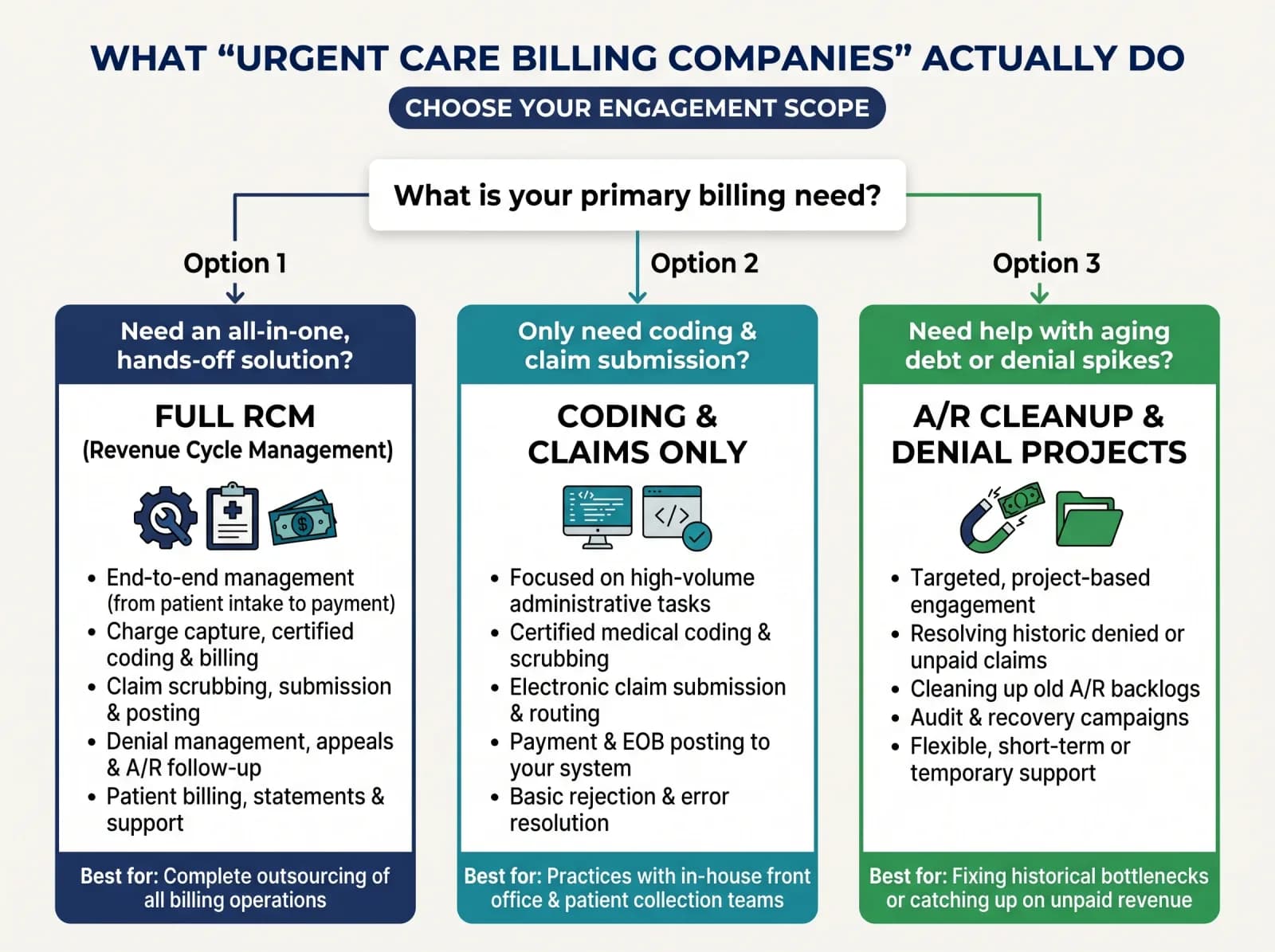
Urgent Care Billing Companies: A Buyer's Guide
A practical buyer's guide to urgent care billing companies: what these vendors actually do, which coding and claim questions to ask, how to read 'top 10' lists, and how to evaluate, price and transition a partner.
Read article Medical Billing Vendor Selection
Medical Billing in Massachusetts: What Independent Practices Should Verify
A practical guide for Massachusetts independent practices on evaluating billing partners by payer familiarity, MassHealth and commercial mix, and accountability — with questions to ask and claims to verify rather than assume.
Read article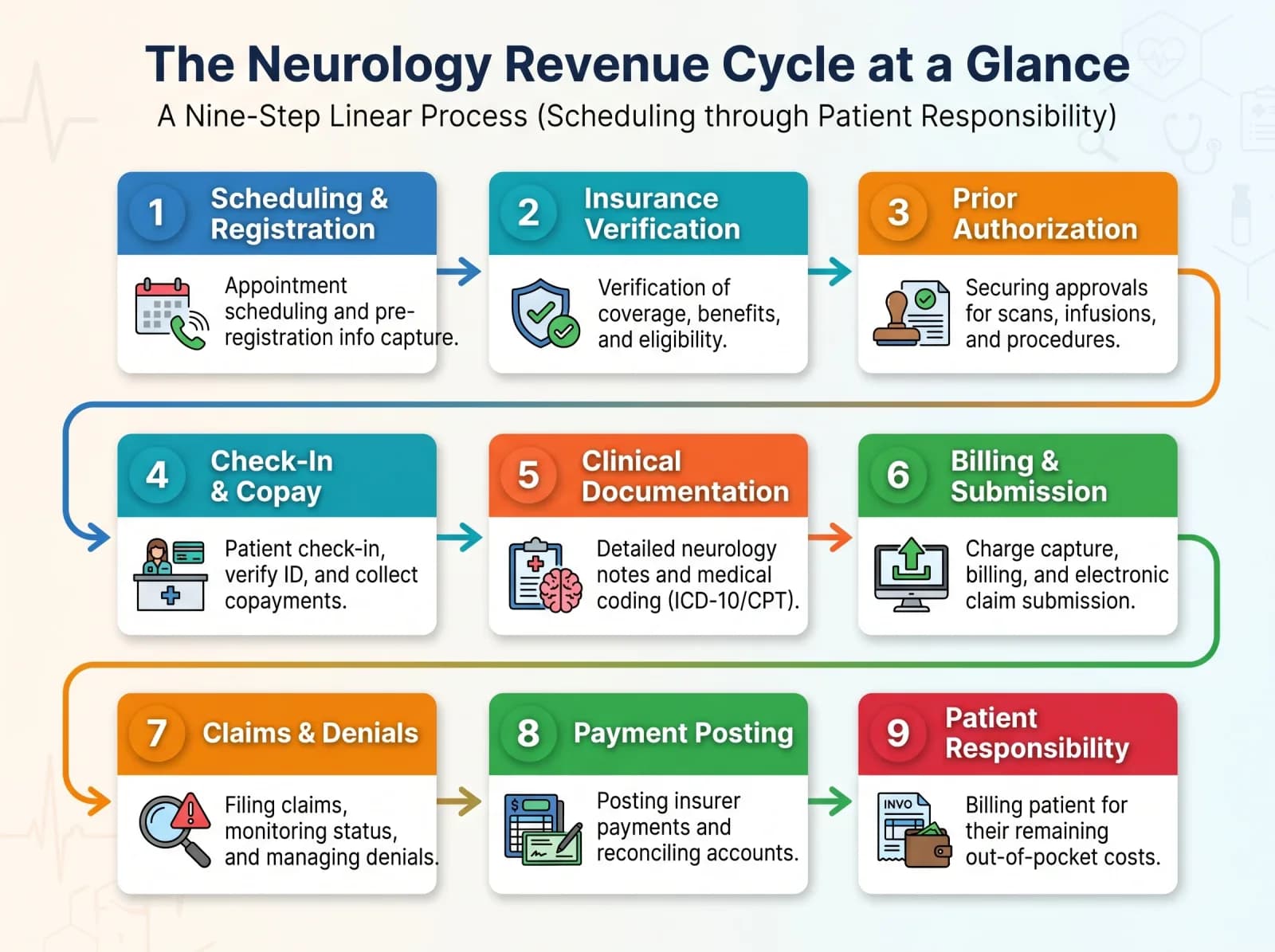 Revenue Cycle Management
Neurology Medical Billing: A Practical Process Guide
A practical map of the neurology revenue cycle, from eligibility and authorization through charge capture, denial review, and patient collections, with process checks a practice manager can own.
Read article