

Revenue Cycle Management for Small Independent Practices in Massachusetts
A practical guide to revenue cycle management for small independent practices in Massachusetts, covering what RCM includes, where revenue leaks, what to verify before outsourcing, and how Knight structures support.

If you run a small independent practice in Massachusetts, "revenue cycle management" can sound like a service built for hospital systems with a dozen departments. In practice, the revenue cycle is just the path every claim takes from the front desk to the bank account — and in a small practice, one missed step on that path usually means money you never collect. Outsourced RCM is worth considering when the work is real but nobody on staff owns it end to end.
What revenue cycle management covers for a small practice
RCM is the full sequence of administrative work that turns a patient visit into a paid claim. For a small practice, a complete outsourced scope typically includes:
- Eligibility and benefits verification before the visit, so you know coverage and cost-sharing up front.
- Prior authorization where the payer or service requires it.
- Charge entry and coding support, with the practice remaining responsible for clinical documentation.
- Claim submission and clearinghouse management, including rejection triage.
- Payment posting and reconciliation against remittance advice.
- Denial management — working appeals and corrected claims rather than writing them off.
- A/R follow-up on aging claims, including patient balances.
- Reporting you can actually read: charges, collections, denial reasons, and aging trends.
Credentialing and payer enrollment often sit alongside RCM because a provider who isn't properly enrolled can't be paid. Knight treats that as a related service through credentialing and contracting. What RCM does not do is guarantee a collection rate — any partner promising specific dollar outcomes before reviewing your data is guessing.
Where small practices typically lose revenue
Most leakage in a small practice isn't dramatic. It's cumulative, and it usually shows up in a few familiar places:
Denials that never get worked
A denial is only a loss if nobody appeals it. Small teams often clear the easy claims and let complex denials age past the payer's appeal window. The fix is a defined denial workflow with owners and deadlines — not a monthly cleanup.
A/R that ages quietly
When staff are also answering phones and checking patients in, follow-up on 60- and 90-day claims slips. Aging reports tell the story: if a large share of receivables sits past 90 days, follow-up isn't happening on schedule.
Eligibility surprises at the back end
Coverage that changed, a plan that requires a referral, or a patient who owes more than expected — all of these are cheaper to catch before the visit than after the claim denies.
Underpriced or unmanaged contracts
Small practices sometimes accept fee schedules without comparing them to the cost of delivering the service. That's a contracting conversation, not a billing one, but it affects the same bottom line.
If you want a rough sense of where your own gaps sit, a structured review is more useful than a hunch. Knight's revenue leak calculator is a starting point, and a full complete RCM service engagement is the deeper version.
What to verify before outsourcing RCM
Small practices get burned less by bad billing and more by vague billing. Before you sign, ask questions that force specifics:
- Who actually works my account? Named team, dedicated or shared, and what happens when someone is out.
- What reports will I get, and how often? Ask to see a sample. If the answer is "you can request anything," ask what's standard.
- How do you handle denials? Who appeals, within what timeframe, and how are write-offs approved?
- Which payers do you work with regularly? Massachusetts practices deal with a mix of commercial plans and public programs; experience with your specific mix matters more than a long payer list.
- How is pricing structured? Percentage of collections, flat fee, or hybrid — each has trade-offs. Knight's guide to how medical billing pricing works walks through the comparison.
- What happens at transition? Who owns the data, how long onboarding takes, and how existing A/R is handled.
- How do you handle compliance and documentation? Confirm that coding decisions follow current official guidance and that any payer-specific rule is verified against that payer's published policy — not assumed.
It also helps to be honest about the alternative. Keeping billing in-house can work well for some practices; the trade-offs are laid out in Knight's in-house vs. outsourced comparison. The right answer depends on your volume, your staff capacity, and how much visibility you want into the numbers.
How Knight structures small-practice RCM support
Knight's approach for small independent practices is built around defined process commitments rather than promises about results:
- A scoped engagement. We start by reviewing your current workflow, aging, and denial patterns, then propose a scope that matches what you actually need — full RCM, or targeted support like denial management or A/R follow-up.
- Documented workflows. Eligibility checks, claim scrubs, denial handling, and follow-up cadences are written down so you know what's happening and when.
- Reporting you can use. Standard reports on charges, payments, adjustments, denials, and aging — reviewed with you on a regular schedule.
- Massachusetts payer familiarity. Our team works with the commercial and public payer mix common to independent practices in the state, and we verify payer-specific requirements against current published guidance.
We don't claim to be the right fit for every practice. If in-house billing is working, we'll say so. If there are specific gaps, we'll describe them plainly.
What to do next
If you're comparing outsourced billing options, the most useful first step is a no-pressure review of your current revenue cycle. Bring your most recent aging report and a sample of denials; we'll walk through what we see and where the process gaps are. You can schedule a consultation or contact us with questions first. There's no obligation, and no expectation that you'll switch anything.
Sources and verification
This article draws on general revenue cycle practice and the following supplied references, which describe medical billing services for Massachusetts practices:
- Medical Billing Services in Massachusetts | More Revenue — providerscarebilling.com
- Medical & Healthcare Billing Services | Independent Practice Partners — ipracticepartners.com
No statistics, payer policies, or coding rules are asserted here. Any payer-specific requirement, filing deadline, or coding decision should be verified against current official payer and regulatory guidance before you rely on it.
Related articles.
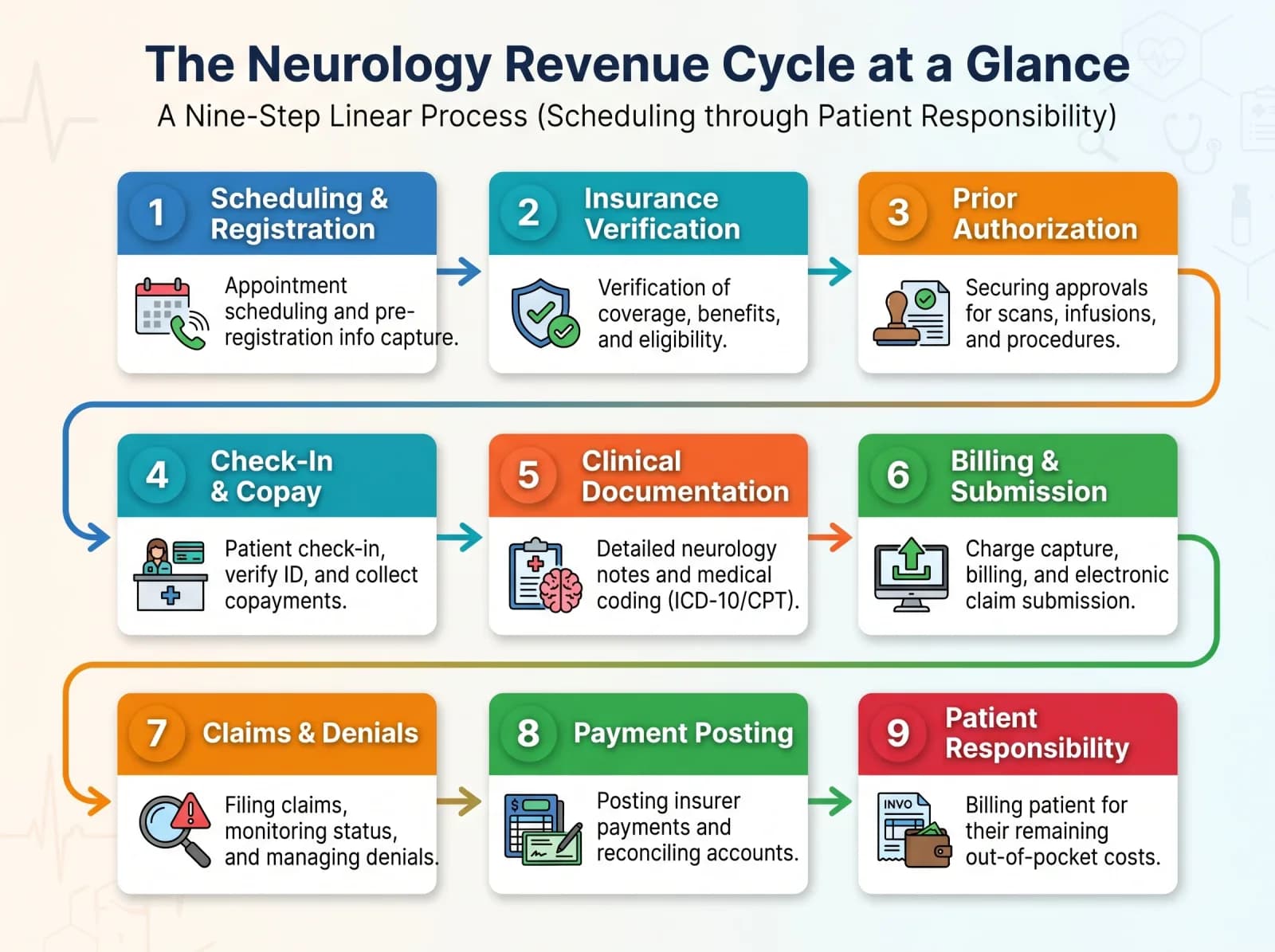 Revenue Cycle Management
Neurology Medical Billing: A Practical Process Guide
A practical map of the neurology revenue cycle, from eligibility and authorization through charge capture, denial review, and patient collections, with process checks a practice manager can own.
Read article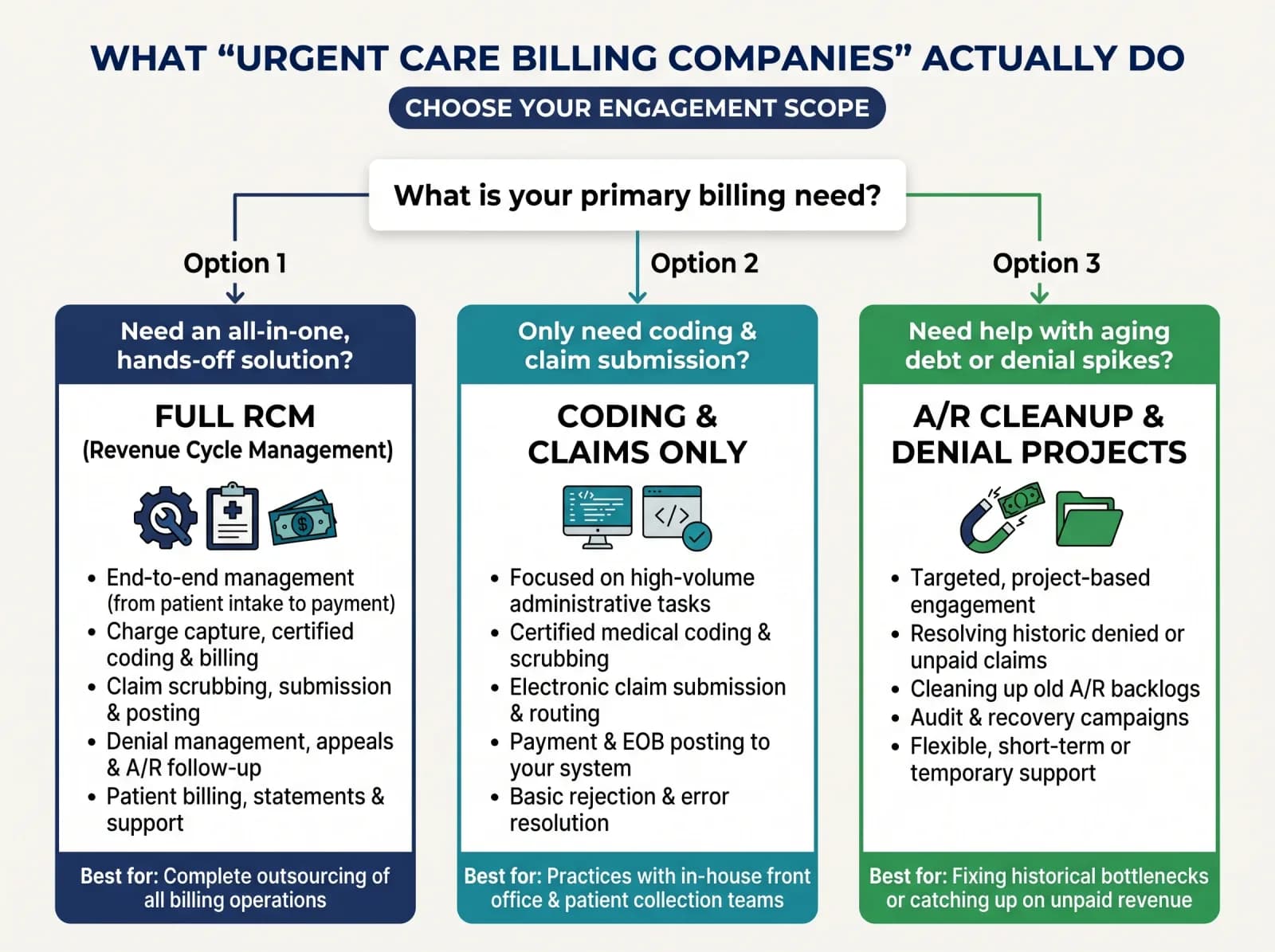 Medical Billing Vendor Selection
Urgent Care Billing Companies: A Buyer's Guide
A practical buyer's guide to urgent care billing companies: what these vendors actually do, which coding and claim questions to ask, how to read 'top 10' lists, and how to evaluate, price and transition a partner.
Read article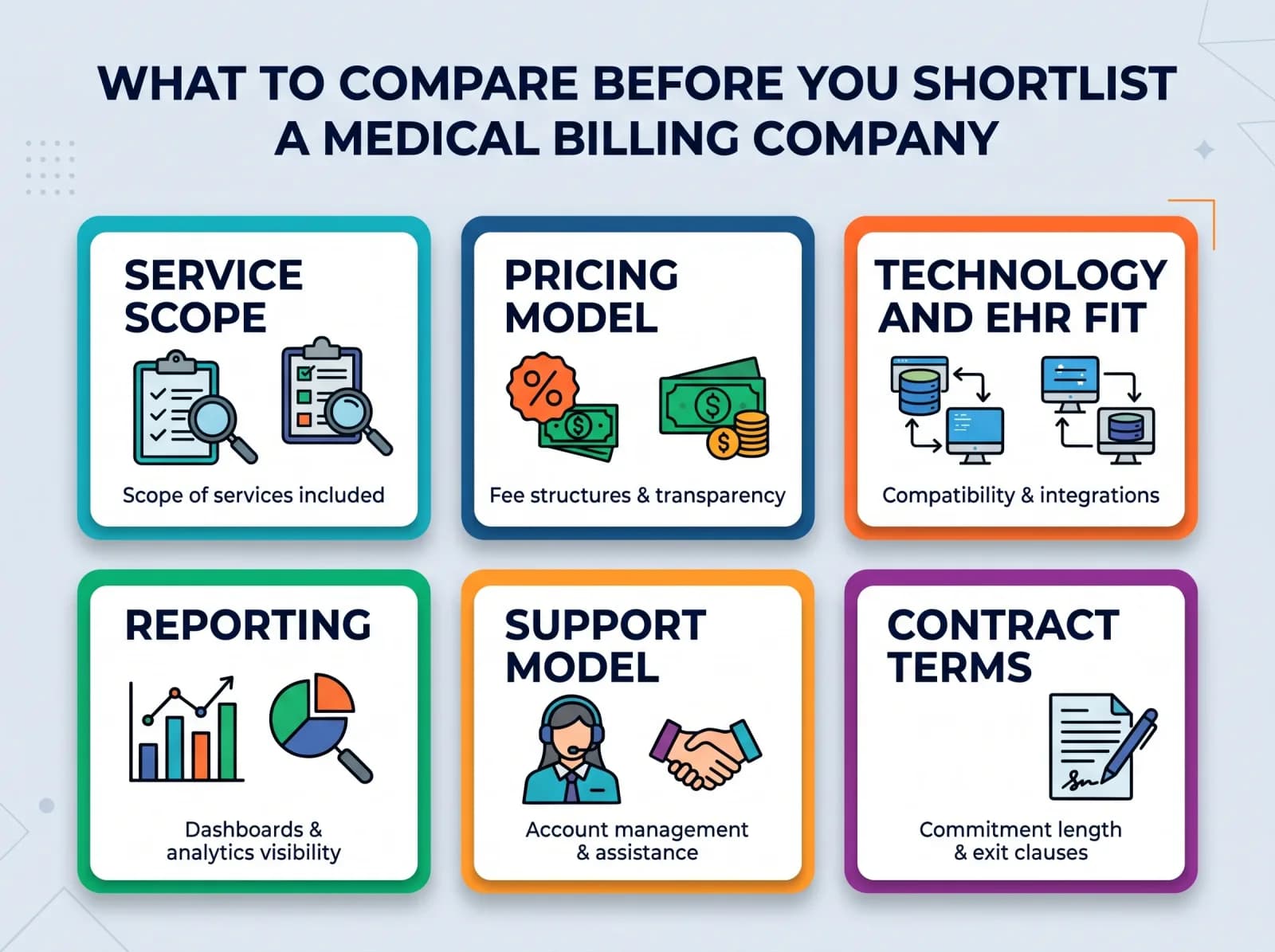 Medical Billing Vendor Selection
Medical Billing Companies for Small Practices: How to Compare
A practical framework for comparing medical billing companies for small practices, covering service scope, pricing, EHR fit, reporting, support, and contract terms.
Read article