

Urgent Care Billing Companies: A Buyer's Guide
A practical buyer's guide to urgent care billing companies: what these vendors actually do, which coding and claim questions to ask, how to read 'top 10' lists, and how to evaluate, price and transition a partner.
If you are searching for "urgent care billing companies," you are probably doing one of two things: trying to fix collections that have slipped, or standing up a new clinic and deciding who should run the revenue cycle. Either way, the search results will often include "top 10" lists, some of which may rank the publisher first, so check for disclosure. This guide takes a different approach. It is a buyer's guide to what urgent care billing actually involves, what to ask vendors, and how to verify claims before you sign.
Why urgent care billing is not general practice billing
Urgent care revenue cycle work has a different shape than a primary care or specialty practice. Visits are walk-in and high-volume, so charges must be captured the same day or they age badly. Patient responsibility can be a meaningful share of balances, and point-of-service collection is a revenue cycle function, not just a courtesy. Some clinics also carry occupational medicine and workers' compensation work alongside commercial and government payers, and multi-site groups may hold contracts that vary by location. A billing partner that is strong on low-volume specialty claims is not automatically strong here.
What urgent care billing companies actually do
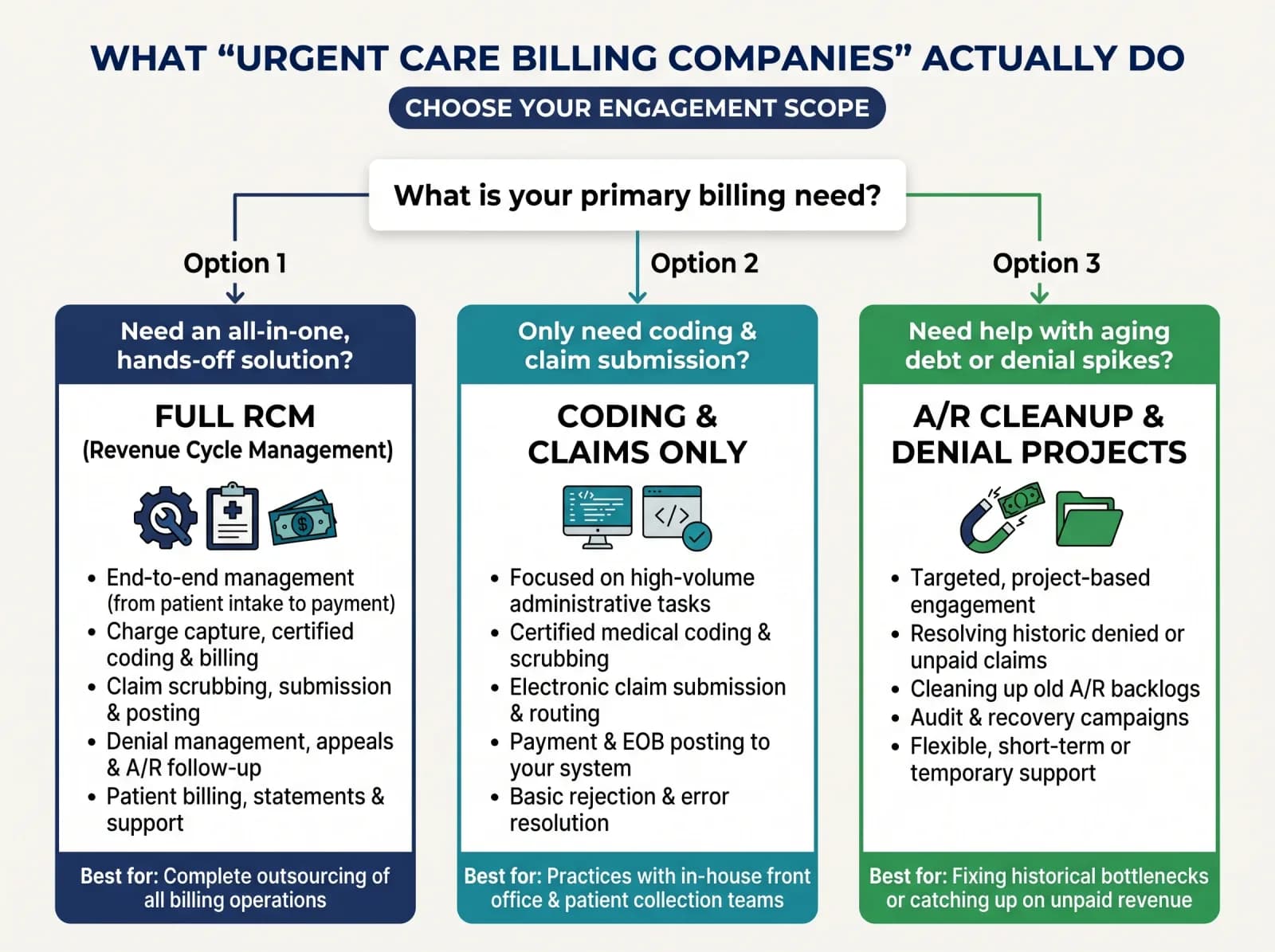
Scope varies widely among urgent care billing companies, and matching scope to your problem matters more than the logo. Common engagements include:
- Full RCM: coding, claim submission, payment posting, denial management and appeals, A/R follow-up, eligibility checks, patient statements, and reporting. See complete RCM services.
- Coding and claims only: charge review, coding, and clean-claim submission, with your staff handling posting and follow-up.
- A/R cleanup or denial projects: targeted work on aged balances or a denial backlog, often as a clean-up engagement.
Be explicit about which of these you are buying. A vendor quoting "billing" may mean only claim submission.
The coding and claim details to ask about
You do not need to be a coder to ask good questions. You do need to hear a specific, confident answer. Topics worth raising include place of service 20 for urgent care, the S9083 global versus itemized billing question (a code some payers use for global urgent care visits), modifier 25 when a same-day E/M and procedure are billed together, and payer-specific rules that differ by contract. Treat each of these as an example of the kind of question to verify rather than a settled rule, since applicability varies by payer and can change. Ask vendors to show how they verify current requirements with each payer and how they document and audit these decisions.
Verify, don't assume. Coding and payer rules change, and this article is not coding, legal, or clinical advice. Do not assume any single rule applies universally across payers or locations. Verify current requirements directly with official payer policy and current coding guidance (for example, AMA and CMS resources), because official guidance can change.
How to read the top 10 lists you will find
Ranking-style content is common for this query, and some lists may rank the publisher first. Treat those lists with caution, and check whether a list discloses its own relationship to the publishers it ranks. Pricing figures and outcome claims in them should be verified independently, and "best" depends on your visit volume, specialty mix, EHR and practice management system, and number of locations. A firm that is excellent for a single-site clinic may be a poor fit for a five-location group. Use the lists to build a long list of names, then evaluate each against your own criteria.
Urgent care billing companies: a vendor evaluation checklist
- Urgent care experience: How many urgent care clients, and what visit volumes?
- System compatibility: Which EHR/PM systems do they work in natively, and how do integrations work?
- Charge capture: What is the same-day workflow, and who owns missing charges?
- Patient collections: Do they support point-of-service estimates and patient statements?
- Denials: Who works them, within what timeframe, and how are they reported?
- Reporting: What metrics, at what cadence, at what level (location vs. group)?
- Staffing: Who touches your claims, and what is their turnover?
- Security: HIPAA posture, access controls, and business associate agreement.
- Contract: Notice period, termination, and data ownership/return.
Questions to ask before signing
Use a script: Who specifically touches our claims? What is your urgent care client mix? How do you handle POS 20 and S9083, and how do you confirm current payer guidance on each? How are denials worked and reported? What happens at month-end close? How do you handle patient balances? What do termination and data return look like? Record the answers and compare them side by side.
Pricing: what to compare and what to verify
Common models used by urgent care billing companies are percentage of collections, per-claim, hourly, and hybrid. Each includes and excludes different work, so ask for an itemized quote, confirm what is in scope, and compare line items across vendors rather than headline rates. We do not publish market rates here because they vary by volume, scope, and system. For a fuller framework, see our guide to how medical billing pricing works.
Multi-location and growing groups
As you add sites, insist on location-level reporting, clear ownership of site-specific queues, and a plan for credentialing and enrollment at each new location. Ask how the vendor keeps visibility consolidated without losing site detail. Our growing practices page describes how we structure this.
How to run a structured evaluation and transition
- Define the problem in numbers (days in A/R, denial rate, patient collections).
- Request references from clinics of similar size and mix.
- Run a pilot or parallel period before full cutover.
- Plan data migration and a written transition timeline.
- Set 30/60/90-day review checkpoints with agreed metrics.
For the transition itself, see switching medical billing.
What to do next
Define your problem in numbers, match urgent care billing companies' scope to it, ask specific coding and claim questions, verify answers against official guidance, compare itemized pricing, and plan a structured transition with review checkpoints.
If you want a second set of eyes, we can review your current workflow and reporting—typically a walkthrough of your charge capture, denial handling, A/R aging, and reporting—with no obligation and no promise of specific results. You can schedule a conversation or contact us with your questions.
Related articles.
 Medical Billing Vendor Selection
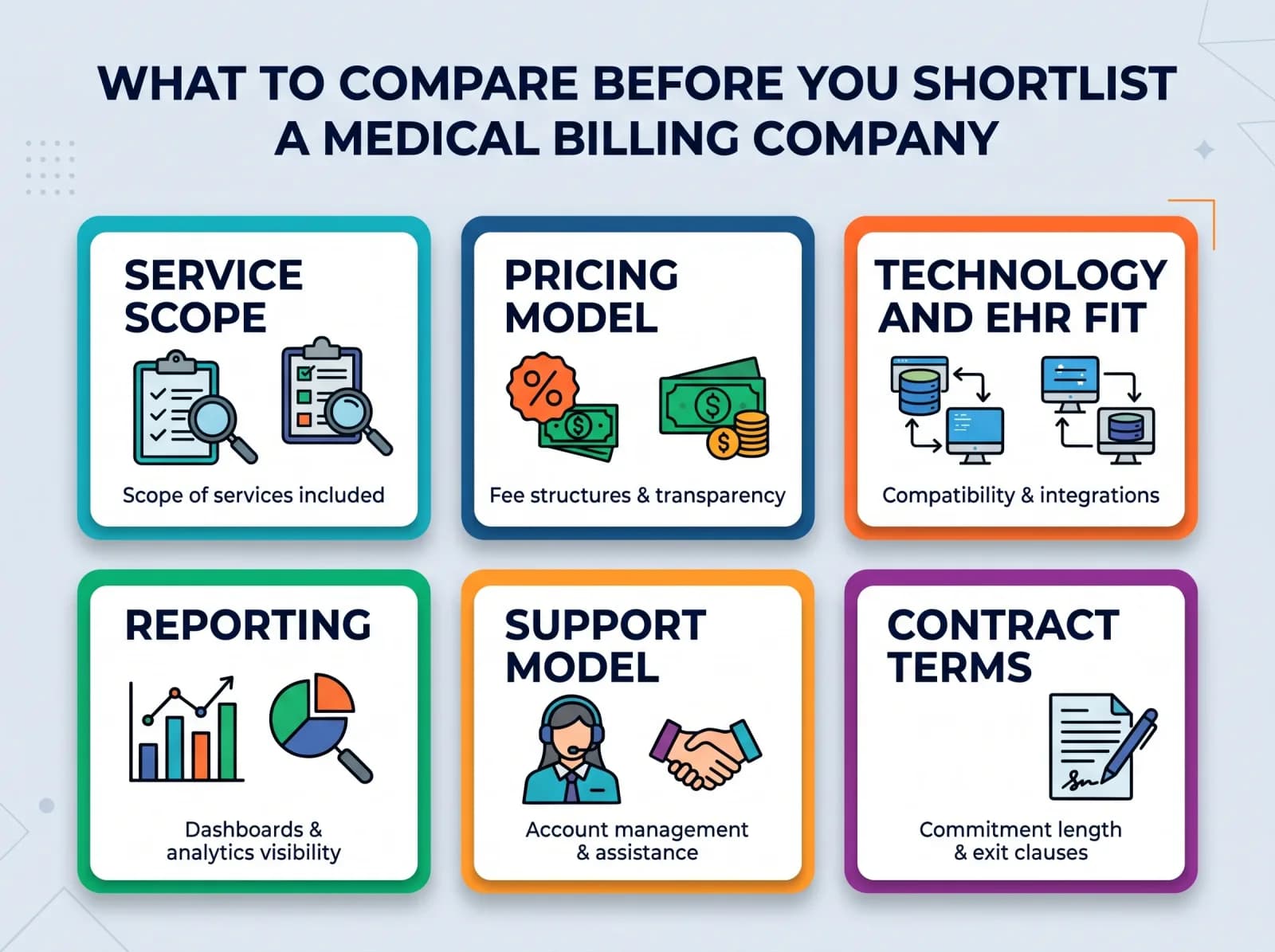
Medical Billing Companies for Small Practices: How to Compare
A practical framework for comparing medical billing companies for small practices, covering service scope, pricing, EHR fit, reporting, support, and contract terms.
Read article Medical Billing Vendor Selection
Medical Billing in Massachusetts: What Independent Practices Should Verify
A practical guide for Massachusetts independent practices on evaluating billing partners by payer familiarity, MassHealth and commercial mix, and accountability — with questions to ask and claims to verify rather than assume.
Read article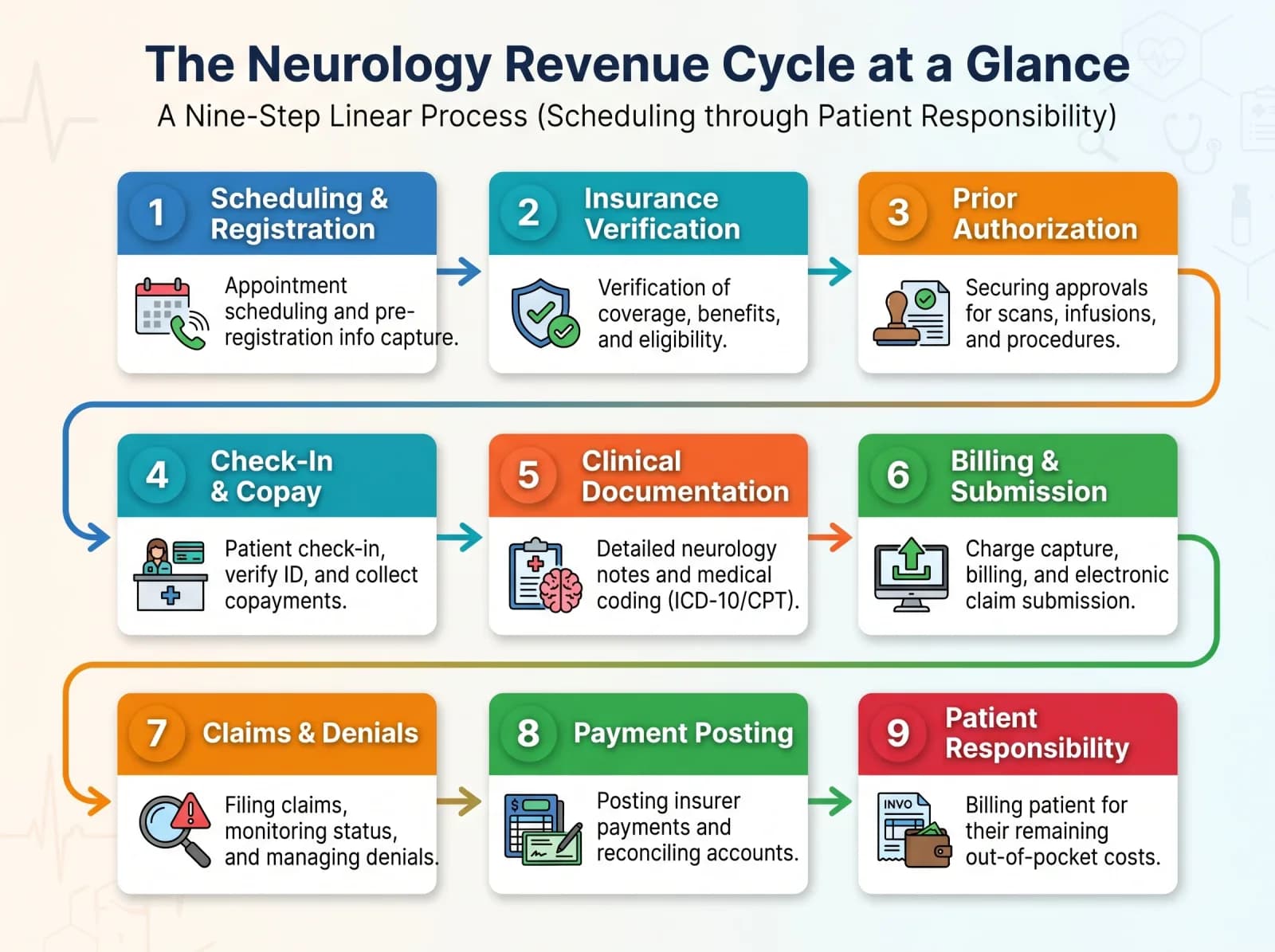 Revenue Cycle Management
Neurology Medical Billing: A Practical Process Guide
A practical map of the neurology revenue cycle, from eligibility and authorization through charge capture, denial review, and patient collections, with process checks a practice manager can own.
Read article