

Emergency Department Billing: How ED Revenue Cycle Differs from Office Billing
A practical guide to emergency department billing for independent ED groups and freestanding EDs, covering structural differences from office billing, where ED claims stall, and what to ask a billing partner before signing.
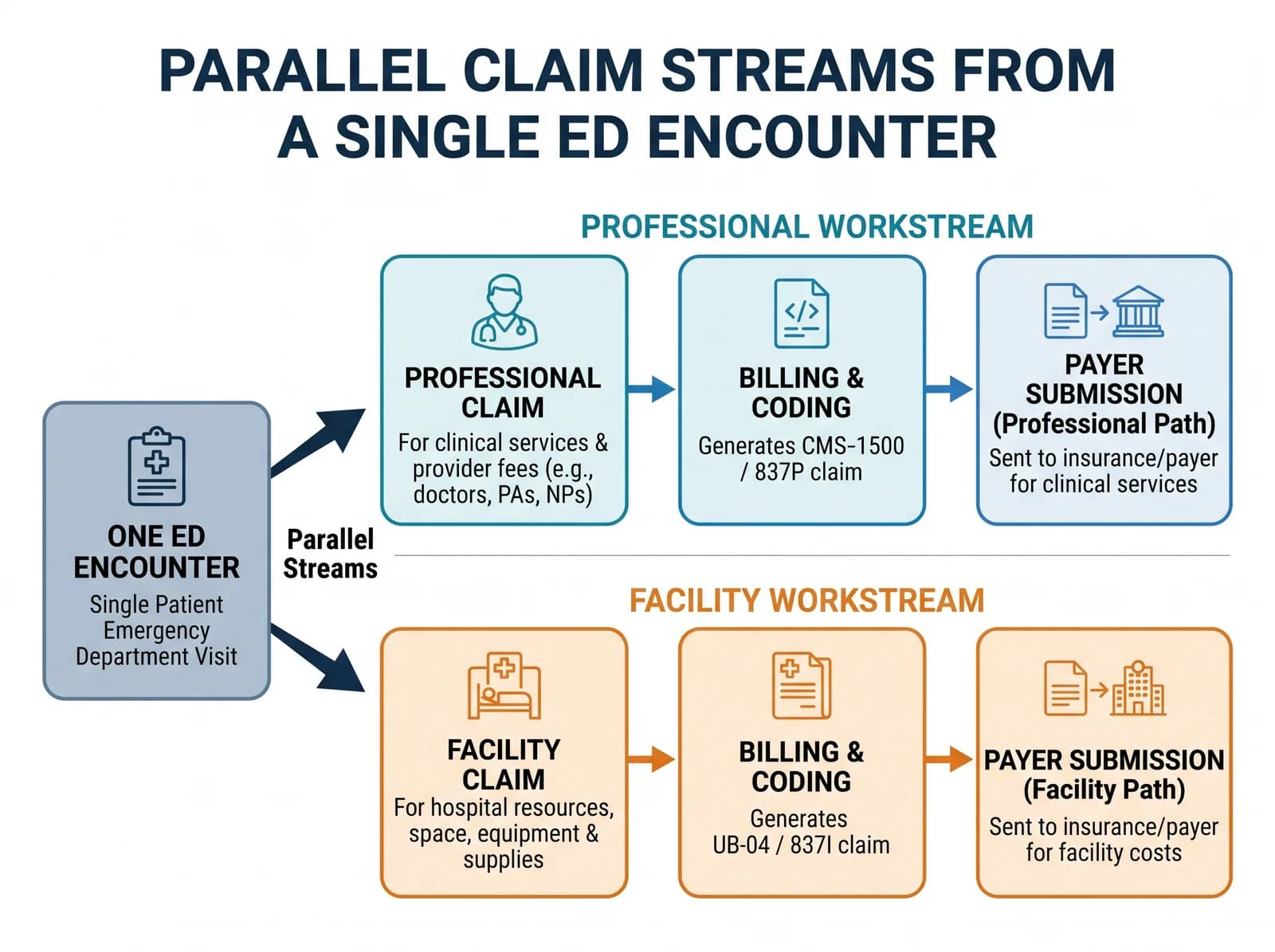
Emergency department billing services: a different revenue cycle, not a bigger office cycle.
Key takeaways: ED billing differs from office billing in three structural ways: separate professional and facility claims, unpredictable volume and payer mix, and compressed documentation handoffs. Claims most often stall at eligibility verification, the documentation-to-claim handoff, and denial follow-up. When evaluating a billing partner, ask specific questions about payer coverage, reporting, system access, and staffing.
Emergency department billing services cover the revenue cycle work specific to ED encounters: professional claims for the physician group, facility claims where applicable, and the eligibility, documentation and denial follow-up that unannounced, high-volume patient flow requires. If you run an independent emergency medicine group or a freestanding ED, you already know the work does not look like a primary care practice's. Your clinicians see whoever walks in, at any hour, often with no appointment, no prior chart and no verified coverage. The billing that follows has to keep up with that reality. This guide explains what emergency department billing services actually have to handle, where ED claims tend to stall, and what to verify before you hand your revenue cycle to an outside partner. It is written for the practice manager or physician-owner doing that evaluation, not for a hospital finance department.
What makes emergency department billing services different from office-based billing
Three structural differences drive most of the operational gap.
Professional and facility claims are separate workstreams
In a hospital ED, the physician group typically bills professional services while the hospital bills the facility component. A freestanding ED may carry both sides or contract them differently depending on how it is organized and enrolled. Before you compare vendors, map which entity bills which component for every site you operate. A billing partner that assumes one claim stream may miss half the picture. Confirm the split with your own contracts and enrollment records, and verify any payer-specific requirements against current official payer guidance rather than a vendor's summary.
Volume, acuity and payer mix shift constantly
Office billing is relatively predictable: scheduled visits, known insurers, recurring patients. ED billing is not. A single shift can produce self-pay encounters, workers' compensation, motor vehicle claims, out-of-state Medicaid and commercial plans your front desk has never seen. Eligibility is often unknown at the point of service, and registration data is captured under time pressure. Your billing process has to tolerate incomplete information at intake and resolve it afterward, rather than assuming clean demographics arrive with every chart.
Documentation and coding handoffs are compressed
ED notes are written fast, by clinicians moving between patients. The distance between what was documented and what supports the level of service billed is where ED revenue can quietly leak. We are not offering coding advice here; the point is procedural. Ask any prospective partner how they handle chart-to-claim review, who queries the clinician when documentation is thin, and how quickly that query happens. A process that waits weeks to ask a question may get worse answers.
Where emergency department claims most often stall
In ED billing generally, problems tend to cluster in three places. Treat these as checkpoints to inspect, not as claims about your specific payer contracts.
1. Eligibility and registration at the point of care
Because patients arrive unannounced, eligibility verification is usually retrospective. The practical question is how fast your process runs a coverage check after the encounter and what happens when it comes back self-pay or mismatched. Look for a defined workflow: who rechecks coverage, how self-pay accounts are screened for assistance programs, and how quickly accounts move from "unknown" to "actionable." Our eligibility and benefits verification describes how that step fits into a broader cycle.
2. The documentation-to-claim handoff
In an office, a coder often sees a complete chart days later. In the ED, charts may be incomplete, addended or split across systems. Ask how claims are held when documentation is pending, how addenda are tracked, and whether the billing team has a named contact on your clinical side. Vague answers here may predict denials later.
3. Denial follow-up speed
ED denials may involve medical necessity, coverage termination, or coordination of benefits between multiple plans, though the denial mix varies by payer and should be verified against your own denial data. Each may have a clock attached, and the clock is set by the payer and your contract, not the vendor. Verify appeal windows and documentation requirements against your own payer agreements and current official payer guidance. What you can evaluate is the vendor's cadence: how often they work denials, how they prioritize high-dollar and time-sensitive accounts, and what reporting shows you the backlog. Our denial management and A/R management outline the process commitments to look for.
What to ask an emergency department billing services partner before signing
Use these as screening questions for any emergency department billing services partner. A partner who cannot answer them specifically for emergency medicine may be generalizing from office work.
Payer and contract coverage
- Which payers do you already work with for ED professional claims, and which facility-side claims if applicable?
- How do you handle out-of-network and balance-billing questions? (Ask for process, not promises.)
- Who manages credentialing and enrollment for new sites or providers, and how are payer effective dates tracked? See credentialing and contracting services.
Reporting you can actually use
- What does a monthly report show: charges, payments, adjustments, A/R aging, denial reasons by payer?
- Can you segment by site, provider and payer mix so a freestanding ED and a hospital-based group are not blended together?
- How quickly are payments posted, and how are patient payments reconciled? Review payment posting expectations.
System access and data ownership
- Do you work inside our existing EHR and practice management system, or require a migration?
- Who owns the data, and what happens to it if we terminate?
- What is your security and access model for staff working our accounts?
Staffing and escalation
- Who is our named account contact, and what is the escalation path when a claim is stuck?
- How do you handle coverage during holidays and overnight volume spikes?
What to do next
You do not need to decide anything today. A useful first step is to gather three things: your current A/R aging by payer, a sample of recent denials with reasons, and a written map of which entity bills which claim component at each site. With those in hand, a conversation is far more productive than a generic demo. If you would like to walk through them with us, you can schedule a consultation or contact our team. We will be candid about fit; no outcome or performance is guaranteed.
Sources and verification
This article is based on general revenue cycle process knowledge and the vendor pages supplied for context only; no external authoritative sources were used, and the vendor pages are not relied on for any factual claim: Medical Billing Company | Medical Healthcare Solutions and 10 Best Medical Billing Services Reviewed for 2026. No independent statistics, payer policies or outcome data were supplied, and none are asserted here. Any statement about payer rules, filing deadlines, coding requirements or appeal windows must be verified against current official payer and regulatory guidance before you rely on it. This article is not legal, coding or clinical advice.
Where this work connects
Related articles.
 Revenue Cycle Management
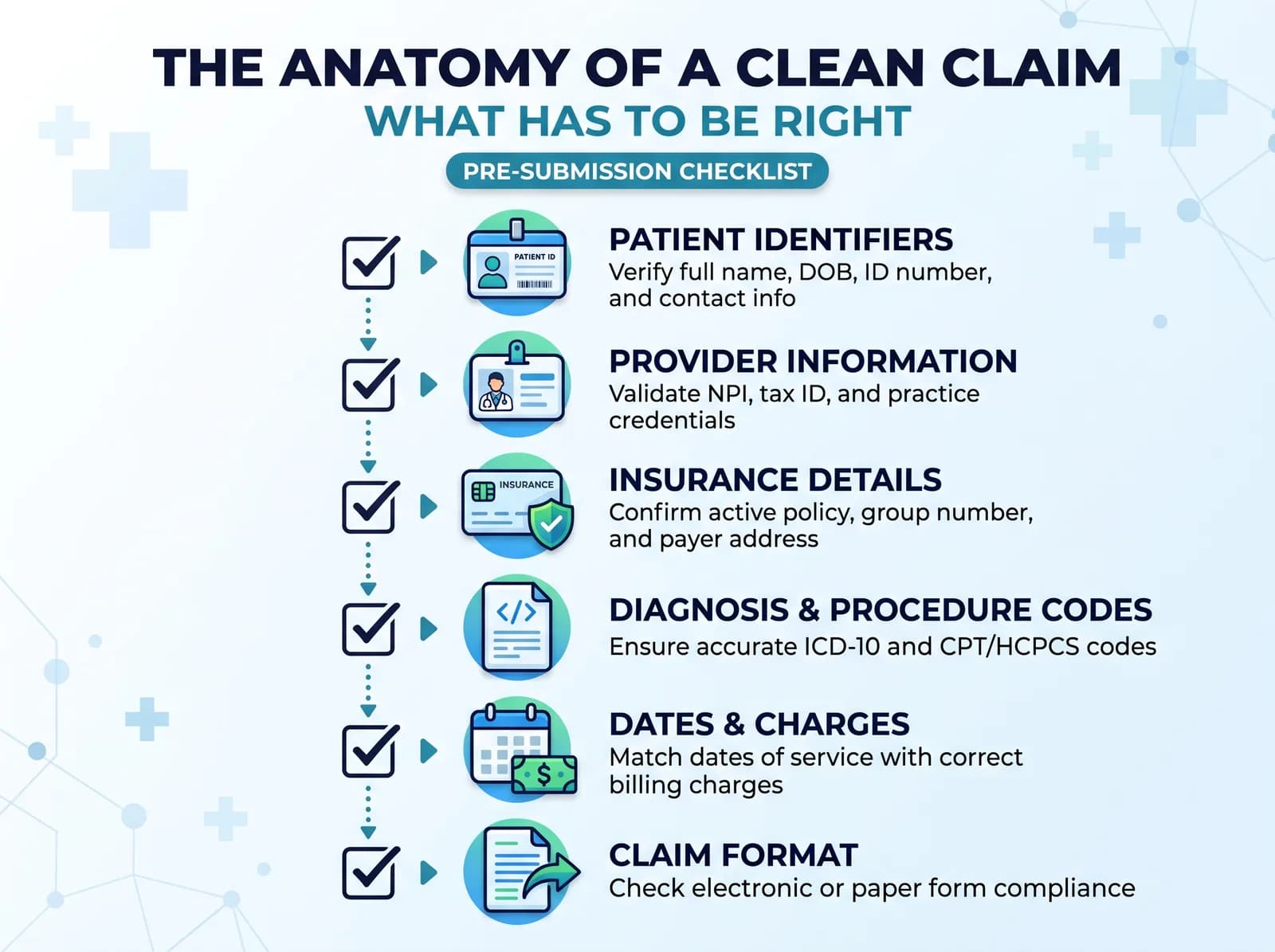
What Is a Clean Claim in Medical Billing? A Practical Guide
A clean claim is one a payer can process without requesting missing or corrected information. This guide explains what has to be right, where small practices break cleanliness, and how to run a daily pre-submission checklist.
Read article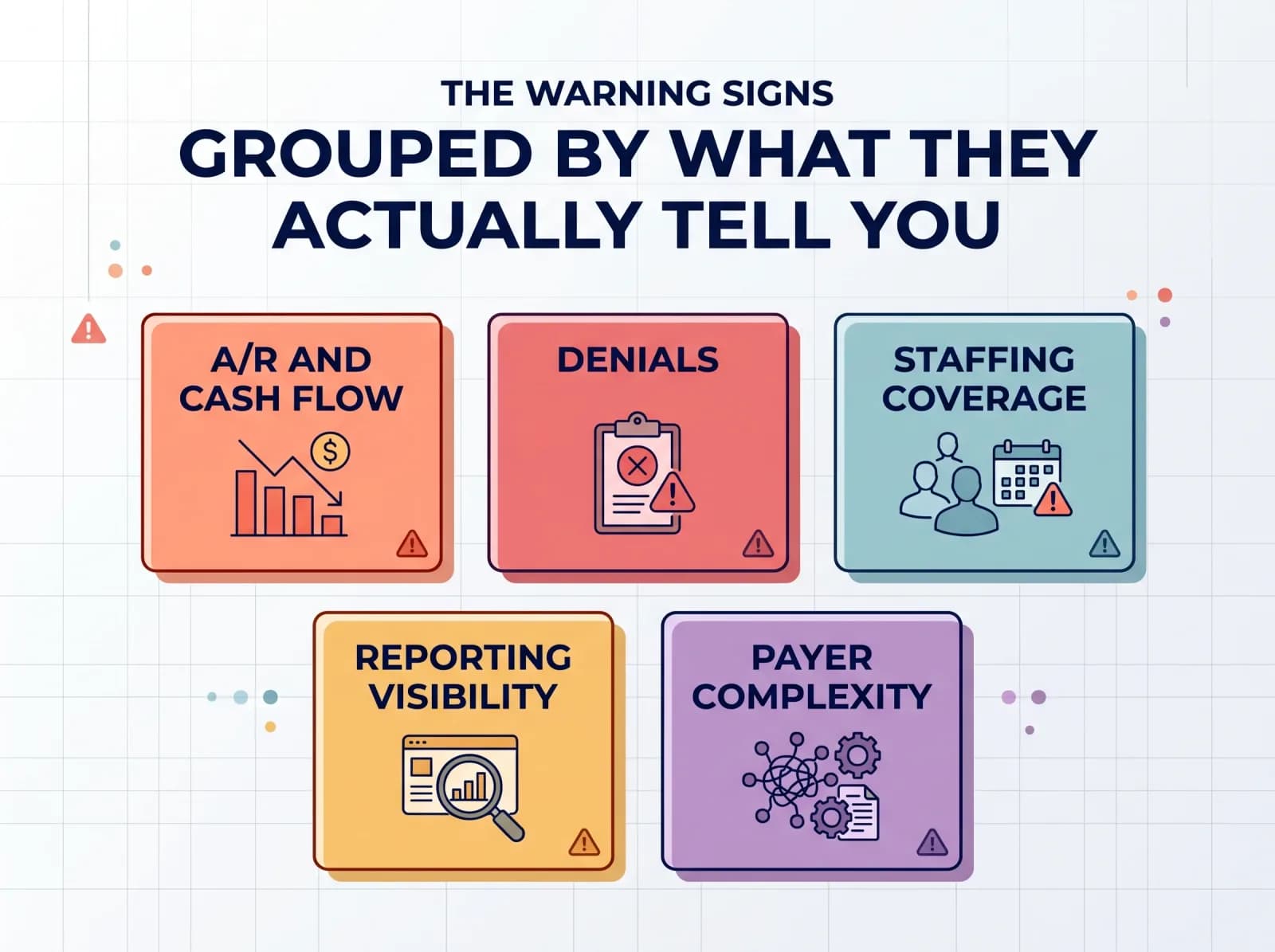 Revenue Cycle Management
Signs Your Practice Has Outgrown In-House Billing
A practical self-diagnostic for independent practices: spot the structural warning signs that in-house billing has outgrown its capacity, and decide whether to invest internally or change model.
Read article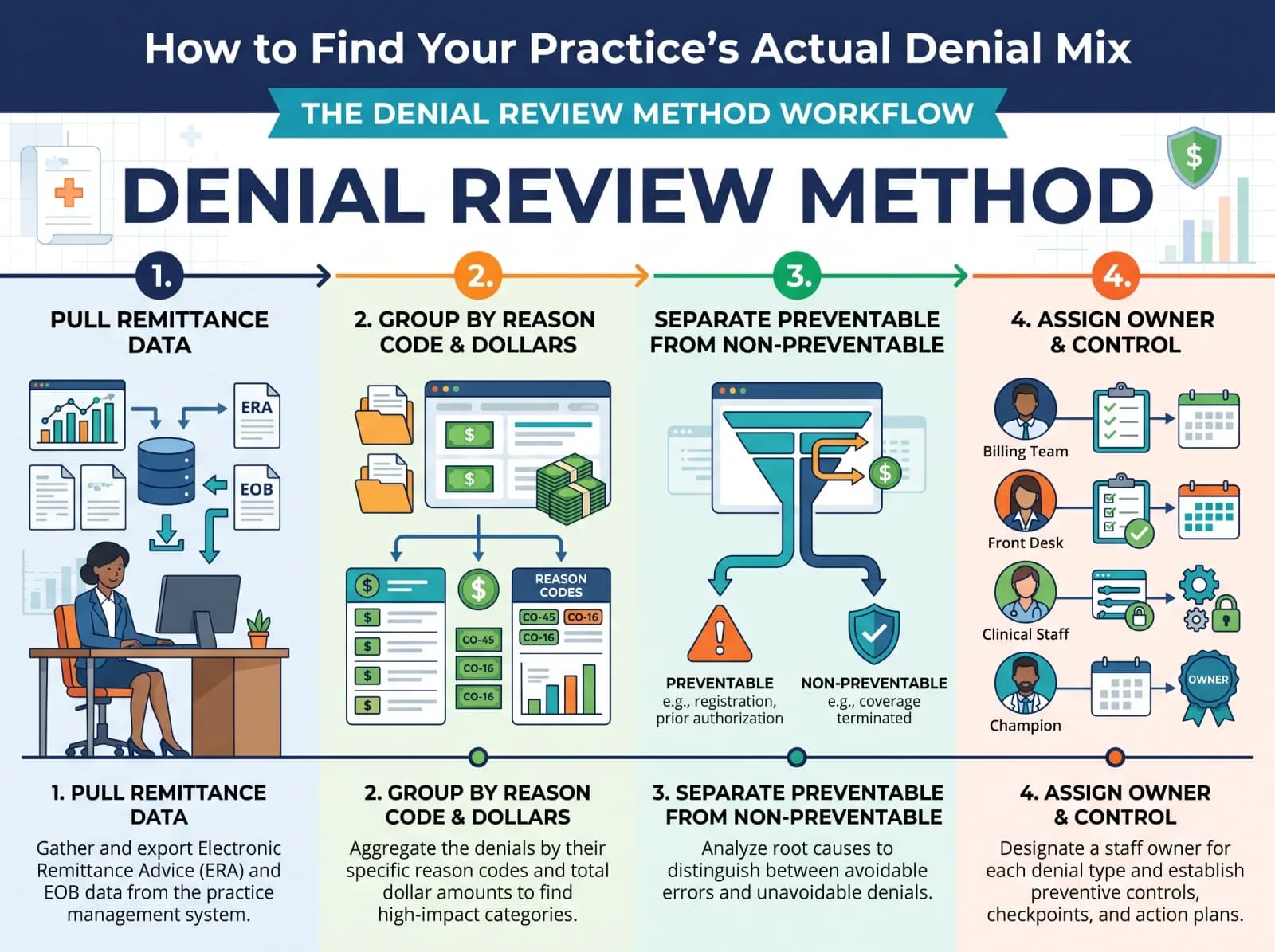 Revenue Cycle Management
What Causes Medical Billing Denials? A Revenue Cycle Guide
A practical guide to the front-end, mid-cycle, and payer-side causes of medical billing denials, plus a method for finding your practice's own denial mix and assigning owners, controls, and metrics.
Read article