

Behavioral Health Authorization Tracking and Denial Follow-Up: A Working Process for Therapy Practices
A practical process for therapy practices to track behavioral health authorizations, catch mismatches before claims go out, and work authorization-related denials through resubmission.
Most authorization problems in a therapy practice don't start at the denial. They start weeks earlier, when a session is scheduled against an authorization that has already run out of visits, was issued for a different CPT code than the one billed, or was never entered into a log anyone checks. By the time the claim comes back denied, the practice has already delivered the service and is now working backward. A practice manager can't eliminate every payer quirk, but a repeatable tracking process turns authorization denials from surprises into a manageable queue.
This is a working process for an independent mental health or behavioral health group practice — a few prescribers and several therapists, billing through a practice management system, managing authorizations in-house or with a small billing team. It covers what to track, when to review it, and how to work an authorization-related denial to resubmission.
Why behavioral health authorizations expire or mismatch claims
Authorization denials usually trace to one of a handful of process gaps. None of them are exotic; they're the ordinary friction of running therapy volume against payer rules that differ from plan to plan.
The common gaps to look for
- Visit counts run out mid-episode. A plan authorizes a set number of sessions. If no one tracks utilization against that number, the last few sessions bill against an exhausted authorization.
- Units and codes don't match. The authorization may specify particular service codes or a unit structure. A session billed under a different code than the authorization covers can deny even when visits remain.
- Dates drift. Authorizations carry start and end dates. A retroactive or late-entered authorization, or a service date just outside the window, creates a mismatch.
- The authorization never reaches the claim. It was obtained but not recorded where the biller or clearinghouse can attach the number. The claim goes out without it.
- Rendering or billing provider mismatch. The authorization may be tied to a specific provider or group. A claim submitted under a different NPI than the payer expects can deny.
These are patterns to verify, not rules to assume. Payer requirements for authorization, units, codes and timelines vary and change; confirm them against each payer's current provider manual and official guidance rather than relying on a general description.
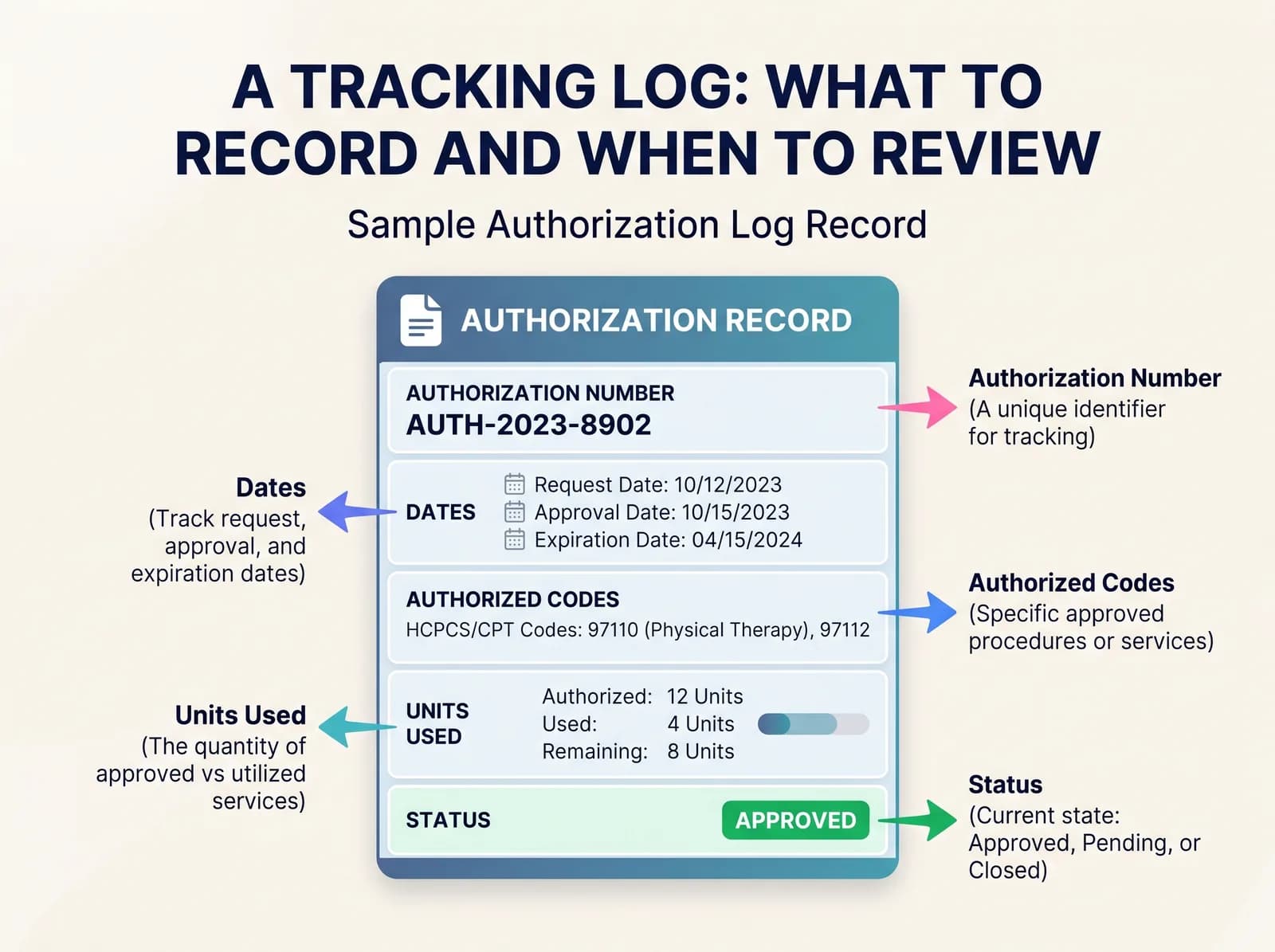
A tracking log: what to record and when to review
The core of the process is a single authorization log that the front desk, clinicians and billing all use and update. Whether it lives in a spreadsheet or a practice management module matters less than that it is current and reviewed on a schedule.
What each authorization record should hold
- Patient identifier and payer/plan
- Authorization number and the date it was issued
- Effective start and end dates
- Authorized service codes and number of units or visits
- Rendering provider named on the authorization
- Units or visits used to date, updated as sessions occur
- Status (active, expiring, exhausted, pending renewal, denied)
- Date of last verification and who verified it
When to review
Set review points that catch problems before the claim, not after. A practical cadence:
- At scheduling or intake: Confirm an authorization exists and covers the planned service before the first session.
- Weekly: Scan the log for authorizations approaching their end date or running low on units, and start renewals early.
- Before claim submission: Confirm the authorization number, dates and codes on the claim match the log.
- Monthly: Reconcile units used against sessions delivered so the log doesn't drift from reality.
Assign one owner for the log. When authorization tracking is everyone's job, it becomes no one's, and the gaps above reappear. If the practice is growing past what an in-house log can reliably hold, that's a signal worth examining; our guide to guide to in-house vs. outsourced medical billing lays out the tradeoffs neutrally.
Authorization denial follow-up: handling the denial
When a claim denies for authorization reasons, work it as a defined sequence rather than an ad hoc scramble.
Steps from review to resubmission
- Read the denial reason precisely. "No authorization" and "authorization expired" and "service not covered by authorization" call for different fixes. Record the exact reason code.
- Pull the authorization record. Compare the number, dates, codes, units and provider on the authorization against the claim. Identify the specific mismatch.
- Determine whether the service was actually authorized. If it was, the fix may be a corrected claim with the right number or code. If it wasn't, or the authorization had lapsed, the path may be a retroactive authorization request, which some payers may accept only within defined windows, if at all; verify each payer's policy.
- Gather supporting documentation. Keep the authorization confirmation, the session record and any payer correspondence together so the appeal or corrected claim is complete on the first pass.
- Submit and log the follow-up date. Record what was sent, to whom, and when to check status. Do not let a resubmission disappear into the same queue that produced the denial.
- Close the loop on the cause. If the denial came from a tracking gap, fix the log or the review cadence so the same gap doesn't recur next month.
Denials that cluster around one payer or one code are telling you something about the front end. A structured structured denial management process separates one-off errors from systemic ones, and the same discipline applies whether you run it in-house or with a partner.
What to confirm with each payer
Authorization rules are payer-specific and subject to change, so build a short reference for each plan you bill and verify it against the payer's current official guidance. Confirm, at minimum:
- Which services require prior authorization and which don't
- How units or visits are counted and whether they reset
- The authorization request and renewal timelines, and whether retroactive requests are accepted
- What identifiers the claim must carry (authorization number, provider NPI, service codes)
- How the payer wants authorization-related appeals or corrected claims submitted
Keep the source and date of each confirmation. When a payer updates its manual, you'll know which entries to revisit. For practices that want the authorization work handled alongside claims and A/R, our prior and retro authorization service page describes how that fits into the broader revenue cycle.
What to do next
If authorization denials are consuming time your team doesn't have, start with the log: pick one payer, build the record fields above, and run the weekly review for a month. That alone will surface where the gaps are. If you would rather map the whole authorization-to-denial workflow with someone who does it daily, schedule a conversation about your authorization workflow. You can also read more process guides on our billing process guides on our blog.
Sources and verification
This article describes general process steps and does not state payer-specific rules, coding requirements or filing deadlines. Those must be verified against each payer's current provider manual and official regulatory guidance before you rely on them. The process described here reflects general practice experience rather than external citations; background reading on billing service models was drawn from the following sources, which are provided for general context and do not support specific claims in this article:
- Medical Billing Company | Medical Healthcare Solutions: https://medicalhealthcaresolutions.com/
- 10 Best Medical Billing Services Reviewed for 2026: https://themedicalpractice.com/services/best-medical-billing-services/
Where this work connects
Related articles.
 Behavioral Health Billing
: Payer Routing, Authorization & Denial Patterns to Verify
Behavioral health claims fail for different reasons than medical claims. Learn what to verify about payer routing, authorization tracking, and denial patterns before outsourcing behavioral health billing.
Read article Revenue Cycle Management
ED and Urgent Care Under One Organization: A Billing Comparison Checklist
A practical checklist for operations leaders comparing ED and urgent care billing workflows, covering where they diverge, shared front-end checks, and what to verify before combining or separating processes.
Read article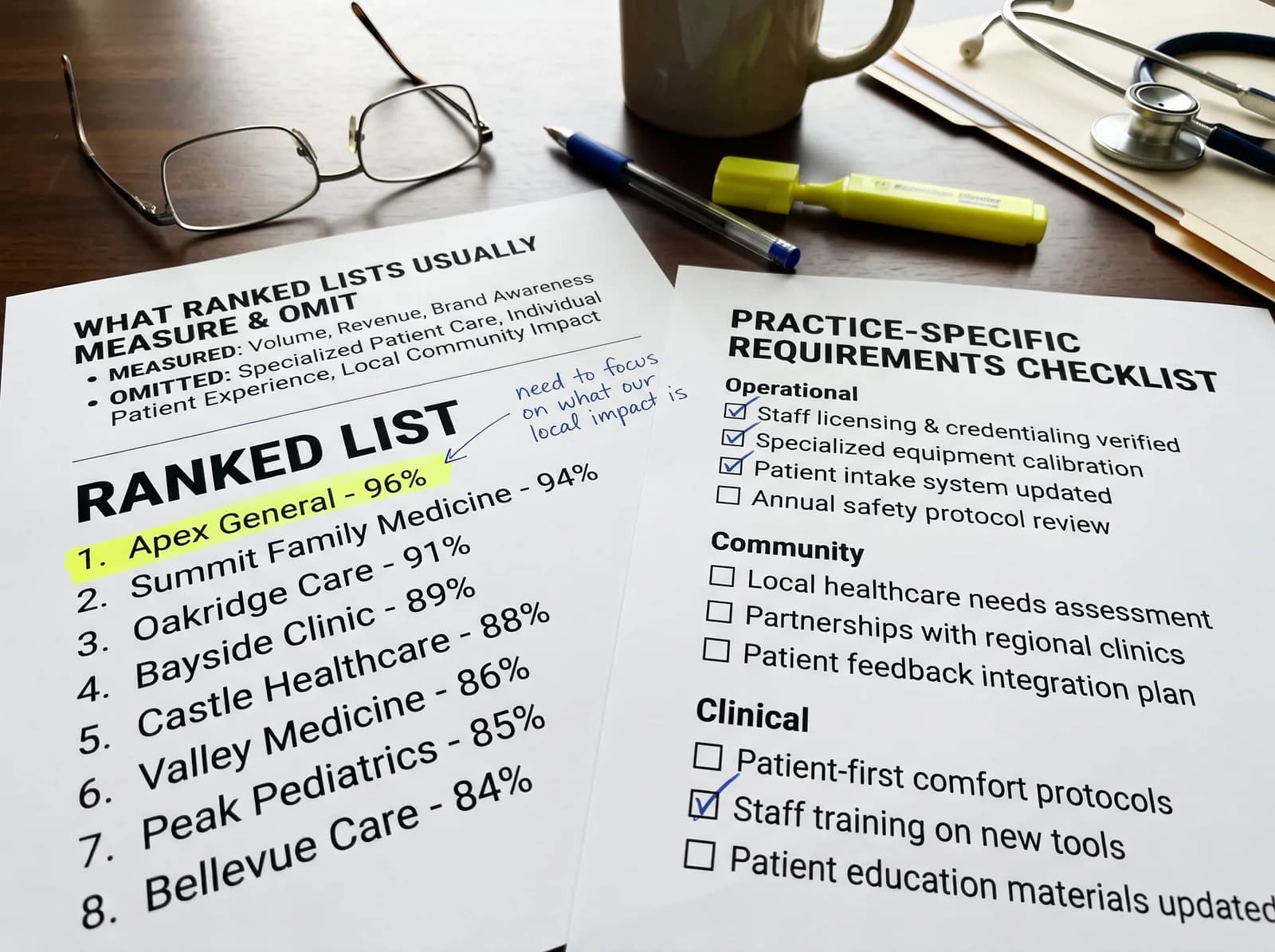 Medical Billing Vendor Selection
Reading "Top Billing Company" Lists: A Neutral Guide for Independent Practices
A practical guide to what ranked medical billing company lists measure, what they omit, and how independent practices can build a shortlist that reflects their own payer mix, specialty, and workflow.
Read article